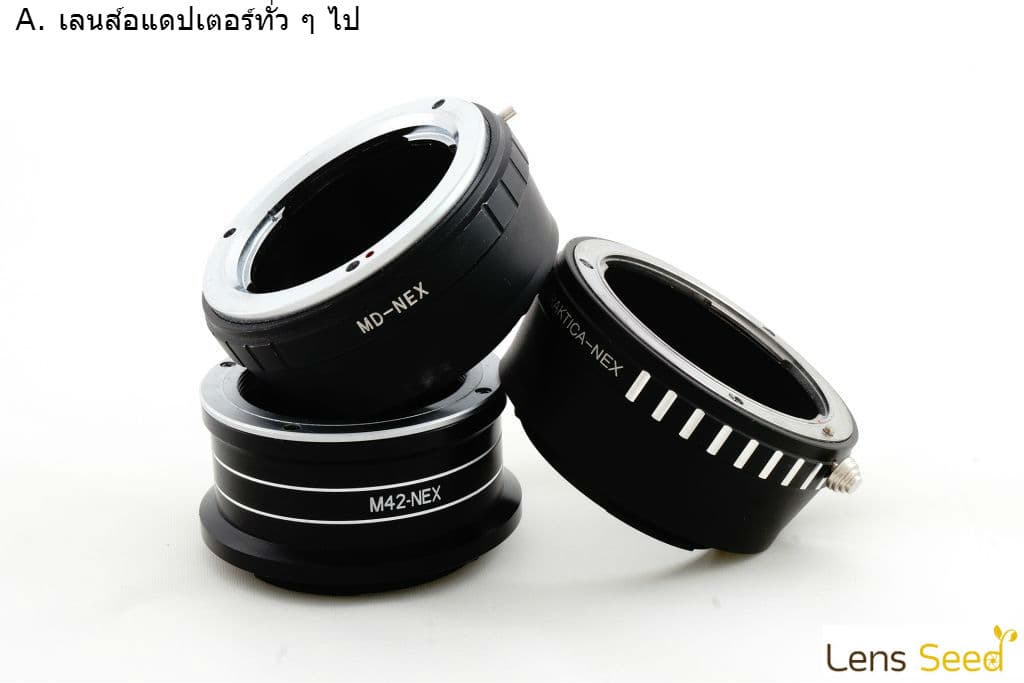
Almost every vintage manual lens fits every mirrorless camera through a simple mechanical adapter costing a few hundred baht. An adapter is a precision metal ring with no glass inside; its only job is to hold the lens at the exact distance from the sensor it was designed for — so image quality is 100% the original lens.
The one rule: flange distance
Every mount was designed to sit a fixed distance from the film or sensor — the flange focal distance (FFD). Adapting works whenever the camera is thinner than the lens expects, leaving a gap for the adapter to fill. Mirrorless bodies are 16–20 mm; film-era SLR lenses sit at 40–46.5 mm — so everything fits.
- Vintage lens mounts (FFD): M42 45.46 · Nikon AI 46.5 · Olympus OM 46 · Contax/Yashica 45.5 · Pentax K 45.46 · Exakta 44.7 · Minolta MD 43.5 · Canon FD 42 · Konica AR 40.5 · Leica M 27.8 mm
- Mirrorless camera mounts (FFD): Nikon Z 16 · Fujifilm X 17.7 · Sony E 18 · Micro Four Thirds 19.25 · Canon RF 20 mm
This is also why vintage SLR glass barely adapts to DSLRs — those bodies are nearly as deep as the film cameras were, so no room remains.
Fujifilm X
The favourite of Thailand's vintage scene. The APS-C sensor crops 1.5× — a 50mm frames like a 75mm, even better for portraits — and Fuji's film simulations pair beautifully with vintage rendering. Buy adapters named lens-mount–FX (M42–FX, MD–FX, FD–FX) and enable "Shoot Without Lens" in the menu once.
Sony E
The widest adapter ecosystem on the market, in both full frame (any A7 — the lens draws exactly the field of view and bokeh it was designed for) and APS-C (A6000 series, 1.5× crop). Sony's focus peaking works superbly with manual glass. Same formula: M42–NEX/E, FD–NEX, MD–NEX.
Nikon Z
The shortest flange in the industry (16 mm) accepts every mount including Leica M. Old Nikkor AI lenses feel most at home here via a simple F–Z ring, and in-body stabilisation makes handheld night shooting with vintage primes noticeably easier.
What beginners get wrong
- Auto-only M42 lenses: some have no A/M switch and need an adapter with an inner flange that presses the stop-down pin — otherwise the aperture stays wide open.
- No infinity focus: the signature of an out-of-spec cheap adapter. A tested adapter is always worth the small premium.
- Canon FD: the adapter's locking ring must be rotated fully or the aperture won't actuate.
- Rangefinder wides: some Leica M lenses wider than 35mm smear corners on digital sensor stacks — research the specific lens first.
Where to go next
Browse the full mount & character map to pick glass for the look you want, or start with the beginner's guide to manual lenses. Every LensSeed listing states its mount clearly, and we'll happily check compatibility with your exact camera via Mint or LINE.