Production
1960 – 1970
Country
-
Optical
-
Updated
Jul 12, 2026
Canon FD
Production
1960 – 1970
Country
-
Optical
-
Updated
Jul 12, 2026
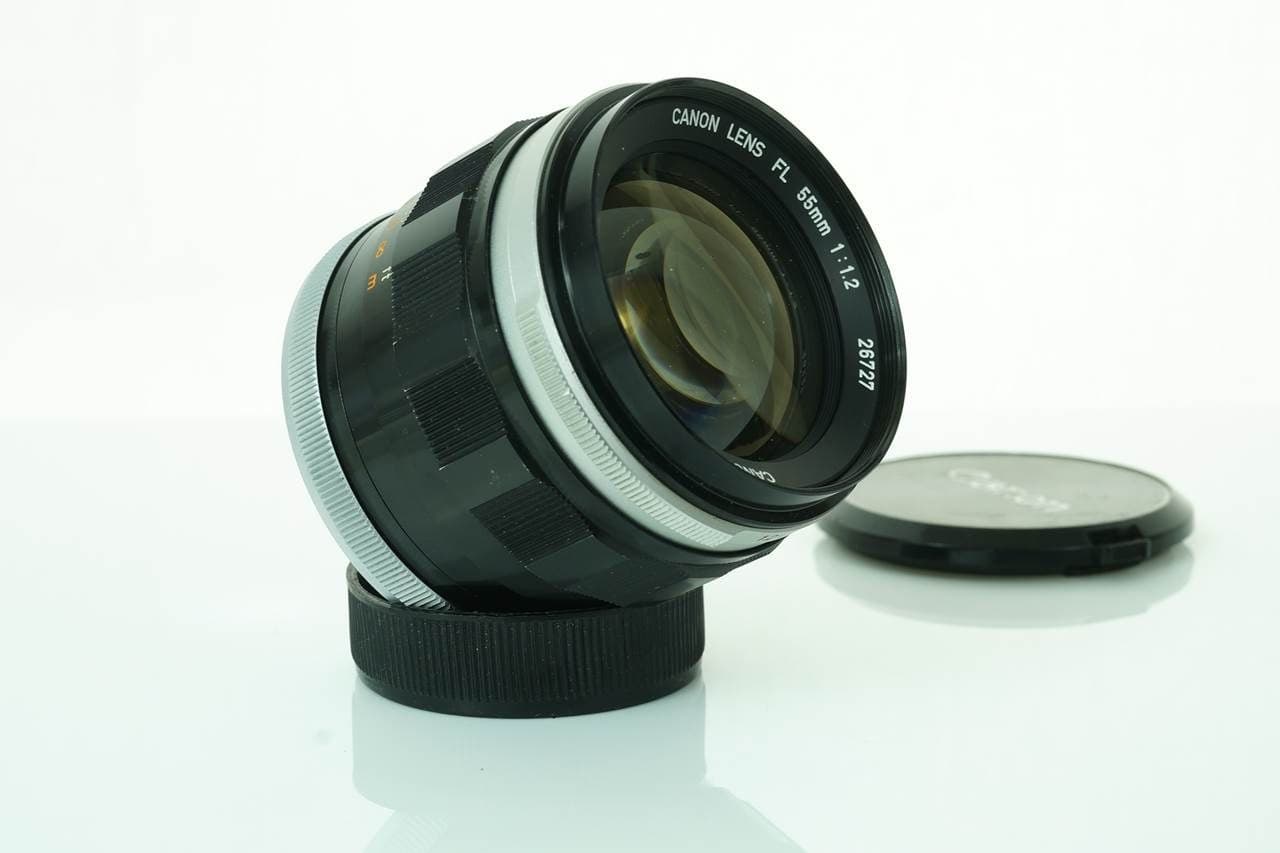
The Canon FL 55mm f/1.2 was introduced in July 1968 as the flagship standard lens for Canon's FL-mount SLR system. It sits in the middle of Canon's fast-fifty dynasty: the R 58mm f/1.2 of 1962 begat the FL 58mm f/1.2 of 1964, which was refined into this shorter, recomputed FL 55mm f/1.2 in 1968; the line then continued into the FD 55mm f/1.2 (1971), the FD 55mm f/1.2 S.S.C. (1973), and the legendary FD 55mm f/1.2 S.S.C. Aspherical (1975) — the first 35mm SLR lens to use an aspherical element. This lens was calculated before computers did the ray tracing, its seven elements in five groups worked out with slide rules, and it was built entirely of metal and glass. Canon's engineers were chasing the same goal every fast-lens designer faces — taming field curvature and flare at maximum aperture — and by the reviewers' own account they 'did not completely succeed,' which is precisely why the lens is prized today: its imperfections ARE its character. No established nickname is evidenced for this specific lens (unlike generic 'nifty fifty' fifties or the 'legendary' Aspherical that followed it). Its cult following rests on being the sweet spot of the lineage — refined enough to be genuinely usable, old enough to keep the painterly optical signature — while remaining affordable, roughly $150-$300 for a clean copy.
Verdict: The Canon FL 55mm f/1.2 is a character lens, full stop — for the photographer who wants painterly, dimensional f/1.2 rendering with glowing highlights, dissolving bokeh, and layered depth, not clinical sharpness. It rewards shooting wide open and composing in planes of distance, and its single-coated glow and per-element color separation give a look modern computed lenses simply don't. If you chase resolution charts, look elsewhere; if you want an affordable, usable slice of Canon's fast-fifty heritage whose imperfections are the whole point, this is the sweet spot of the lineage.
Smooth and creamy, with a pleasing out-of-focus rendering that adds depth and separation to the subject.
Warm and natural tones, with a slightly muted look that gives images a vintage feel.
Mild flare and ghosting when shooting into bright light, adding a subtle character to the image.
Moderate contrast, with a softness that can be pleasing for portraiture and landscape photography.
Noticeable but not excessive vignetting, which can be used creatively to draw the viewer's attention to the center of the frame.
The Canon FL 55mm f/1.2 is a character lens, full stop — for the photographer who wants painterly, dimensional f/1.2 rendering with glowing highlights, dissolving bokeh, and layered depth, not clinical sharpness. It rewards shooting wide open and composing in planes of distance, and its single-coated glow and per-element color separation give a look modern computed lenses simply don't. If you chase resolution charts, look elsewhere; if you want an affordable, usable slice of Canon's fast-fifty heritage whose imperfections are the whole point, this is the sweet spot of the lineage.