Production
-
Country
-
Optical
-
Updated
Jul 18, 2026
No technical spec yet
Production
-
Country
-
Optical
-
Updated
Jul 18, 2026
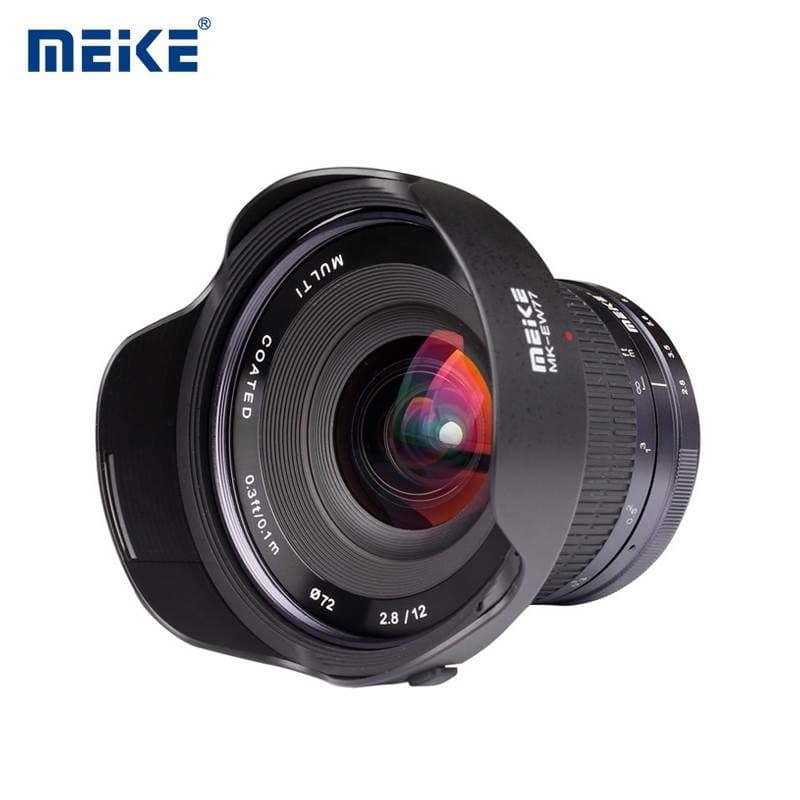
The Meike 12mm f/2.8 is a budget ultra-wide-angle prime introduced around 2016 by Hong Kong Meike Digital Technology — a Chinese maker whose name blends 'Mei' (beauty) and 'Ke' (technology), and which built its reputation on accessories (notably grips for Sony's A7 series) before moving into manual-focus optics. It was positioned squarely as a value play: reviewers noted a launch price near 229 USD / 150–200 euros, roughly a third of the Zeiss Touit 12mm f/2.8 and about half the Rokinon/Samyang 12mm f/2.0 it was implicitly compared against. On APS-C it gives an ~18mm-equivalent field of view; the Micro Four Thirds version yields the classic ~24mm-equivalent. As one reviewer observed, producing a fast ultra-wide (over 100 degrees of coverage) with a usable aperture is optically difficult, so a metal-bodied f/2.8 twelve at this price was seen as offering 'more for less.' Meike is also the original manufacturer behind rebadged copies sold under other names, including Neewer. No established collector nickname or jargon for this lens appears in the reviews, and it is a modern budget optic rather than a cult classic — its appeal is practical value, all-metal construction, and features rare at its price (a 72mm filter thread on an ultra-wide, 10cm close focus) rather than a legendary rendering signature.
Verdict: A pragmatic, inexpensive all-metal ultra-wide for manual-focus shooters — landscapes, architecture, interiors and astro on APS-C or Micro Four Thirds — who value a solid build, a rare 72mm filter thread and unusually close 10cm focusing over autofocus convenience. Its documented strengths are handling and value; its actual optical rendering signature is not established in the available reviews, so buy it as a capable budget wide-angle tool rather than a character lens with a famous look, and be ready to embrace fully manual operation and an unconventional aperture scale.
A pragmatic, inexpensive all-metal ultra-wide for manual-focus shooters — landscapes, architecture, interiors and astro on APS-C or Micro Four Thirds — who value a solid build, a rare 72mm filter thread and unusually close 10cm focusing over autofocus convenience. Its documented strengths are handling and value; its actual optical rendering signature is not established in the available reviews, so buy it as a capable budget wide-angle tool rather than a character lens with a famous look, and be ready to embrace fully manual operation and an unconventional aperture scale.