Production
-
Country
Japan
Optical
-
Updated
Jul 13, 2026
M42 · 55mm · f/1.8
Production
-
Country
Japan
Optical
-
Updated
Jul 13, 2026
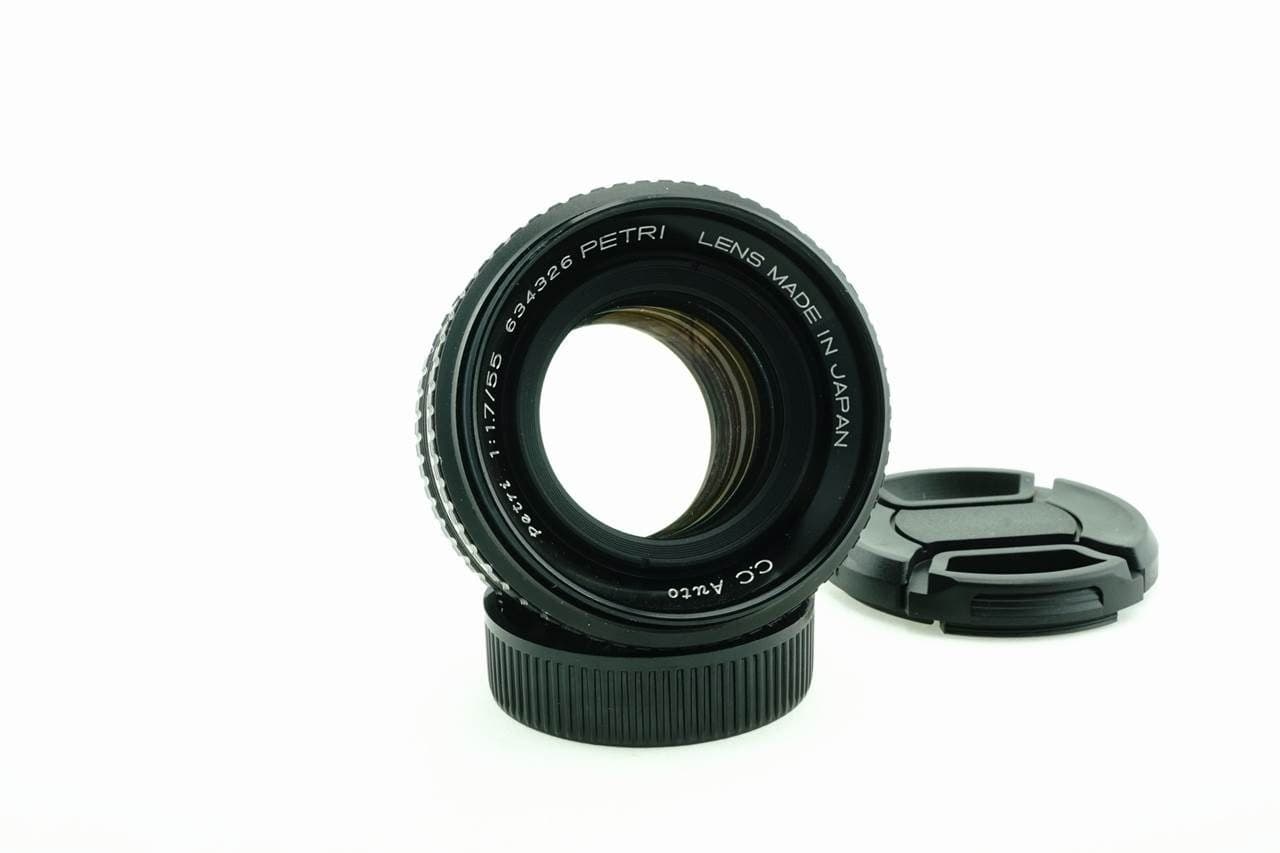
The Petri C.C. Auto 55mm f/1.8 was Petri's standard prime for the M42 screw-mount era, made by Japan's Petri Camera Company as the 'normal' lens bundled with or offered alongside its SLR bodies. Like most Japanese standard fifties of its generation, it was designed to be the affordable everyday optic — competent, fast enough for available-light work, and built to last. What sets its reputation apart is not marketing but word of mouth: the very same optical unit was rebadged and sold under other names, including Carenar (as a 55/1.7-1.8) and Exaktar/Exactar in M42, so many photographers have shot this glass without realizing it was a Petri underneath. Community jargon around it is consistent and genuine: reviewers and forum members repeatedly call it a 'sleeper' and an 'underdog' — a lens that quietly exceeds the low expectations set by the Petri name. There is no glamorous cult nickname like 'Bokeh Monster' or 'Radioactive' attached to it; its following is grounded in the surprise of buyers who expected a mediocre budget fifty and instead found a genuinely sharp, well-rendering lens. The affection is real enough that at least one user regretted selling a copy and bought another — a small but telling detail about how the lens grows on people who use it.
Verdict: The Petri 55mm f/1.8 is a genuine sleeper: a tank-built, sharp standard fifty whose corner-to-corner performance and smooth, honest bokeh reward anyone willing to look past the modest Petri name (or its Carenar/Exaktar rebadges). It is for the value-minded manual-focus shooter who wants a dependable everyday fifty with pleasing rendering and doesn't need the last increment of bokeh polish that the SMC Takumar 55mm f/1.8 provides. Expect a slightly softer, lower-contrast look wide open that firms up beautifully stopped down — a characterful, underrated optic rather than a flashy legend.
Smooth and mild out-of-focus rendering, pleasing for an f/1.8 lens and good with transparent surfaces, though rated 'not the best but still good' and a notch behind the SMC Takumar 55mm f/1.8.
Sharp with next to no corner softness even wide open and good rendering at all apertures; slightly lighter and lower in contrast in the centre at f/1.8, which cleans up stopped down.
Good across all apertures but loses some contrast wide open at f/1.8, firming up as it is stopped down.
No classic corner falloff reported; the centre appears a little lighter and loses some brightness at f/1.8, easing when stopped down.
Real adapters from our shop that fit this lens mount.
Standard · ฿325 · In stock
Standard · ฿325 · In stock
Standard · ฿325 · In stock
Standard · ฿325 · In stock
Standard · ฿540 · In stock
Standard · ฿540 · In stock
Standard · ฿540 · In stock
Standard · ฿540 · In stock
Standard · ฿540 · In stock
Standard · ฿1,250 · In stock
Standard · ฿890 · Out of stock
Standard · ฿890 · Out of stock
The Petri 55mm f/1.8 is a genuine sleeper: a tank-built, sharp standard fifty whose corner-to-corner performance and smooth, honest bokeh reward anyone willing to look past the modest Petri name (or its Carenar/Exaktar rebadges). It is for the value-minded manual-focus shooter who wants a dependable everyday fifty with pleasing rendering and doesn't need the last increment of bokeh polish that the SMC Takumar 55mm f/1.8 provides. Expect a slightly softer, lower-contrast look wide open that firms up beautifully stopped down — a characterful, underrated optic rather than a flashy legend.