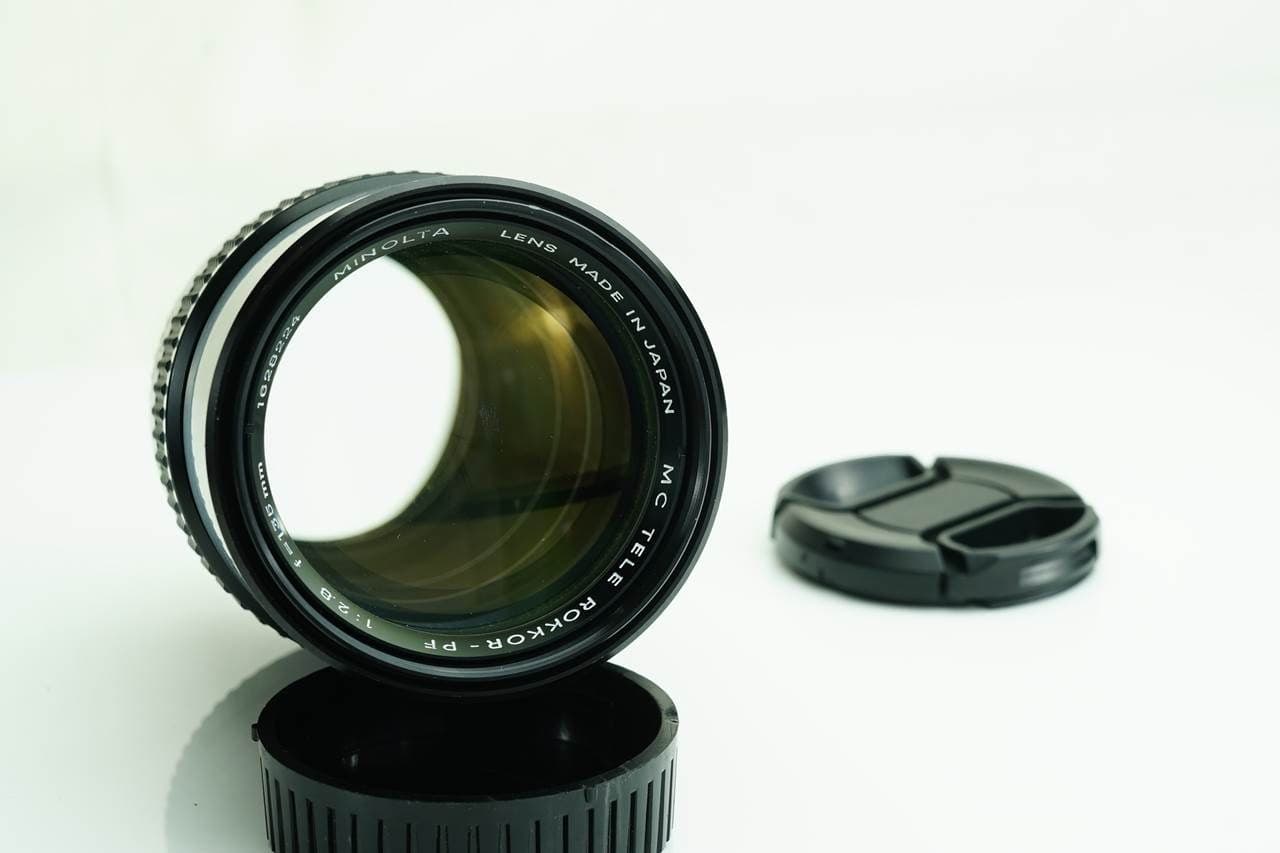
Production
1975
Country
Japan
Optical
6 elements in 5 groups (MC Tele Rokkor-X)
Updated
Jul 10, 2026
Minolta MD · 135mm · f/2.8
Production
1975
Country
Japan
Optical
6 elements in 5 groups (MC Tele Rokkor-X)
Updated
Jul 10, 2026
The Minolta 135mm f/2.8 exists as a family of manual-focus telephoto primes for Minolta's SR bayonet (SLR) system, spanning the MC and later MD generations from the 1960s through the 1980s. Among the most documented is the MC Tele Rokkor-X 135mm f/2.8, released in the mid-1970s as one of no fewer than sixteen 135mm lenses Minolta built for the SR mount. This particular copy sits in the middle of a long production lineage: it shows measurable improvements over the earlier non-'X' versions in chromatic aberration, softness, and vignetting when shot wide open, but reviewers note it is not the final, sharpest Minolta 135mm design that would offer the best wide-open control. The MC mount was eventually superseded by the MD mount, and the two are cross-compatible (with MD offering better support for shutter-priority modes). A budget offshoot also existed: the Minolta Celtic 135mm f/2.8, Minolta's economy sub-brand (described by one reviewer as Minolta's equivalent to Nikon's Series E line). The Celtic sacrificed some mechanical refinement — notably swapping the Rokkor's distinctive diamond-textured focus grip for a slippery rubber ring that ages poorly — while retaining nearly all of the optical performance. Because the Celtic name lacks prestige, these lenses are shunned in the vintage market and can be found for as little as $20, which reviewers consider a hidden bargain. No established cult nickname exists for this lens; it is loved instead for its combination of solid all-metal build, genuinely smooth bokeh, and low cost of entry. (Note: an entirely separate, later Minolta/Sony 135mm f/2.8 STF autofocus lens — famously dubbed the 'True King of Bokeh' for its apodization element — is a different lens from these manual-focus SR-mount 135mms and should not be confused with them.)
Verdict: The Minolta 135mm f/2.8 is a budget hero for portrait shooters who value smooth, creamy bokeh and pleasing color over clinical corner-to-corner sharpness. Wide open it renders point-source highlights into large, clean bokeh balls with a soft background, while stopping down to f/5.6 sharpens the whole frame. It's not the sharpest of Minolta's many 135mm designs at f/2.8, and flare control is only fair, but its all-metal build, useful built-in hood, and rock-bottom price — especially in the overlooked Celtic guise — make it one of the best value telephoto primes in the vintage Minolta system. Buy it for portraits and character, not for laboratory sharpness.
Exceptionally smooth 'bokehlicious' rendering with large, clean bokeh balls from point sources, aided by six curved aperture blades.
Rich, pleasing color rendering that reviewers rate very highly; specific warm/cool bias unknown.
Sharp where it matters but not the sharpest Minolta 135mm; corners sharpen to tack-sharp by f/5.6.
Only decent flare control; veiling glare and a faint yellow arc can appear in harsh light, though the built-in hood helps.
Definite vignetting at f/2.8 that disappears by f/4.
Real adapters from our shop that fit this lens mount.
Standard · ฿540 · In stock
Standard · ฿540 · In stock
Standard · ฿540 · In stock
Standard · ฿1,250 · In stock
Standard · ฿890 · Out of stock
Standard · Out of stock
Standard · Out of stock
The Minolta 135mm f/2.8 is a budget hero for portrait shooters who value smooth, creamy bokeh and pleasing color over clinical corner-to-corner sharpness. Wide open it renders point-source highlights into large, clean bokeh balls with a soft background, while stopping down to f/5.6 sharpens the whole frame. It's not the sharpest of Minolta's many 135mm designs at f/2.8, and flare control is only fair, but its all-metal build, useful built-in hood, and rock-bottom price — especially in the overlooked Celtic guise — make it one of the best value telephoto primes in the vintage Minolta system. Buy it for portraits and character, not for laboratory sharpness.