Production
1982
Country
-
Optical
13 elements in 9 groups
Updated
Jul 9, 2026
Available in multiple mounts including Olympus OM, M42, Pentax K/KA, Nikon F and Minolta SR · 70mm · f/4
Production
1982
Country
-
Optical
13 elements in 9 groups
Updated
Jul 9, 2026
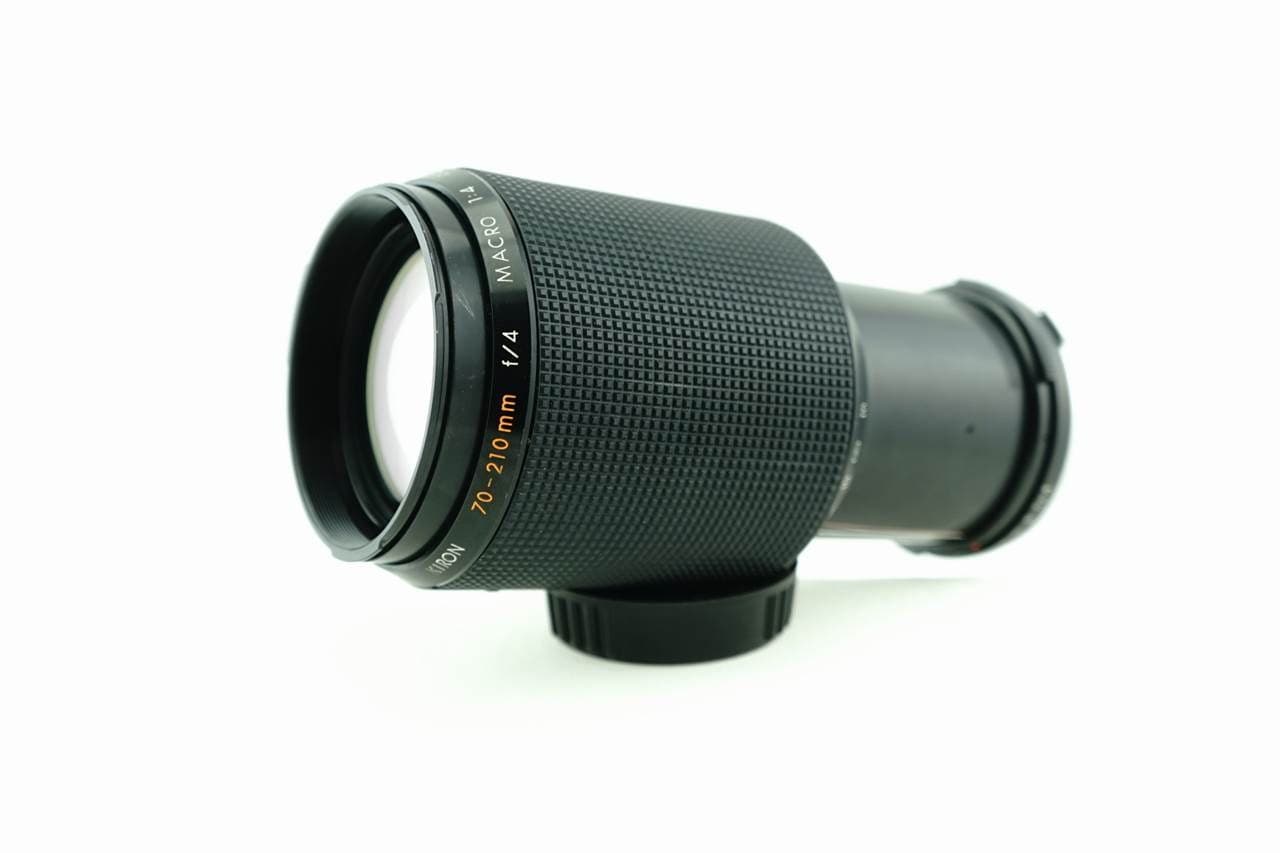
The Kiron 70-210mm f/4 Macro emerged at the end of the 1970s when Vivitar transitioned its Series 1 70-210mm production to Tokina for the version 2 lenses. Kiron built this constant-aperture telephoto zoom as a parallel, and according to the Pentax Forums review database it 'deserves cult classic cachet' as 'a more than worthy alternative to those Vivitar Series 1 70-210mm TP's.' Its most distinctive mechanical signature is the 'Zoomlock' — a sliding button that locks the to-and-fro motion of the zoom sleeve — and some models add a focus-lock mechanism (adjustable focus limiters) as well. Notably, it is one of the few zoom lenses of any era that does not have a rotating front element, which is a genuine advantage for filter use. The early version documented on allphotolenses.com was fitted with the Zoomlock only and entered production in 1982, later replaced by a similar lens that added a 'Focustop' facility; early units carry serial numbers beginning 259xxxxx, while 1983 units run 367xxxxx and 1984 units 467xxxxx. It was produced in M42, Pentax K/KA, Nikon F, Minolta SR and other mounts of the era. No specific nickname beyond the 'Kiron' brand itself and the 'Zoomlock' feature name is established in these reviews. People love it for its reliability, sharpness across the whole focus range, and its strong value — reviewers give it an average around 9.2 with 100% recommending it.
Verdict: The Kiron 70-210mm f/4 Macro is a sharp, reliable constant-aperture telephoto zoom with a genuine cult following, prized as an alternative to the Vivitar Series 1 70-210mm. It rewards shooters who want dependable across-the-range sharpness, bright color, and useful close-focus macro, along with the practical bonuses of a Zoomlock and a non-rotating front element. Expect a slightly purple color tendency and a hefty body, but for the money it delivers strong optical value.
Highly rated by the community (~9.2), though a lone reviewer scored it 3/5; specific out-of-focus geometry not described.
Bright, vivid color with good brightness, though one reviewer observed the palette skews slightly toward purple.
Reported as sharp across the entire focus range with a very high community sharpness rating (~9.4).
Real adapters from our shop that fit this lens mount.
Standard · ฿325 · In stock
Standard · ฿325 · In stock
Standard · ฿540 · In stock
Standard · ฿540 · In stock
Standard · ฿540 · In stock
Standard · ฿540 · In stock
Standard · ฿950 · In stock
Standard · ฿990 · In stock
Standard · ฿1,250 · In stock
Standard · ฿890 · Out of stock
Standard · Out of stock
Standard · Out of stock
The Kiron 70-210mm f/4 Macro is a sharp, reliable constant-aperture telephoto zoom with a genuine cult following, prized as an alternative to the Vivitar Series 1 70-210mm. It rewards shooters who want dependable across-the-range sharpness, bright color, and useful close-focus macro, along with the practical bonuses of a Zoomlock and a non-rotating front element. Expect a slightly purple color tendency and a hefty body, but for the money it delivers strong optical value.