Production
1965 – 1975
Country
Japan
Optical
5 elements in 5 groups
Updated
Jul 4, 2026
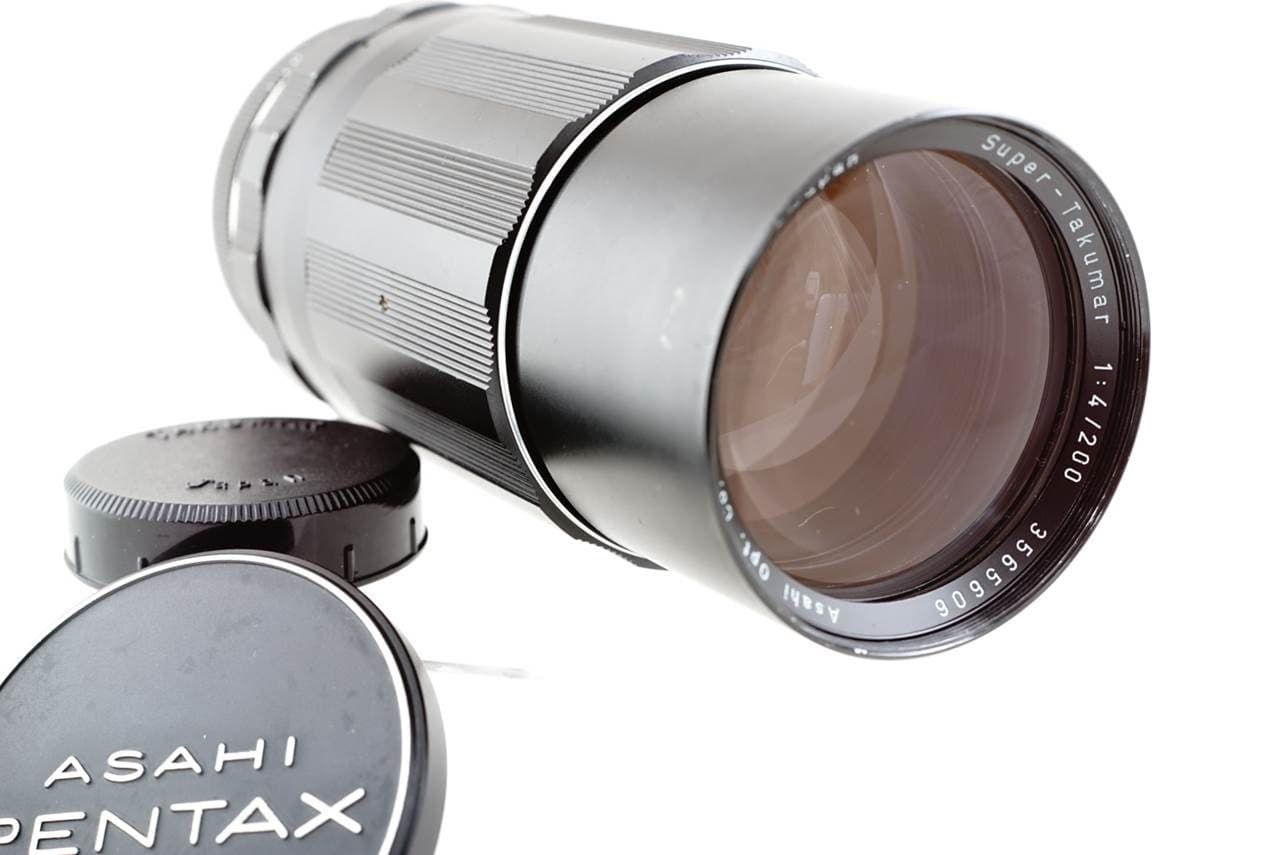
M42 screwmount (adaptable to Pentax K) · 200mm · f/4
Production
1965 – 1975
Country
Japan
Optical
5 elements in 5 groups
Updated
Jul 4, 2026
The Super-Takumar and Super-Multi-Coated (S-M-C) Takumar 200mm f/4 are classic M42 screw-mount telephoto primes produced by Asahi Optical Co. from 1965 to 1975. According to community sources, Asahi Pentax made numerous variations of the 200mm lens over the M42 era, including a faster F3.5 version and the slower, older Tele-Takumar F5.6, with four versions of the M42-mount lens total once the Super-Multi-Coated variants are counted. The Super-Takumar (1965-1971) featured basic single or double coatings, while the S-M-C Takumar (1971-1975) added Pentax's Super Multi-Coating for improved contrast, color fidelity, and flare resistance, plus open-aperture metering support on Spotmatic F, ES, and ES II bodies. No established nicknames are documented in the reviews. Its cult following is grounded in its affordability (averaging around $59), robust all-metal build, excellent optical performance, and easy adaptability to modern mirrorless and DSLR systems thanks to the universal M42 mount. Reviewers consistently recommend it (100% of 44 reviewers), praising it as a compact, affordable alternative to faster f/2.8 telephotos with genuine vintage rendering.
Verdict: The Takumar 200mm f/4 is an affordable, superbly built vintage telephoto for photographers who value excellent center sharpness, smooth bokeh, and natural rendering over outright speed. It's ideal for portraits, nature, and compressed-perspective work, and its universal M42 mount makes it a low-risk, high-reward pick for mirrorless adapters. Choose the single-coated Super-Takumar for muted, monochrome-friendly output, or the S-M-C version for richer color and better flare resistance.
Wonderfully smooth bokeh despite only 6 aperture blades, especially from f/5.6 to f/8, with no bubble or swirl.
Natural rather than vivid colors, lending well to black-and-white conversion, especially on the single-coated Super-Takumar.
Excellent center sharpness, usable wide open at f/4 and peaking at f/8 before diffraction sets in.
Coatings suppress reflections for high contrast, with the S-M-C version adding improved flare resistance.
High contrast, with the S-M-C version offering improved contrast and color fidelity over the earlier version.
Little to no vignetting reported, with good corner performance and minimal falloff.
The Takumar 200mm f/4 is an affordable, superbly built vintage telephoto for photographers who value excellent center sharpness, smooth bokeh, and natural rendering over outright speed. It's ideal for portraits, nature, and compressed-perspective work, and its universal M42 mount makes it a low-risk, high-reward pick for mirrorless adapters. Choose the single-coated Super-Takumar for muted, monochrome-friendly output, or the S-M-C version for richer color and better flare resistance.