Production
1990
Country
-
Optical
8 elements in 8 groups (lightweight version).
Updated
Jul 4, 2026
Minolta MD · 28mm · f/3.5
Production
1990
Country
-
Optical
8 elements in 8 groups (lightweight version).
Updated
Jul 4, 2026
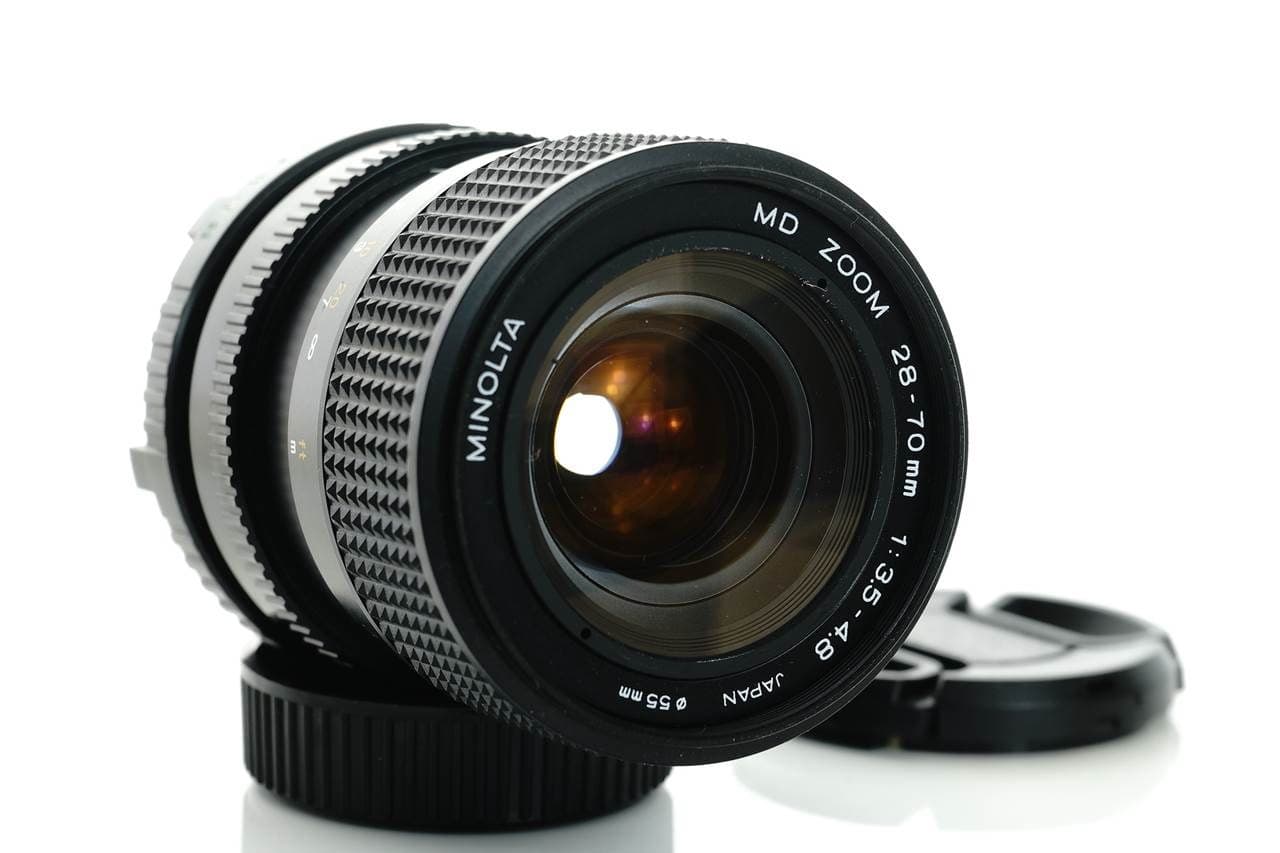
The Minolta MD 28-70mm f/3.5-4.8 hails from the final years of Minolta's manual-focus era, part of the New-MD generation (collector classification 'MD IIIa'). According to Lens QA Works, this lens is notable because it was not truly built by Minolta itself—it was developed and produced by a third party. Names like Cosina and Hoya/Tokina have been floated in various sources, but without serious documented evidence. Confounding matters further, at least two mechanically distinct MD 28-70mm f/3.5-4.8 lenses existed under the Minolta logo: a 'heavy' version and a 'lightweight' version, both sharing the same 8-element/8-group optical formula but with 'absolutely different mechanical constructions,' and both apparently on sale around the same time. Dating is contested: the lens is variously marked 1985 (believed incorrect), with researcher Andrea Aprà citing Josef Scheibel's book and his own data pointing to March 1990 as the introduction date of the first of the two versions. Michel Brien's Canadian price lists show the lens absent in 1989/07 but present by 1995/04. Marketed during Minolta's pivot toward its autofocus AF system, it was a phase-out product from a company no longer committed to the manual lineup. It carries no established nickname. Its cult following, per Dutch Thrift, comes from being a compact, affordable, versatile do-it-all walk-around zoom that delivers a 'slightly softer, more organic look' compared to modern clinical optics, appealing to photographers and filmmakers who enjoy the tactile feel of manual glass.
Verdict: The Minolta MD 28-70mm f/3.5-4.8 is a compact, affordable manual zoom for photographers and filmmakers who value tactile handling and a warm, gently organic vintage look over clinical sharpness. It rewards a slower, more deliberate style and shines as a versatile walk-around lens for street, travel, and creative video—provided you stop down for critical sharpness and accept its modest aperture and murky, multi-version provenance.
Classic Minolta color, described as slightly warm.
Not a wide-open sharpness lens; stopping down to f/5.6-f/8 yields sharp results.
Gentle, slightly lower/softer global contrast typical of vintage rendering.
The Minolta MD 28-70mm f/3.5-4.8 is a compact, affordable manual zoom for photographers and filmmakers who value tactile handling and a warm, gently organic vintage look over clinical sharpness. It rewards a slower, more deliberate style and shines as a versatile walk-around lens for street, travel, and creative video—provided you stop down for critical sharpness and accept its modest aperture and murky, multi-version provenance.