Production
1981 – 1987
Country
-
Optical
10 elements in 9 groups, traditional spherical multicoated front-group focusing design.
Updated
Jul 4, 2026
Nikon AI-S · 35mm · f/3.5
Production
1981 – 1987
Country
-
Optical
10 elements in 9 groups, traditional spherical multicoated front-group focusing design.
Updated
Jul 4, 2026
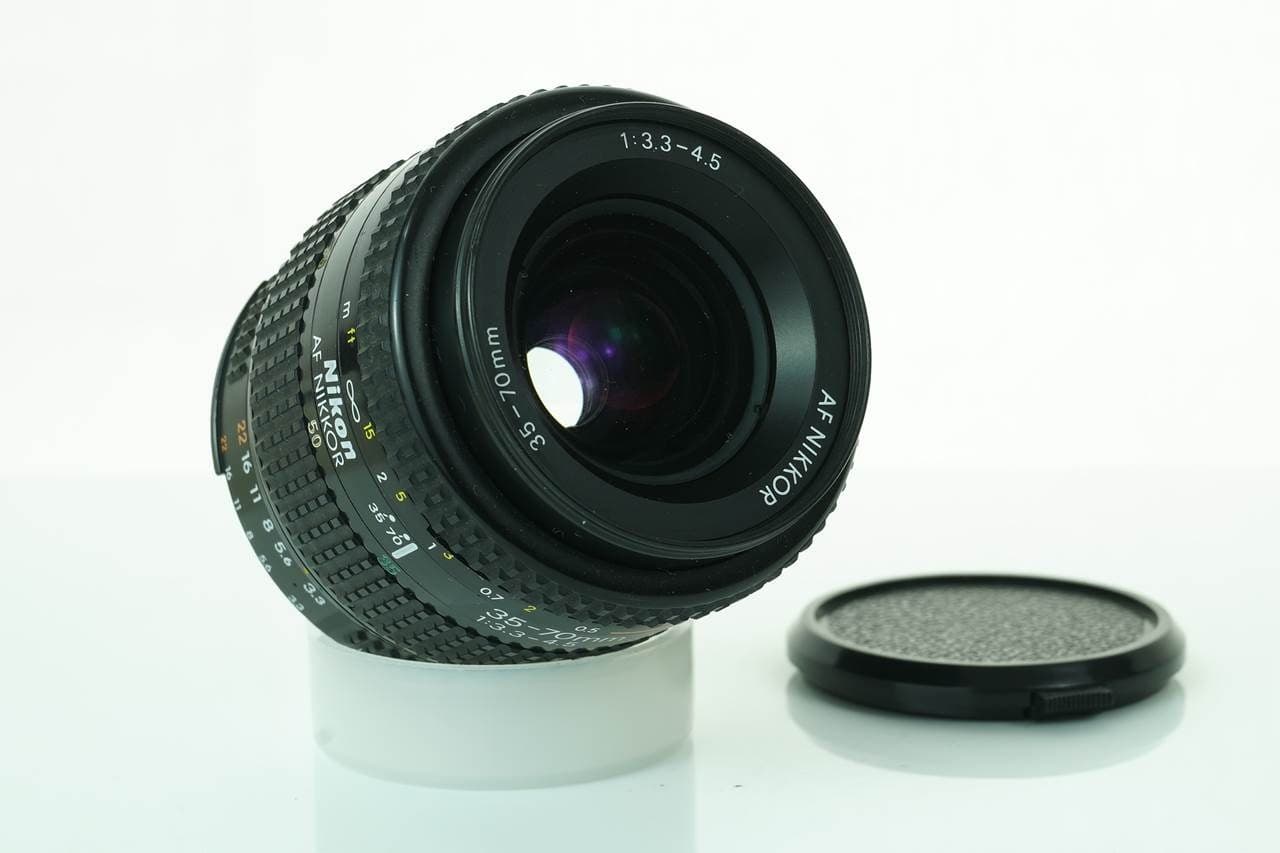
The Nikon Zoom-NIKKOR 35-70mm f/3.5 was Nikon's early attempt at a professional-grade constant-aperture 'standard zoom,' covering the focal range that could replace two or three prime lenses at a time when carrying multiple primes was the norm. According to Richard Haw, the original AI version was sold from 1977 to 1981 and was revolutionary in covering the important focal lengths used for photojournalism, events, and travel photography. The AI-s version reviewed by Ken Rockwell was introduced in 1981 as Nikon's second professional midrange zoom, replacing the earlier AI version with an entirely different optical and mechanical system, and was built until it was replaced by the 35-70mm f/2.8 AF (pre-D) in 1987; Nikon made about 160,000 of the AI-s versions. Rockwell strongly distinguishes these professional constant f/3.5 zooms from Nikon's cheaper f/3.3-4.5 and f/3.5-4.8 consumer zooms, which he calls among Nikon's crappiest lenses sharing only the focal range. There are no established nicknames or community jargon evidenced in these reviews. It has a modest cult following among Nikon manual-focus enthusiasts due to its superb build quality, constant aperture, and low distortion, though Haw notes it is 'dated today' and best appreciated by the lens aficionado.
Verdict: The Nikon 35-70mm f/3.5 is a robustly built professional constant-aperture standard zoom best suited to Nikon manual-focus enthusiasts and film shooters who value low distortion, solid build, and versatile framing. It performs well stopped down to f/8 but is inconsistent wide open and shows its age on modern high-resolution digital bodies. Prized by aficionados rather than a mainstream legend, and not to be confused with Nikon's cheaper 35-70mm variable-aperture consumer zooms.
Rockwell rates it very sharp at every setting; Haw finds it decent stopped down to f/8 but hit-or-miss wide open and less impressive on modern cameras.
The Nikon 35-70mm f/3.5 is a robustly built professional constant-aperture standard zoom best suited to Nikon manual-focus enthusiasts and film shooters who value low distortion, solid build, and versatile framing. It performs well stopped down to f/8 but is inconsistent wide open and shows its age on modern high-resolution digital bodies. Prized by aficionados rather than a mainstream legend, and not to be confused with Nikon's cheaper 35-70mm variable-aperture consumer zooms.