Production
1980
Country
Japan
Optical
12 elements in 9 groups
Updated
Jul 4, 2026
Canon FD · 70mm · f/4
Production
1980
Country
Japan
Optical
12 elements in 9 groups
Updated
Jul 4, 2026
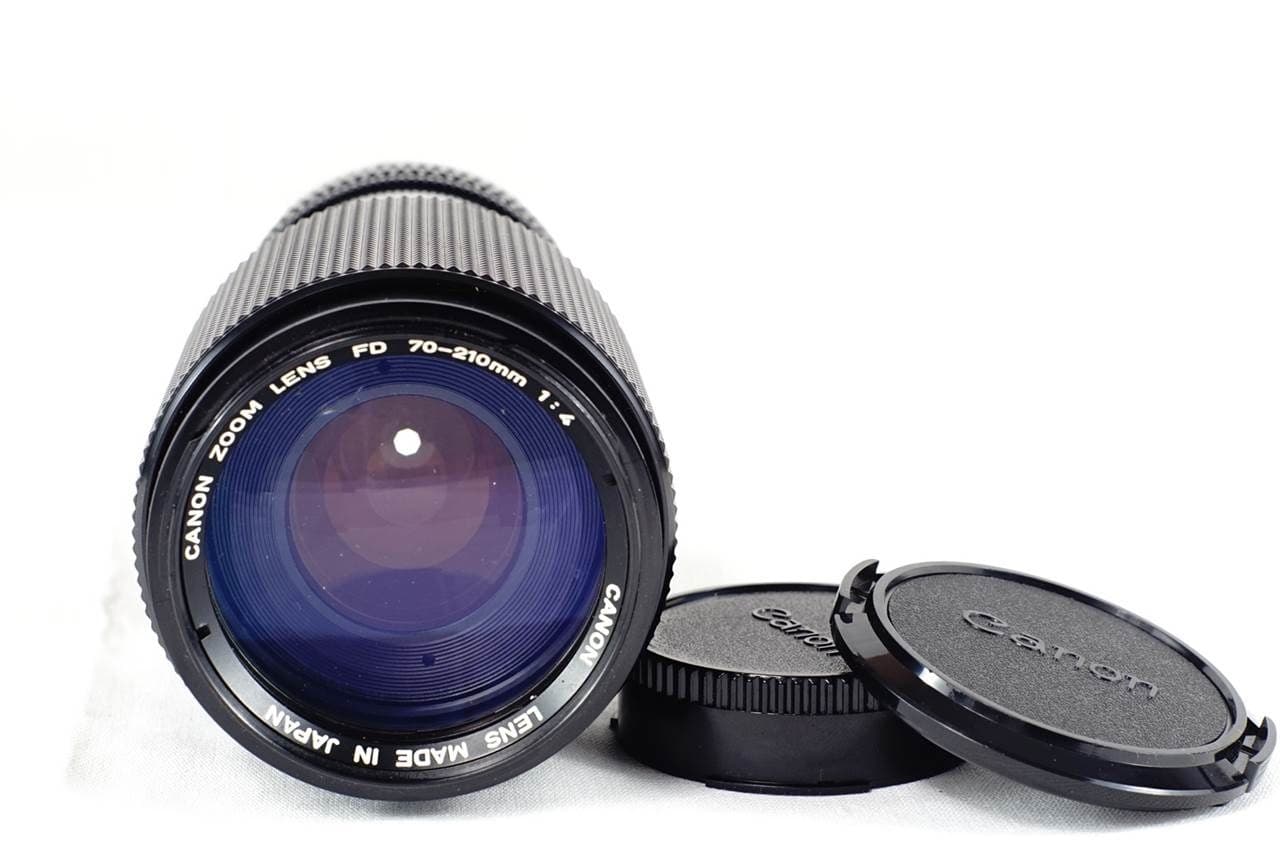
The Canon New FD 70-210mm f/4 was introduced in 1980, a year after Canon's related 80-200mm f/4 lens, arriving at a time when zoom lens optical science was maturing and telephoto zooms were coming into their own. Aimed largely at the consumer market, it packed a constant f/4 aperture across a 3x zoom range covering focal lengths that would otherwise require several fixed lenses (roughly 85mm, 100mm, 135mm and 200mm territory). It uses a one-touch push-pull design where a single ring handles both zoom and focus simultaneously, and it includes a macro function accessible at 70mm allowing focus down to 44cm. Canon's own design notes emphasize that a high-refraction element was used to prevent coma at the center focal length while maintaining resolution and contrast throughout the zoom range. Built in Japan before Canon moved manufacturing offshore, it is a metal-and-glass instrument that feels like a precision tool. No established nickname or community jargon is evidenced in the reviews. Its cult following stems from being an underrated, dirt-cheap performer (often found for €25-$40) that punches above its consumer-grade origins, and it has found a second life among video shooters and mirrorless adapters who appreciate the smooth one-touch operation.
Verdict: The Canon New FD 70-210mm f/4 is a hugely underrated, budget-friendly telephoto zoom for those who value sharpness, contrast, and solid mechanics over dreamy bokeh or premium color saturation. It's ideal for beginners learning telephoto work, travelers wanting a versatile do-it-all zoom, and video/mirrorless shooters who love smooth one-touch operation. Enthusiasts chasing the ultimate rendering or the richer color of the 80-200mm f/4L may want to look elsewhere, but for the money it is hard to beat.
Unremarkable and neutral; does not deliver the dreamy bokeh some users hope for at f/4.
More subdued and less saturated than Canon's premium 80-200mm f/4L.
Sharp and contrasty across the range, softening somewhat wide open at f/4 but sharp when stopped down a few clicks.
High contrast, repeatedly praised and maintained throughout the zoom range.
The Canon New FD 70-210mm f/4 is a hugely underrated, budget-friendly telephoto zoom for those who value sharpness, contrast, and solid mechanics over dreamy bokeh or premium color saturation. It's ideal for beginners learning telephoto work, travelers wanting a versatile do-it-all zoom, and video/mirrorless shooters who love smooth one-touch operation. Enthusiasts chasing the ultimate rendering or the richer color of the 80-200mm f/4L may want to look elsewhere, but for the money it is hard to beat.