Production
-
Country
Japan (Tokina-made versions)
Optical
-
Updated
Jul 4, 2026
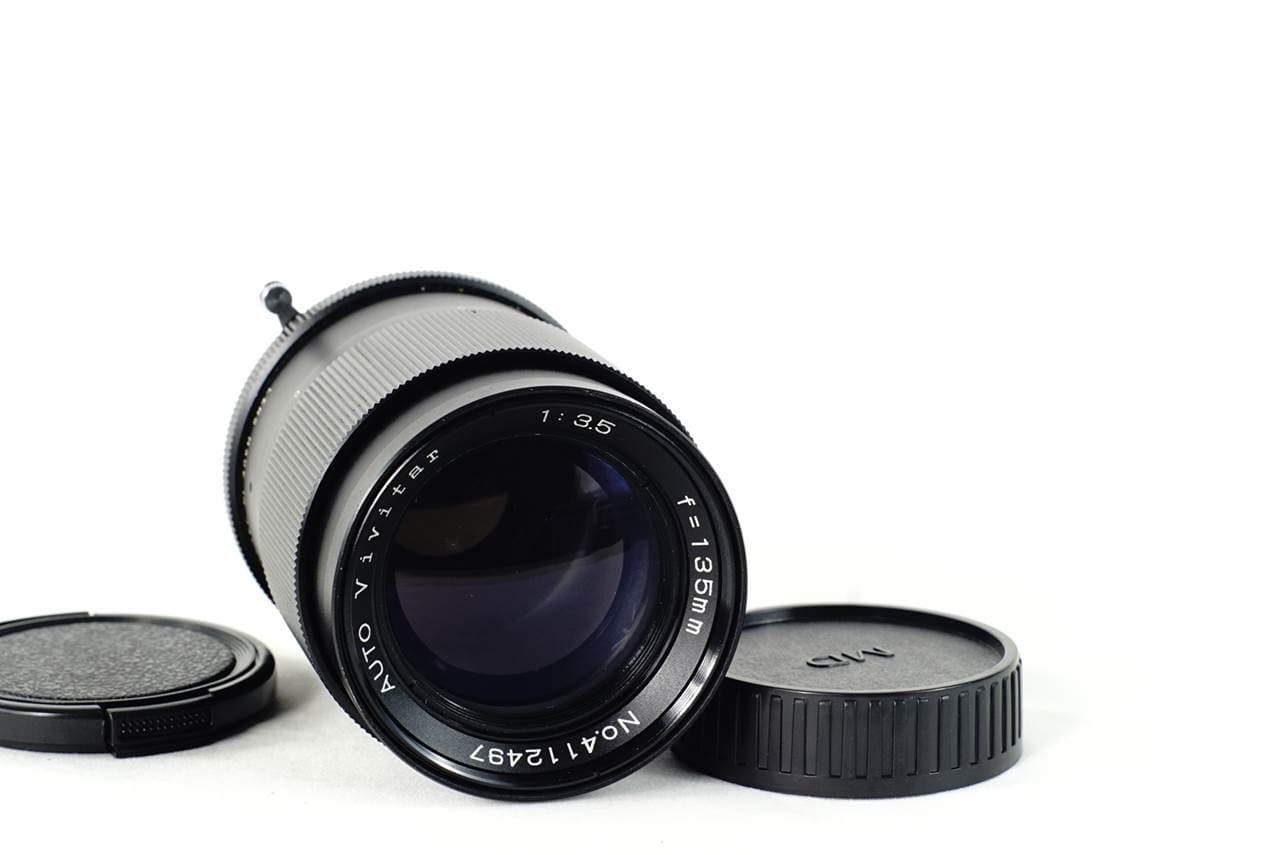
Minolta MD (also available in M42 screwmount and T-4 variants) · 135mm · f/3.5
Production
-
Country
Japan (Tokina-made versions)
Optical
-
Updated
Jul 4, 2026
The Vivitar 135mm f/3.5 belongs to the vast family of Vivitar-branded telephoto primes that flooded the market in the 1960s through 1980s. Vivitar was a rebrander rather than a manufacturer, contracting production out to various Japanese optical houses. According to the reviews here, at least one version of this lens was made in Japan by Tokina and shared its optical formula with lenses sold under other labels: one source notes it is 'identical to the Dollonds-S 135mm' and 'was also sold under the Sears label.' A separate T-4 mount variant is documented as a 'Vivitar 135mm f/3.5 Auto Telephoto (T-4 Tokina)' built for the T4 interchangeable-lens system popular in the 1970-80's. Because Vivitar sold many differently-built 135mm f/3.5 lenses over the years, exact provenance depends on the specific sample. No established nickname or community jargon (such as 'Bokeh King') is evidenced in the reviews for this particular lens. Its modest cult following stems from being an inexpensive, sharp, well-built classic telephoto that punches above its price point — one reviewer paid around $69 and rated it 8/10, calling it 'a fantastic lens.'
Verdict: A sharp, affordable, and well-regarded classic 135mm telephoto that delivers corner-to-corner sharpness and smooth bokeh far exceeding its bargain price. Best for budget-minded vintage shooters who want a versatile short telephoto for both portraits and landscapes, and who don't mind fully manual operation. Just verify the specific variant and mount, as the plastic mount on some samples is the main compromise.
Smooth and pleasant, becoming less harsh when stopped down; one 15-blade version credited with especially soft bokeh.
Sharp, including very sharp into the corners, and nearly indistinguishable from the Takumar wide open.
A sharp, affordable, and well-regarded classic 135mm telephoto that delivers corner-to-corner sharpness and smooth bokeh far exceeding its bargain price. Best for budget-minded vintage shooters who want a versatile short telephoto for both portraits and landscapes, and who don't mind fully manual operation. Just verify the specific variant and mount, as the plastic mount on some samples is the main compromise.