Production
1993 – 1999
Country
Japan (D version); Thailand (N version)
Optical
6 elements in 6 groups (earliest D, with one aspherical); 8 elements in 7 groups (later D and N versions)
Updated
Jul 4, 2026
Nikon F (AF-D) · 35mm · f/4
Production
1993 – 1999
Country
Japan (D version); Thailand (N version)
Optical
6 elements in 6 groups (earliest D, with one aspherical); 8 elements in 7 groups (later D and N versions)
Updated
Jul 4, 2026
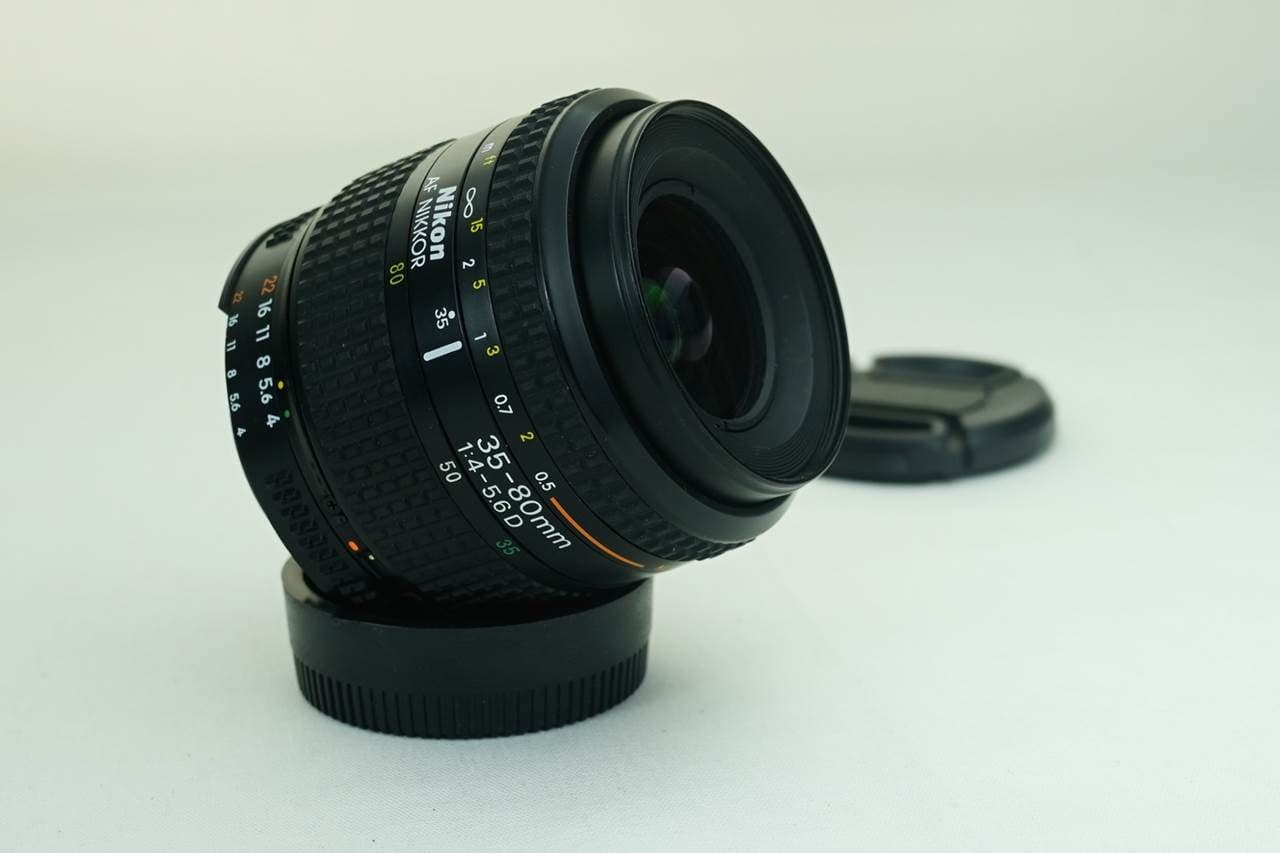
The AF Zoom-Nikkor 35-80mm f/4-5.6D was a product of Japan's post-bubble economy, when the burst of the country's speculative boom forced companies like Nikon to prioritize budget above all else. According to Richard Haw's detailed repair histories, the original version was sold from roughly 1993/1994 to 1995 and was made in Japan. It was soon replaced by the cheaper, flimsier AF Zoom-Nikkor 35-80mm f/4-5.6D (N) in 1995 (produced until 1999), which was manufactured at Nikon's then-nascent Thai plant as part of a cost-cutting drive. Confusingly, both share the same name and even the earlier D version has two subvariants: the earliest with a simpler 6-elements-in-6-groups formula including one aspherical element, and a later batch that adopted the same 8-elements-in-7-groups optics as the plastic (N) version while keeping the older barrel exterior. Haw notes the aspherical element was likely dropped because it cost more to produce, so the redesigned formula avoided it entirely. There are no established nicknames or cult jargon for this lens in the reviews; it was a bundled kit zoom meant to complement entry-level Nikon bodies, and Haw candidly admits people (including himself) looked down on the cheap Thai version before he softened his view on the early Thai Nikkors. This is not a cult lens so much as a historical artifact of an era when frugality reshaped Nikon's manufacturing.
Verdict: The Nikon 35-80mm f/4-5.6D is a compact, lightweight, budget kit zoom born from Japan's post-bubble frugality. It's a competent travel companion in good light, and the earlier Japan-made version with its metal bayonet is the one to prefer over the cheaper-feeling Thai (N) successor. It has no cult following or celebrated optical signature in these reviews, so it's best suited to collectors of Nikon history, casual shooters wanting a light kit lens, or repair enthusiasts rather than those chasing distinctive rendering.
The Nikon 35-80mm f/4-5.6D is a compact, lightweight, budget kit zoom born from Japan's post-bubble frugality. It's a competent travel companion in good light, and the earlier Japan-made version with its metal bayonet is the one to prefer over the cheaper-feeling Thai (N) successor. It has no cult following or celebrated optical signature in these reviews, so it's best suited to collectors of Nikon history, casual shooters wanting a light kit lens, or repair enthusiasts rather than those chasing distinctive rendering.