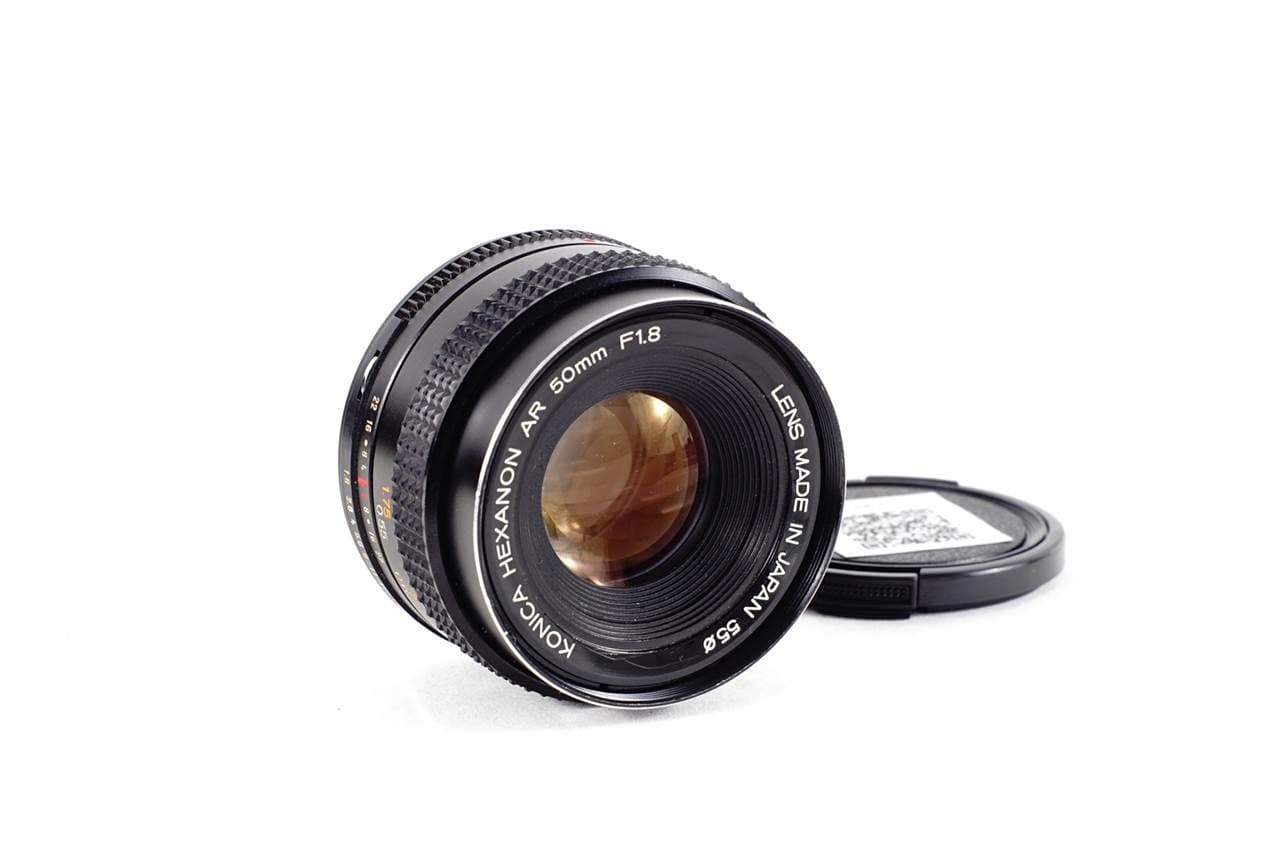
Production
1973 – 1979
Country
Japan
Optical
-
Updated
Jul 4, 2026
Konica AR · 50mm · f/1.7
Production
1973 – 1979
Country
Japan
Optical
-
Updated
Jul 4, 2026
The Konica Hexanon AR 50mm f1.7 was introduced in 1973 as the fixed standard lens accompanying Konica's Autoreflex T3 SLR, the successor to the T2. It quickly earned a reputation for optical performance, particularly its sharpness. When Konica refreshed its lineup in 1976 with the smaller, lighter Autoreflex TC, an updated version of this lens was released to match the new body: it was made smaller and lighter, its closest focusing distance grew from 45cm to 55cm, and aperture half-stops were removed, though the optical quality was said to remain the same. Production of this second version continued until 1979, when the FS-1 camera arrived bundled with a 40mm f1.8 pancake lens instead. Within the Hexanon standard-lens family, the f1.7 sits as the entry-level or 'budget priced' standard option, below the faster 50mm f1.4 and the iconic 57mm f1.2. Despite being the slowest of the three, reviewers regard it as the sharpest and an outright excellent performer with arguably the best price/performance ratio of the range. Konica Hexanons historically lagged in popularity among vintage-lens shooters because their short flange distance (40.5mm) made them difficult to adapt to DSLRs without optical corrective elements; the rise of mirrorless cameras like the Canon EOS R, with much shorter flange distances, finally made simple adapting possible and reignited interest. No established nickname is evidenced in the reviews.
Verdict: The Konica Hexanon AR 50mm f1.7 is a sharp, contrasty, well-built standard prime that offers arguably the best price-to-performance of the Konica AR line. It is ideal for photographers on a budget who want excellent center sharpness and subject separation, especially on mirrorless bodies where it adapts easily. Those bothered by hexagonal bokeh highlights or seeking silky-smooth aperture action may prefer another lens, but for value and image quality it is hard to beat.
Excellent subject separation, but the six-blade aperture produces visible hexagonal highlights when stopped down; no swirl or bubble effect.
A standout trait with strong center sharpness even wide open, improving significantly when stopped down and adequate for most photos from about f2.8.
Contrasty with high global contrast; images noted as contrasty and sharp.
The Konica Hexanon AR 50mm f1.7 is a sharp, contrasty, well-built standard prime that offers arguably the best price-to-performance of the Konica AR line. It is ideal for photographers on a budget who want excellent center sharpness and subject separation, especially on mirrorless bodies where it adapts easily. Those bothered by hexagonal bokeh highlights or seeking silky-smooth aperture action may prefer another lens, but for value and image quality it is hard to beat.