Production
1950
Country
-
Optical
4 elements in 4 groups (New FD and 1976 FD); 4 elements in 3 groups (1970/1973 FD).
Updated
Jul 4, 2026
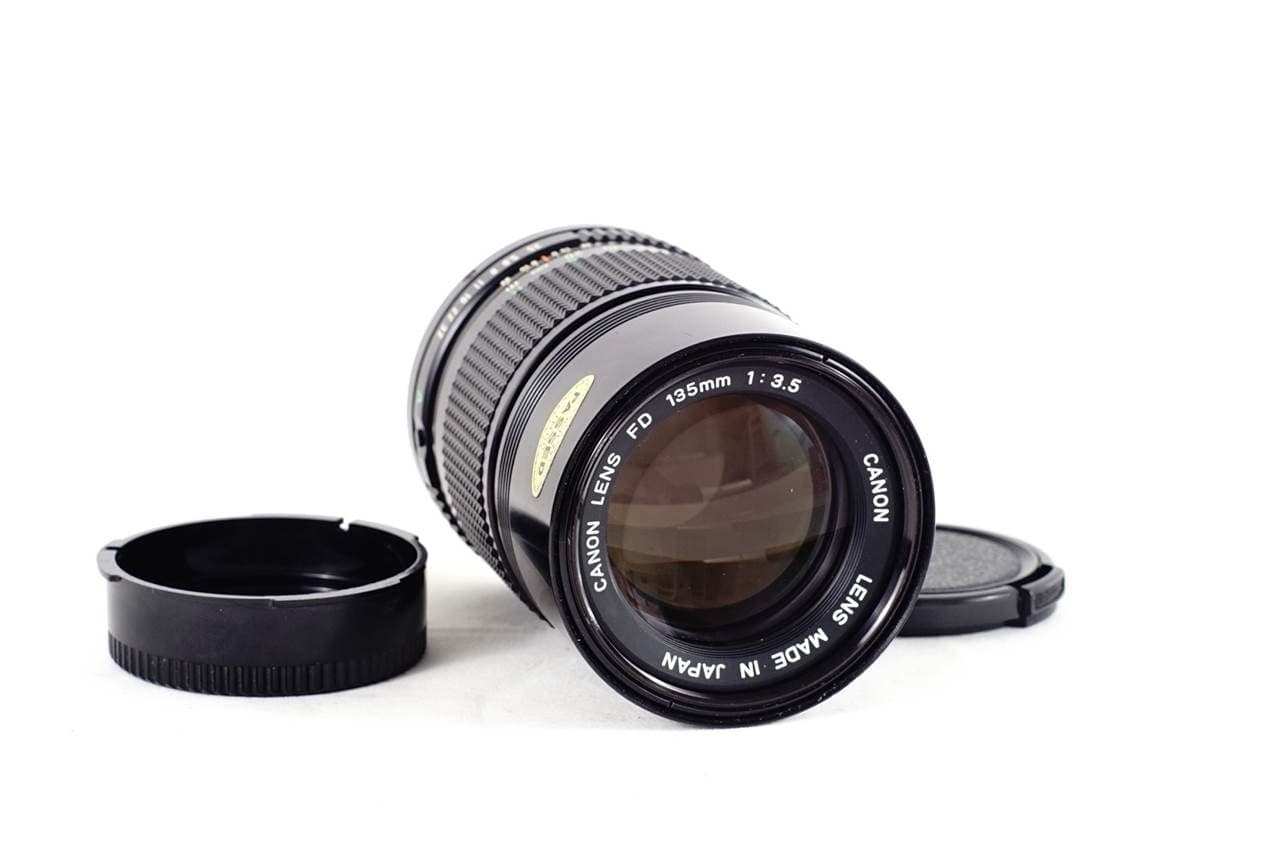
Canon FD · 135mm · f/3.5
Production
1950
Country
-
Optical
4 elements in 4 groups (New FD and 1976 FD); 4 elements in 3 groups (1970/1973 FD).
Updated
Jul 4, 2026
The Canon 135mm f/3.5 is a long-running budget telephoto that spans multiple eras of Canon's optical history. Its origins reach back to a Leica Thread Mount (LTM) rangefinder version released around 1950, which was manufactured for roughly 25 years and appeared in 8 different versions—changes that, per Canon lore, were purely visual with the optical formula reportedly unchanged. On rangefinders, 135mm sits at the very upper limit of usability, framed via small dedicated framelines (as on the Canon Model 7) or an external viewfinder. The FD-mount lineage that followed had two major eras: the older FD version sold from 1970 to 1978, and the New FD (nFD) version introduced in 1979. The older FD line itself had three sub-versions: a 1970 original (4 elements/3 groups, 8 aperture blades), a 1973 lighter revision (same optics, 8 blades), and a 1976 version that switched to 4 elements in 4 groups with only 6 blades. All older FD variants used the simpler S.C. coating. The 1979 nFD version is lighter still, retains the 4-element/4-group design and 6 blades, but upgrades to the more advanced S.S.C. coating. This is a lens people love not for prestige but for value: it's small, light, cheap, and delivers performance that reviewers say rivals modern lenses costing dramatically more. No established nicknames are evidenced beyond the LTM reviewer's playful, personal remark that the long thin rangefinder version gives off 'clown vibes' on the camera—not an established community term.
Verdict: The Canon 135mm f/3.5 is a modest, honest, and remarkably affordable short telephoto that punches far above its price—especially the New FD version, whose S.S.C. coating, low vignetting, smooth bokeh, and sharp-across-the-frame performance rival far pricier glass. It's ideal for the budget-minded photographer who wants a compact, well-built 135mm for portraits and compression, and isn't bothered by the fiddly FD mount, plastic-heavy nFD construction, or the leisurely f/3.5 aperture. It's a great shooter but, as reviewers note, a less compelling collector's piece than Canon's more striking breech-lock lenses.
Smooth and creamy on the New FD, avoiding distinct polygons from point sources.
Razor sharp in the center wide open at f/3.5; sharp across the entire frame by f/5.6, with focus shift present.
New FD S.S.C. coating nearly eliminates flare; older S.C. versions are less flare-resistant.
Very low; roughly one stop wide open, about 0.4 stop at f/5.6, and ~0.2 stop stopped down further on the nFD.
The Canon 135mm f/3.5 is a modest, honest, and remarkably affordable short telephoto that punches far above its price—especially the New FD version, whose S.S.C. coating, low vignetting, smooth bokeh, and sharp-across-the-frame performance rival far pricier glass. It's ideal for the budget-minded photographer who wants a compact, well-built 135mm for portraits and compression, and isn't bothered by the fiddly FD mount, plastic-heavy nFD construction, or the leisurely f/3.5 aperture. It's a great shooter but, as reviewers note, a less compelling collector's piece than Canon's more striking breech-lock lenses.