Production
1981
Country
-
Optical
5 elements in 5 groups, no floating elements
Updated
Jul 4, 2026
Minolta MD · 135mm · f/3.5
Production
1981
Country
-
Optical
5 elements in 5 groups, no floating elements
Updated
Jul 4, 2026
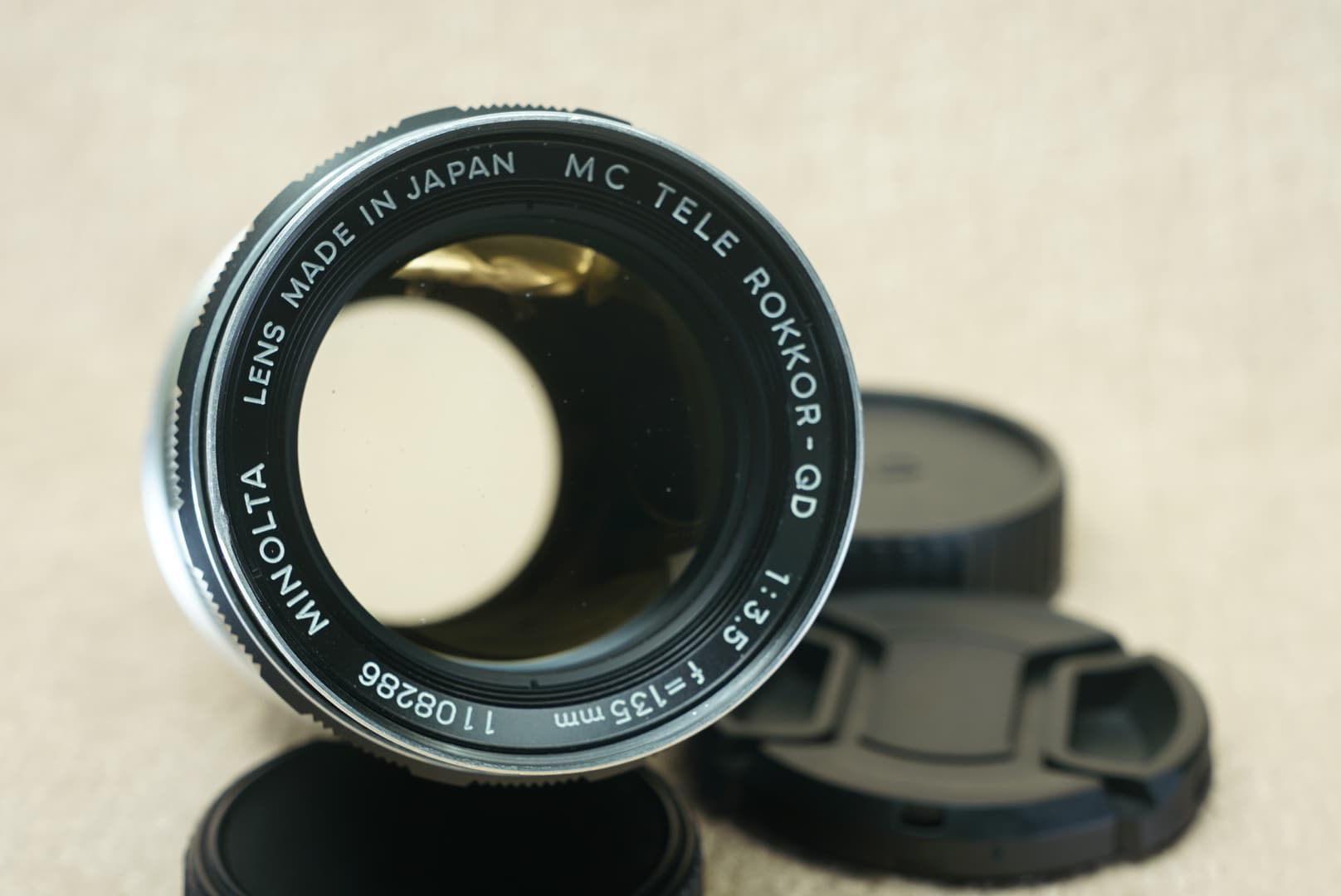
The Minolta MD 135mm 1:3.5 (New-MD, collector's 'MD III' style) was released in 1981 alongside the Minolta X-700 camera, with which it shares matching design cues from that year. It represents the final and most compact iteration of Minolta's budget 135mm telephoto line, tracing its lineage back to earlier MC Rokkor-QD versions (such as the MC Tele Rokkor-QD 135mm f3.5 from 1969, a 4-element/4-group design). The MD III version was redesigned to 5 elements in 5 groups. According to reviewers, it is 'in the list of most popular lenses among Minolta fans,' but the reviewer stresses this popularity comes 'not because of IQ' — rather because it is 'the most little and cute 135mm lens.' Weighing just 285g and only 72.5mm long with a built-in hood, it was the lightweight, pocketable choice for photographers who didn't need the speed of the faster MD 135mm f2.8 or f2.0 siblings. No established nicknames or community jargon are evidenced in the reviews. Its cult following rests on its portability and low cost rather than any exotic optical signature.
Verdict: The Minolta MD 135mm f3.5 is the featherweight, pocket-friendly telephoto for Minolta shooters who prize portability over speed. It won't out-resolve its faster f2.8 and f2.0 siblings, but it delivers surprisingly comparable image quality with nice bokeh and clean geometry in a tiny, charming package. Ideal for portrait and travel photographers who want a compact 135mm and are happy shooting from F5.6, or wide open at F3.5 for portraits.
Nice bokeh across short, long, and light-bubble tests, with no swirl or harshness.
Good test results, usable wide open at F3.5 and sharp from F5.6, though not as sharp as faster siblings.
Present but not emphasized as a problem; specific severity unknown.
The Minolta MD 135mm f3.5 is the featherweight, pocket-friendly telephoto for Minolta shooters who prize portability over speed. It won't out-resolve its faster f2.8 and f2.0 siblings, but it delivers surprisingly comparable image quality with nice bokeh and clean geometry in a tiny, charming package. Ideal for portrait and travel photographers who want a compact 135mm and are happy shooting from F5.6, or wide open at F3.5 for portraits.