Production
1949 – 1968
Country
East Germany
Optical
Cooke Triplet (3 elements in 3 groups)
Updated
Jul 4, 2026
Exakta (also produced in M42 screw mount) · 50mm · f/2.9
Production
1949 – 1968
Country
East Germany
Optical
Cooke Triplet (3 elements in 3 groups)
Updated
Jul 4, 2026
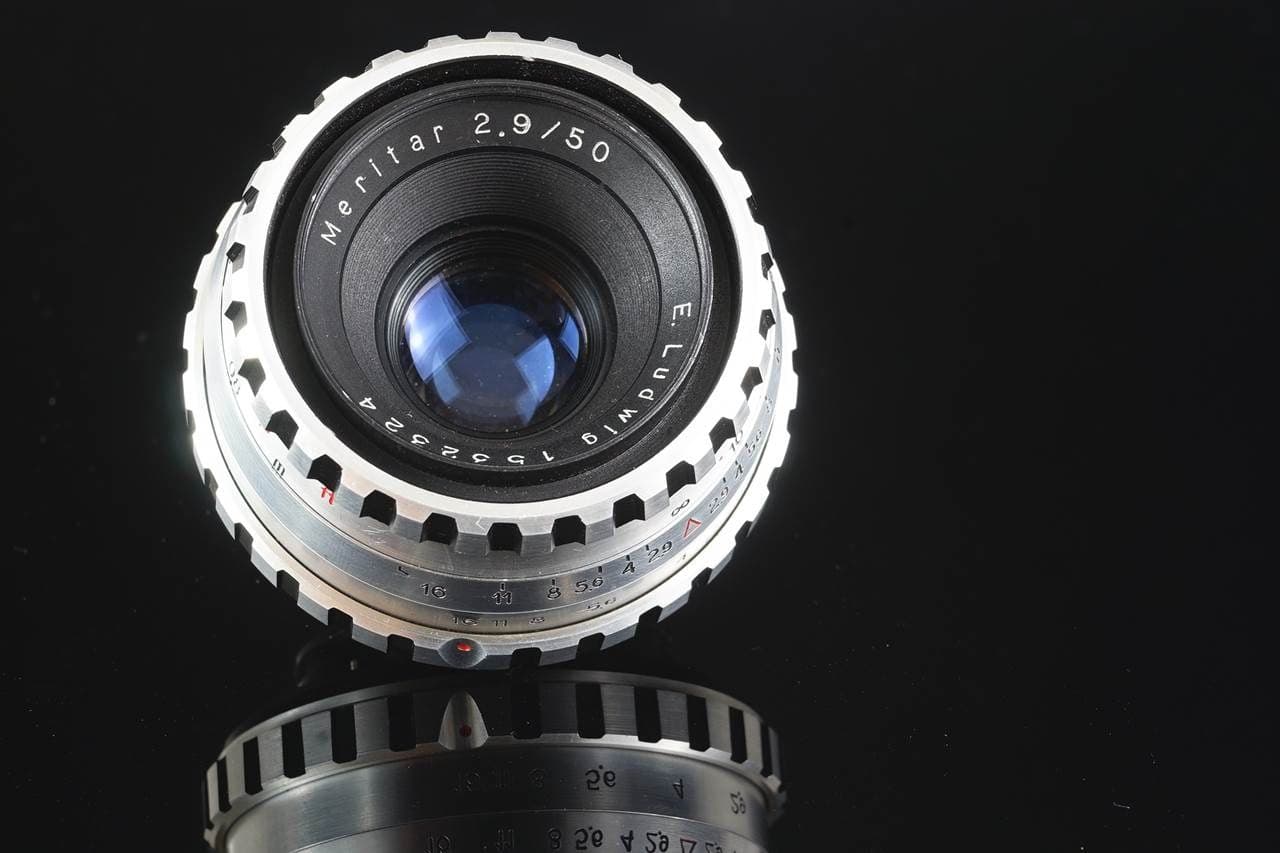
The E. Ludwig Meritar 50mm was produced in East Germany by Ernst Ludwig between 1949 and 1968, marketed as an affordable, entry-level lens often bundled with Exa/Exakta bodies. It uses a Cooke Triplet optical formula (3 elements in 3 groups), a 19th-century design dating back to simpler optics that emphasizes distinctive rendering. Reviewers repeatedly note it shares this same triplet formula with the famed (and far pricier) Meyer-Optik Trioplan 100mm F2.8, which is often cited as the source of its character. The lens has a cult following among vintage lens shooters and filmmakers for its organic, film-like imperfections rather than technical excellence. One reviewer directly compares its character to the 'legendary Helios 44-2 58mm F2,' saying any lens similar to it is 'pretty magical.' Note: the reviews cover the f/2.9 version; specifics on an f/2.8 variant are unknown. No established nicknames are evidenced in the reviews. Some versions are marked with a red 'V' to indicate single coating.
Verdict: The E. Ludwig Meritar 50mm is a cheap, compact, character-first triplet lens for photographers and filmmakers who value organic, film-like imperfection over technical perfection. It won't be your main or even second 'sharp' 50mm, but for the right creative project it delivers colorful rainbow flares, smooth slightly-swirly bokeh, and diffused colors at a bargain price. Ideal for BMPCC/Super 35 shooters seeking a vintage look, especially paired with a Speedbooster.
Smooth and beautiful, described as slightly swirly wide open.
Diffused, muted colors compared to strongly multi-coated lenses, well-suited to color grading in post.
Center sharpness quite good wide open per one reviewer but overall soft; sharpens noticeably stopped down to F4-F8 with soft edges/corners.
Loses contrast toward the sun and produces colorful rainbow-like flares, considered a desirable artistic trait.
Low contrast wide open at f/2.9, improving noticeably when stopped down to f/5.6-f/8.
The E. Ludwig Meritar 50mm is a cheap, compact, character-first triplet lens for photographers and filmmakers who value organic, film-like imperfection over technical perfection. It won't be your main or even second 'sharp' 50mm, but for the right creative project it delivers colorful rainbow flares, smooth slightly-swirly bokeh, and diffused colors at a bargain price. Ideal for BMPCC/Super 35 shooters seeking a vintage look, especially paired with a Speedbooster.