Production
1971 – 1982
Country
Japan
Optical
4 elements (V5) or 5 elements (V3/V4), depending on variant.
Updated
Jul 4, 2026
M42 · 135mm · f/2.8
Production
1971 – 1982
Country
Japan
Optical
4 elements (V5) or 5 elements (V3/V4), depending on variant.
Updated
Jul 4, 2026
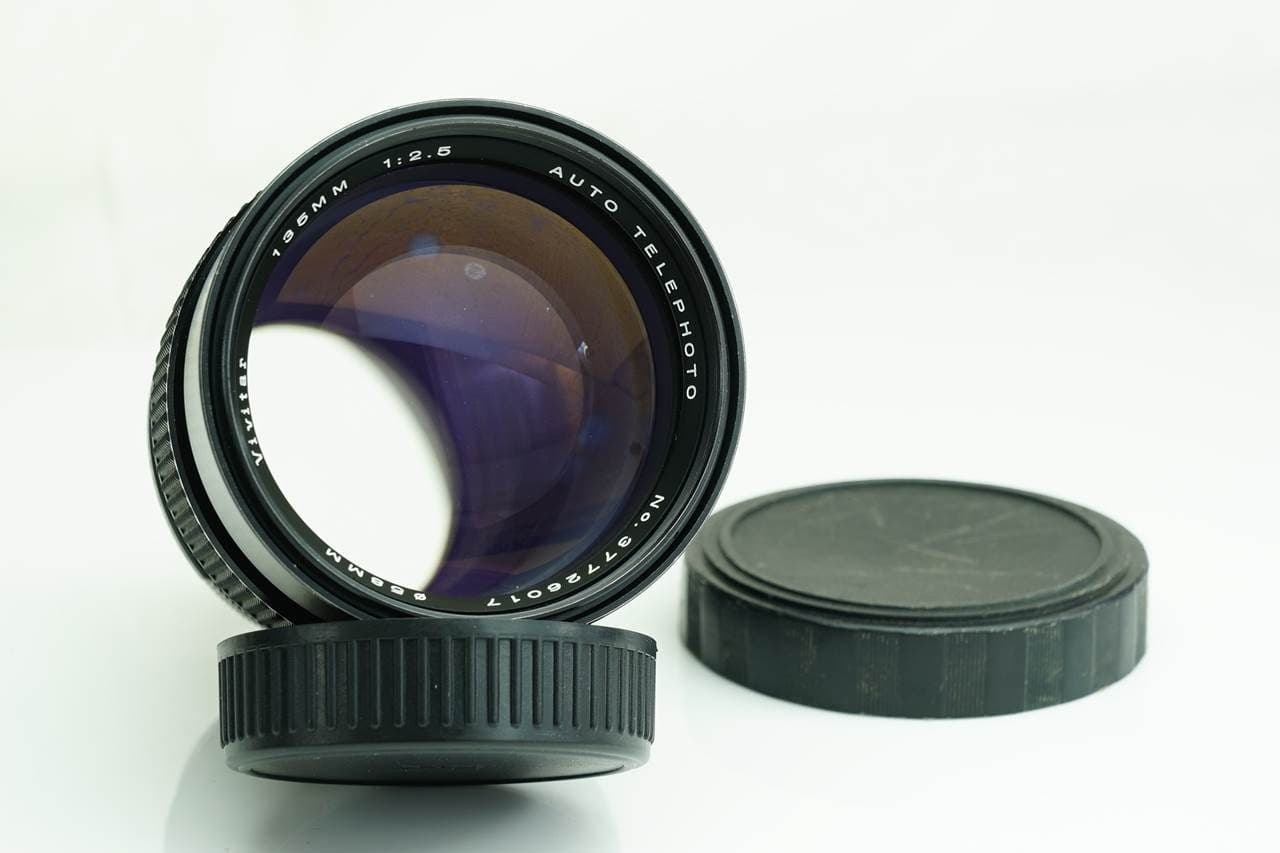
The Vivitar 135mm f/2.8 belongs to the golden era of Japanese third-party lensmaking, when optical houses in Japan quietly crafted glass that could rival many brand-name options. Sold under the Vivitar name, this compact M42-mount telephoto was made for the universal M42 screw mount and was compatible with Praktica, Pentax, and many other systems of its time. Several optical manufacturers produced the lens for Vivitar over the years, which is why photographers still confirm the serial prefix when hunting for a specific optical formula. The Komine-made versions covered here came in both 4-element and 5-element variants that look identical: the 5-element 'milled metal grip' V3 (roughly 1971–1974), the 5-element 'rubber grip' V4 (1974–76), and the 4-element V5 (1976–82). A separate, rarer 'Close Focusing' version was also made by Komine (1975–81), distinguished by its 62mm filter thread and 1:2 magnification. No established nickname is documented in the reviews for the standard 55mm lens. Its cult following stems from being sharp, solidly built all-metal glass with pleasing vintage character at a very affordable price, making it an easy and rewarding way to add tactile control and vintage rendering to a modern mirrorless kit via a simple M42 adapter.
Verdict: The Vivitar (Komine) 135mm f/2.8 is a well-built, affordable all-metal manual telephoto that rewards deliberate shooters and portrait photographers who value vintage character. It's dreamy and glowing wide open and quite sharp stopped down, with smooth bokeh and flattering compression — though its chromatic aberration and merely good (not class-leading) out-of-focus rendering keep it a character lens rather than a clinical performer. For the price, it's an easy recommendation for anyone wanting tactile vintage rendering on a modern mirrorless body.
Smooth and rounded, especially with mid-distance backgrounds; 8-blade versions produce beautiful bokeh, though one reviewer felt it wasn't the best for a 135mm f/2.8.
Soft and dreamy wide open at f/2.8, improving significantly stopped down, particularly in the center.
Lower, gentle contrast wide open, improving significantly from f/4 onward.
The Vivitar (Komine) 135mm f/2.8 is a well-built, affordable all-metal manual telephoto that rewards deliberate shooters and portrait photographers who value vintage character. It's dreamy and glowing wide open and quite sharp stopped down, with smooth bokeh and flattering compression — though its chromatic aberration and merely good (not class-leading) out-of-focus rendering keep it a character lens rather than a clinical performer. For the price, it's an easy recommendation for anyone wanting tactile vintage rendering on a modern mirrorless body.