Production
1962 – 1974
Country
Japan
Optical
7 elements in 6 groups, refined from the original 7-elements-in-5-groups design.
Updated
Jul 4, 2026
Nikon Non-AI · 35mm · f/2.8
Production
1962 – 1974
Country
Japan
Optical
7 elements in 6 groups, refined from the original 7-elements-in-5-groups design.
Updated
Jul 4, 2026
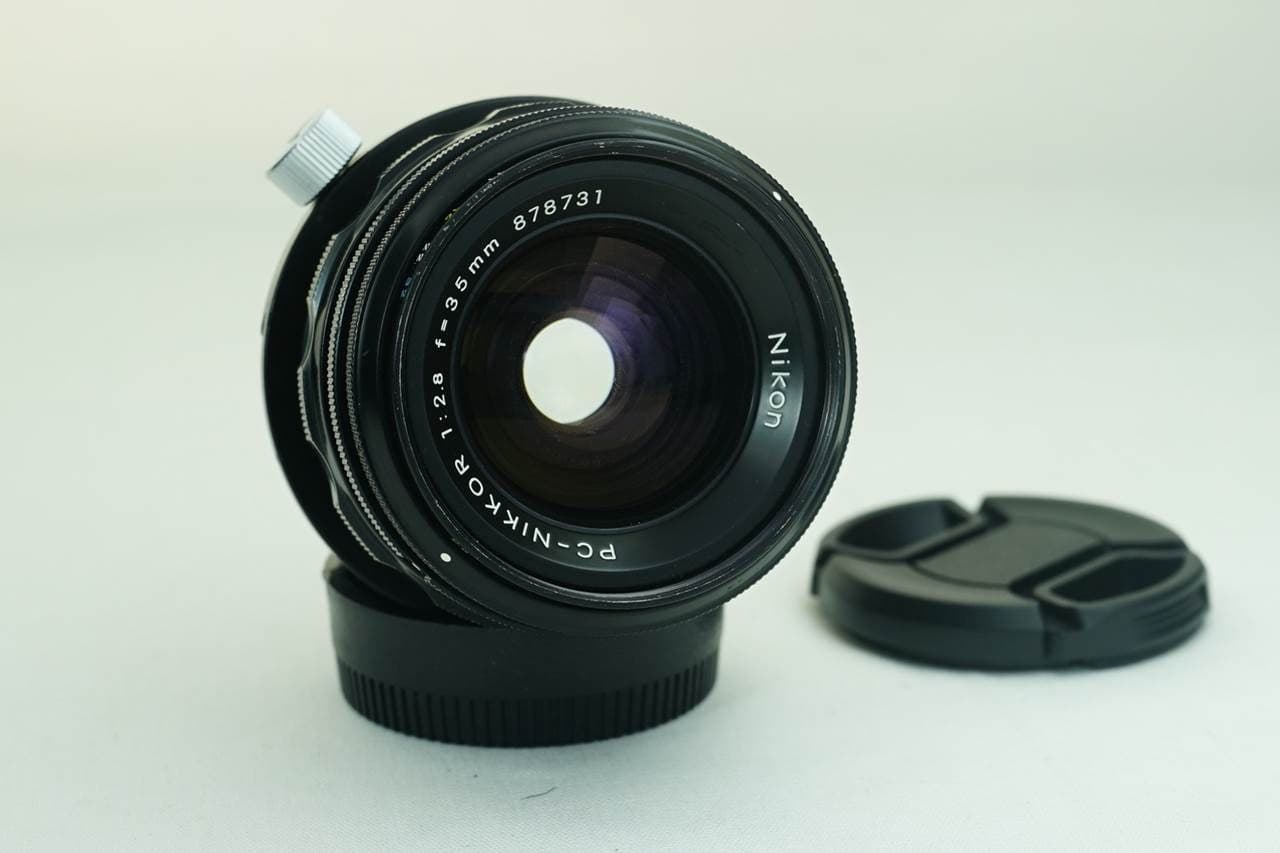
The Nikon Nikkor 35mm f/2.8 is a compact wide-angle legacy lens whose lineage traces back to 1959. According to phillipreeve.net there are four optically distinct versions. The first, the Nikkor-S 3.5cm f/2.8 Auto, was produced from 1959 to 1962 with a 7-element/5-group design; Richard Haw refers to this original as the 'Tick-Mark' version. As Richard Haw explains, this original was 'made in a rush so that the Nikon F would have a wide-angle lens in its kit,' but the design was difficult to manufacture and had major flaws. The second version, the Nikkor-S 35mm f/2.8 (produced 1962-1974), introduced a refined 7-element/6-group optical formula that, in Richard Haw's words, 'enhanced its performance greatly' and 'corrected the older design's major flaws' while being simpler to manufacture. This second version is the NON-AI lens covered here — distinguishable from the first by its 'made in Japan' engraving on the hill-valley type focus ring, and its focal length marked in mm rather than cm. It bought Nikon time until the even better New-Nikkor 35mm f/2.8 arrived. Phillip Reeve calls the later variant 'currently one of my favorite lenses' despite some weaknesses. The lens has a modest but loyal following among adapters-to-mirrorless for its small size, all-metal build, and classic Nikkor rendering. No established nickname exists for this specific NON-AI version beyond the collector's 'Tick-Mark' term applied to the earlier 3.5cm original.
Verdict: The NON-AI Nikkor-S 35mm f/2.8 (1962-1974) is a compact, superbly built all-metal classic wide-angle for enthusiasts who appreciate vintage Nikkor engineering and want a small, durable adapted 35mm. Its refined 7/6 optical formula is a genuine improvement over the original Tick-Mark version, and it is well-liked despite modest quirks. Detailed rendering character for this exact version is not well documented in the available sources, so buyers seeking specific bokeh or color signatures should temper expectations, but those wanting a tough, pocketable legacy 35mm will find it rewarding.
Second-version optical formula is described as 'much better in every way' than the original 7/5 design, but frame-by-frame sharpness detail is not provided.
The NON-AI Nikkor-S 35mm f/2.8 (1962-1974) is a compact, superbly built all-metal classic wide-angle for enthusiasts who appreciate vintage Nikkor engineering and want a small, durable adapted 35mm. Its refined 7/6 optical formula is a genuine improvement over the original Tick-Mark version, and it is well-liked despite modest quirks. Detailed rendering character for this exact version is not well documented in the available sources, so buyers seeking specific bokeh or color signatures should temper expectations, but those wanting a tough, pocketable legacy 35mm will find it rewarding.