Production
1959 – 1989
Country
Japan
Optical
6 elements in 6 groups (AI-S per Analog.Cafe); base2photo lists AI-S as 8 elements in 8 groups.
Updated
Jul 4, 2026
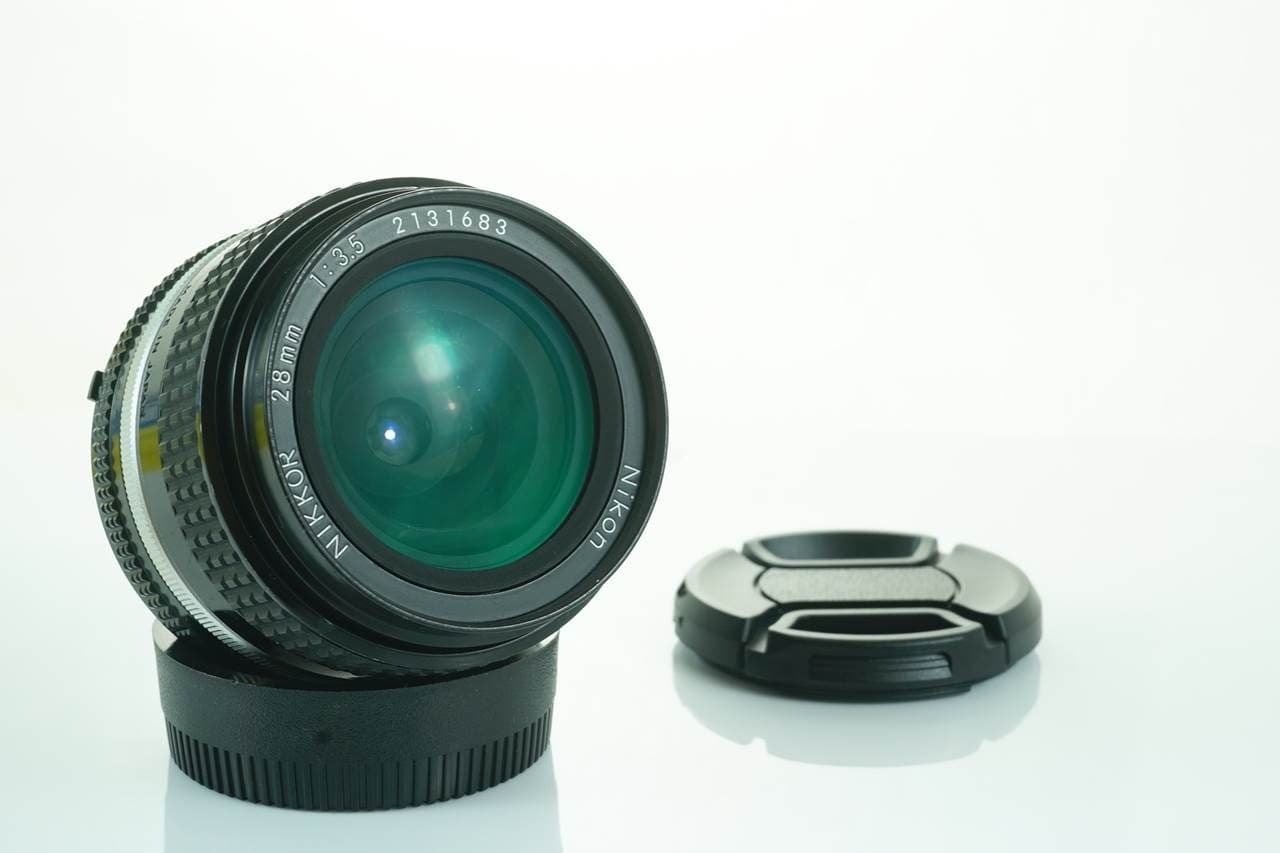
Nikon AI · 28mm · f/3.5
Production
1959 – 1989
Country
Japan
Optical
6 elements in 6 groups (AI-S per Analog.Cafe); base2photo lists AI-S as 8 elements in 8 groups.
Updated
Jul 4, 2026
The Nikon 28mm f/3.5 traces its lineage directly to the very first 28mm SLR lens Nikon produced: the Nikkor-H Auto 2.8cm f/3.5, developed by Zenji Wakimoto and launched in 1959 alongside the pioneering, pro-level Nikon F. At the time the camera market was dominated by rangefinders, which lack a reflex mirror and therefore allow the rear element to sit close to the film plane. The Nikon F's SLR mirror box, combined with the F-mount's 46mm flange distance, made wide-angle design far more challenging. Wakimoto adapted the retrofocus principle pioneered by Angenieux of France to overcome this, and the Nikkor-H 2.8cm f/3.5 was born. As sources note, retrofocus lenses not only clear the flange distance but also reduce vignetting because the optics sit farther from the focal plane. The design saw several revisions: the multicoated 'K' (New-Nikkor) version arrived in February 1975 with updated cosmetics but the same six-element optic and, per one review, a seven-bladed diaphragm stopping to f/22 (an upgrade over the earlier five-blade unit). In 1977 the AI version introduced revised optics with a smaller front element, larger rear element, and thicker glass throughout to improve peripheral brightness. The AI-S version (1977-1981/manufactured, sold roughly 1981-1989 per one source) carried the same improved optics. Notably, the AI-S review states this f/3.5 does NOT feature the close-range correction (CRC) system found in its faster cousins the 28mm f/2.8 and f/2.0 AI-S lenses — though the Analog.Cafe review describes the design's floating-element CRC heritage, so sources disagree on this point (unknown/conflicting). The lens has a modest but devoted following among film shooters: one photographer calls the Nikkor-H 28mm f/3.5 his 'all-time favourite' lens that 'seems perfect,' with 'nothing else I need in terms of picture quality, build and handling.' No established nickname exists for this lens in the reviews.
Verdict: The Nikon 28mm f/3.5 is a compact, sharp, all-metal wide-angle that punches above its modest maximum aperture. It is best suited to documentary and street shooters who value a reliable, honest 28mm rendering, and to infrared photographers who will appreciate its clean, hot-spot-free performance. Its flaws — moderate color fringing, mild barrel distortion, some coma, and merely 'fair' bokeh — are typical of its era and largely correctable. Choose the multicoated K, AI, or AI-S versions for improved contrast and peripheral brightness; the AI-S offers the sharpest optics of the family. Not a bokeh showpiece, but a dependable, beloved workhorse for those who love the 28mm focal length.
Rated 'fair,' explicitly not swirly, with large non-swirly bokeh balls at close focus wide open; some coma present.
A fairly sharp lens; the AI-S is sharpest overall, with the pre-AI sweet spot at f/8.
Excellent for infrared with no hot spots and good contrast; visible-light flare behavior unknown.
Good contrast, particularly in the multicoated K/AI versions; older single-coated Nikkor-H would be lower.
Retrofocus design reduces vignetting; AI/AI-S revisions improved peripheral brightness with no strong complaints.
The Nikon 28mm f/3.5 is a compact, sharp, all-metal wide-angle that punches above its modest maximum aperture. It is best suited to documentary and street shooters who value a reliable, honest 28mm rendering, and to infrared photographers who will appreciate its clean, hot-spot-free performance. Its flaws — moderate color fringing, mild barrel distortion, some coma, and merely 'fair' bokeh — are typical of its era and largely correctable. Choose the multicoated K, AI, or AI-S versions for improved contrast and peripheral brightness; the AI-S offers the sharpest optics of the family. Not a bokeh showpiece, but a dependable, beloved workhorse for those who love the 28mm focal length.