Production
1959
Country
Japan
Optical
5 elements in 4 groups
Updated
Jul 4, 2026
Pentax K (M42 screwmount for earlier versions) · 35mm · f/3.5
Production
1959
Country
Japan
Optical
5 elements in 4 groups
Updated
Jul 4, 2026
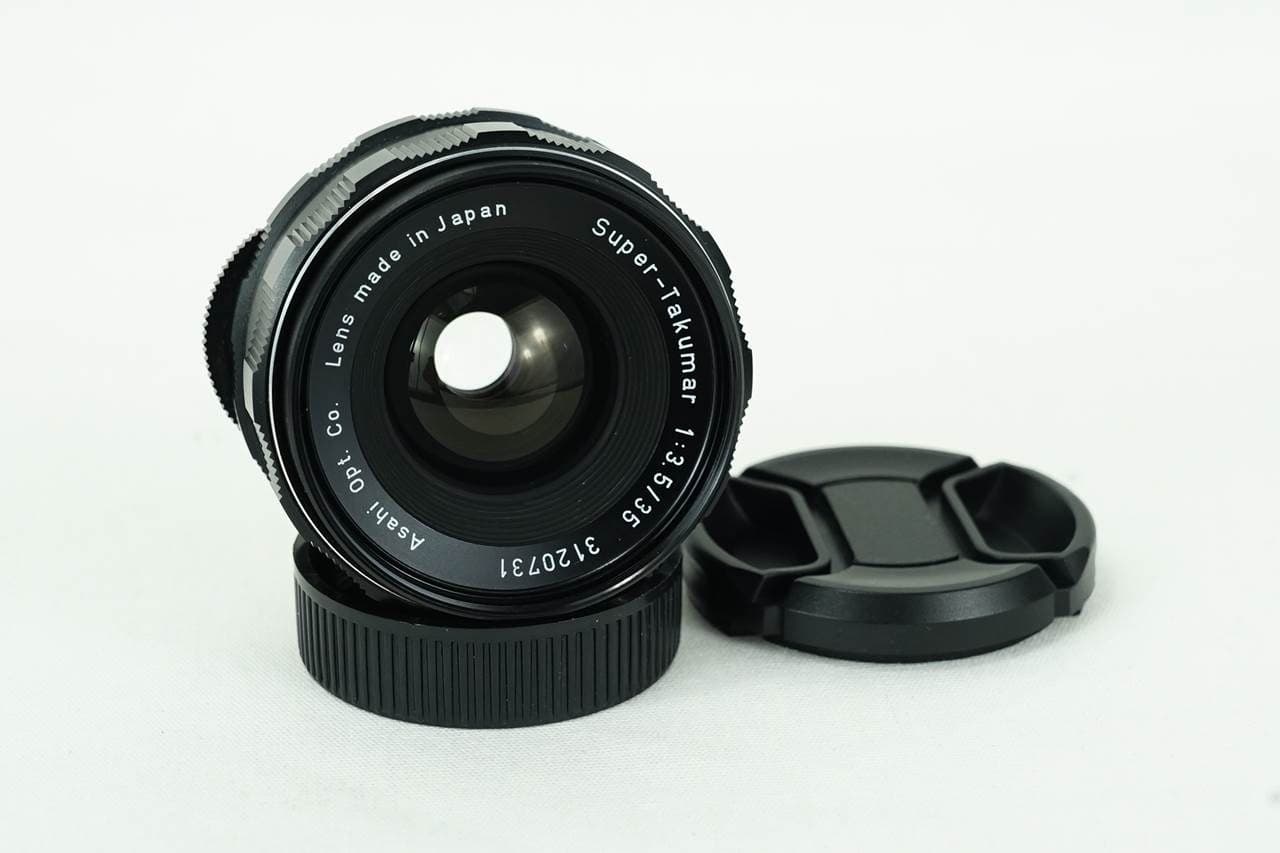
The Takumar 35mm f/3.5 is a wide-angle M42 screwmount prime with a remarkable production history: introduced in 1959 as the Auto-Takumar, its optical design remained fundamentally unchanged across five distinct M42 versions (Auto-Takumar, three Super-Takumar variants, and a Super-Multi-Coated version) and even carried through to a later K-mount version. The Super-Takumar variants can be distinguished by their minimum aperture and distance scale details: the first version stops down to f/22, the second to f/16 with no distance-scale 'window,' and the third adds a 'window' to the distance scale. The Super-Multi-Coated (SMC) version arrived around 1971. No established nicknames or community jargon are evidenced in the reviews for this lens. It has a devoted following thanks to its classic Takumar build quality, compact and light form factor, buttery-smooth focus and aperture rings, and its reputation as a versatile all-rounder that renders beautifully on film with that 'yesteryear quality.'
Verdict: The Takumar 35mm f/3.5 is a compact, beautifully built, and affordable vintage wide-angle that rewards film shooters with characterful, sharp-centered images and classic Takumar color. It's ideal for those who want a durable, pocketable all-rounder with vintage soul — best enjoyed on film, where its character and corner vignetting shine, though it remains a clean and capable performer on digital.
Out-of-focus rendering not detailed in reviews; community bokeh score around 7.5.
Classic vintage Takumar color with a warm 'yesteryear quality' on film, varying by film stock.
Sharp in the center; corners are sharp on digital but can show vignetting on film.
Pronounced corner vignetting on film; minimal on digital.
The Takumar 35mm f/3.5 is a compact, beautifully built, and affordable vintage wide-angle that rewards film shooters with characterful, sharp-centered images and classic Takumar color. It's ideal for those who want a durable, pocketable all-rounder with vintage soul — best enjoyed on film, where its character and corner vignetting shine, though it remains a clean and capable performer on digital.