Production
-
Country
-
Optical
6 elements in 5 groups
Updated
Jul 4, 2026
Konica AR · 40mm · f/1.8
Production
-
Country
-
Optical
6 elements in 5 groups
Updated
Jul 4, 2026
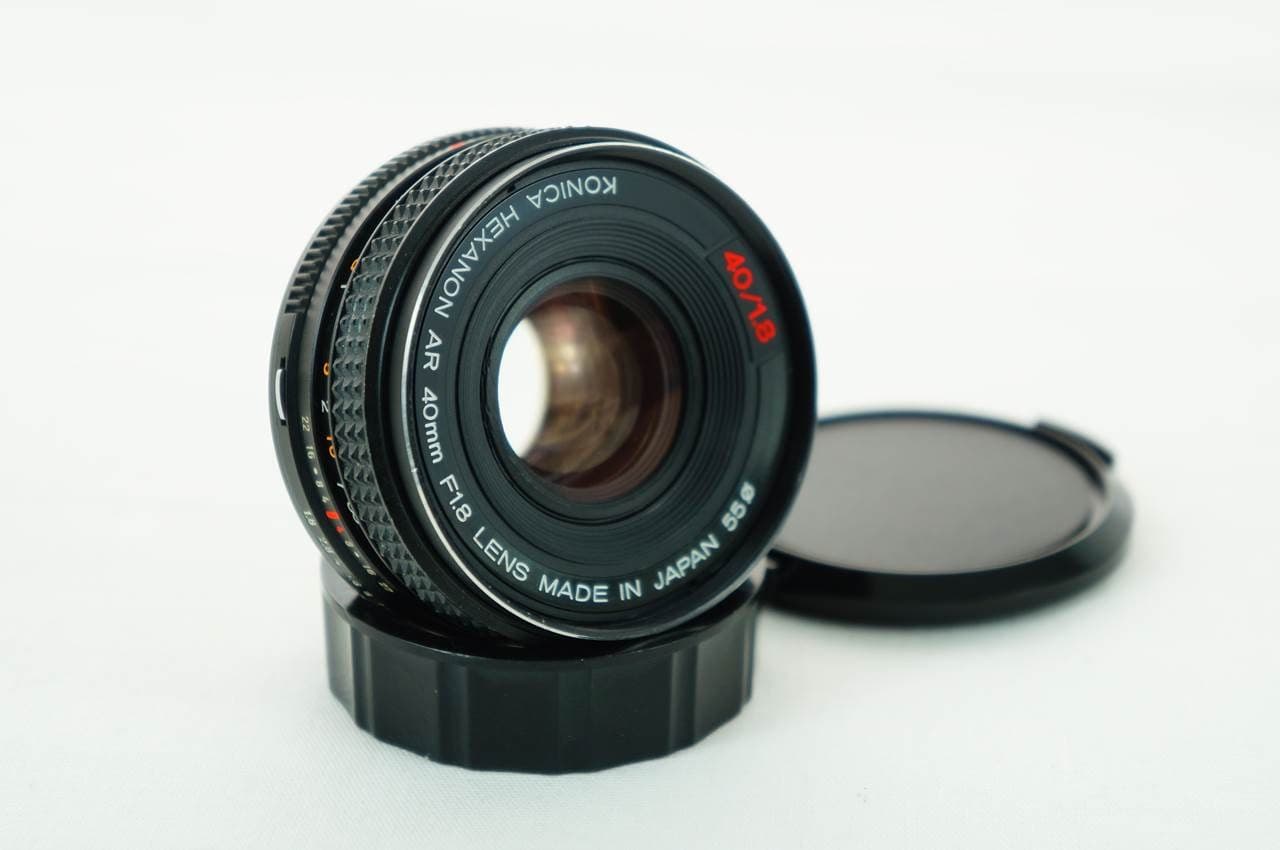
The Konica Hexanon AR 40mm f/1.8 is a pancake standard lens that was shipped as a kit lens with Konica SLR cameras during a couple of years in the mid and late 1970s. Although it is not a true wide-angle lens, its 40mm focal length is slightly wider than a normal 50mm, which many photographers find helpful for street photography as it includes more of the environment from the same camera-to-subject distance while avoiding the perspective distortion of a faster 35mm lens. When it was introduced, some photography magazines reportedly considered it among the sharpest lenses of its time, though there is no hard proof of that claim. Today it enjoys a cult following largely because it can be found very cheaply (around $20-30), is genuinely compact, and adapts beautifully to modern mirrorless bodies like the Nikon Z6/Z7 and Fuji cameras. No established nicknames or community jargon for this specific lens are evidenced in the reviews.
Verdict: The Konica Hexanon AR 40mm f/1.8 is a cheap, compact, and characterful pancake standard lens ideal for street and everyday shooters who want a classic 40mm rendering with smooth wide-open bokeh and lovely color. It rewards shooting at f/1.8 or stopped down for sharpness, but its busy, jagged bokeh at intermediate apertures and awkward aperture ring are its main compromises. For the price, it's an easy recommendation for adapting to mirrorless.
Smooth and bubble-like at f/1.8 with strong subject separation, but becomes busy with jagged aperture edges at f/2.8 and f/4.
Lovely, pleasing color rendering.
Sharpness is 'ok' wide open at f/1.8 and improves stopped down to f/5.6-f/8.
A little prone to flare, though it can have artistic value.
The Konica Hexanon AR 40mm f/1.8 is a cheap, compact, and characterful pancake standard lens ideal for street and everyday shooters who want a classic 40mm rendering with smooth wide-open bokeh and lovely color. It rewards shooting at f/1.8 or stopped down for sharpness, but its busy, jagged bokeh at intermediate apertures and awkward aperture ring are its main compromises. For the price, it's an easy recommendation for adapting to mirrorless.