Production
1977 – 1999
Country
Soviet Union
Optical
6 elements in 4 groups
Updated
Jul 4, 2026
M42 · 58mm · f/2
Production
1977 – 1999
Country
Soviet Union
Optical
6 elements in 4 groups
Updated
Jul 4, 2026
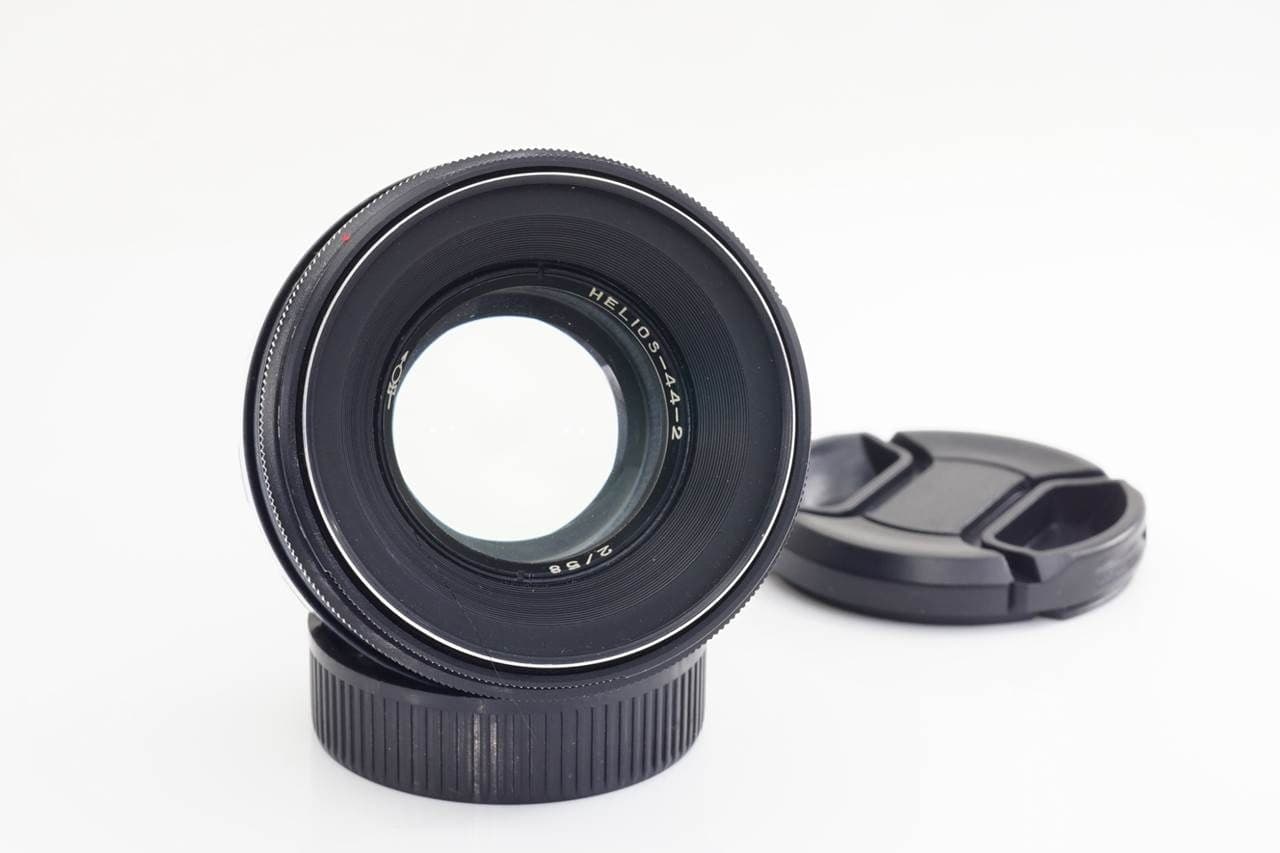
The Helios-44 family is one of the most mass-produced and recognizable vintage optics ever made. The line originated in 1958 as a Soviet copy of the German Carl Zeiss Biotar 58mm f/2 design, produced initially by the Krasnogorskiy Mechanical Factory (KMZ) and later by other manufacturers such as MMZ and Jupiter—a production span that stretched all the way to 1999 across all variants, made across the Soviet Union in various forms and mounts. It was mass-produced for the various Zenit SLR bodies it originally shipped with, and it's quite possible to find one attached to an old Zenit camera lying in an attic. Because of this, the lens is fairly easy and inexpensive to find, and it's often recommended as the first lens for photographers interested in classic lenses. The 44M-4 variant emerged in the late 1970s as a generational update with a 6-element-in-4-group construction, a single clicked aperture ring, and an automatic diaphragm—a refinement over older preset-aperture models like the 44-2. The community refers to its most famous trait as 'swirly' bokeh, and reviewers describe the lens as 'A King Of Character.' People love it because, despite being inexpensive and non-radioactive, it produces striking, large, swirling bokeh and surprising character, making it an excellent starting point for a vintage lens collection. Reviewers note that later versions are said to have more resolving power, but in practice early versions seem to be better, with the earlier versions rendering closest to the original Biotar.
Verdict: The Helios-44 is the definitive entry point into vintage character lenses: cheap, plentiful, non-radioactive, and capable of striking swirly bokeh with surprising center sharpness. It is for the photographer who values character, mood, and idiosyncrasy over clinical perfection—those chasing edge-to-edge sharpness need not apply. Accept its sample variation, shoddy tolerances, and flare, and it rewards you as a true 'King of Character.'
Large, swirling bokeh is its most distinctive feature, most pronounced on full-frame and requiring a specific mix of background, distance, highlights, and focus.
Center sharpness is decent to surprisingly good, but edge and corner performance is poor on full-frame.
Flares excessively compared to modern lenses; the plain-coated 44M-4 is more flare-prone than later multi-coated siblings.
The Helios-44 is the definitive entry point into vintage character lenses: cheap, plentiful, non-radioactive, and capable of striking swirly bokeh with surprising center sharpness. It is for the photographer who values character, mood, and idiosyncrasy over clinical perfection—those chasing edge-to-edge sharpness need not apply. Accept its sample variation, shoddy tolerances, and flare, and it rewards you as a true 'King of Character.'