Production
1962 – 1979
Country
East Germany
Optical
Anastigmatic triplet (Cooke triplet type), 3 elements in 3 groups.
Updated
Jul 4, 2026
Exakta (also available in M42/Praktica/Pentacon mounts) · 50mm · f/2.8
Production
1962 – 1979
Country
East Germany
Optical
Anastigmatic triplet (Cooke triplet type), 3 elements in 3 groups.
Updated
Jul 4, 2026
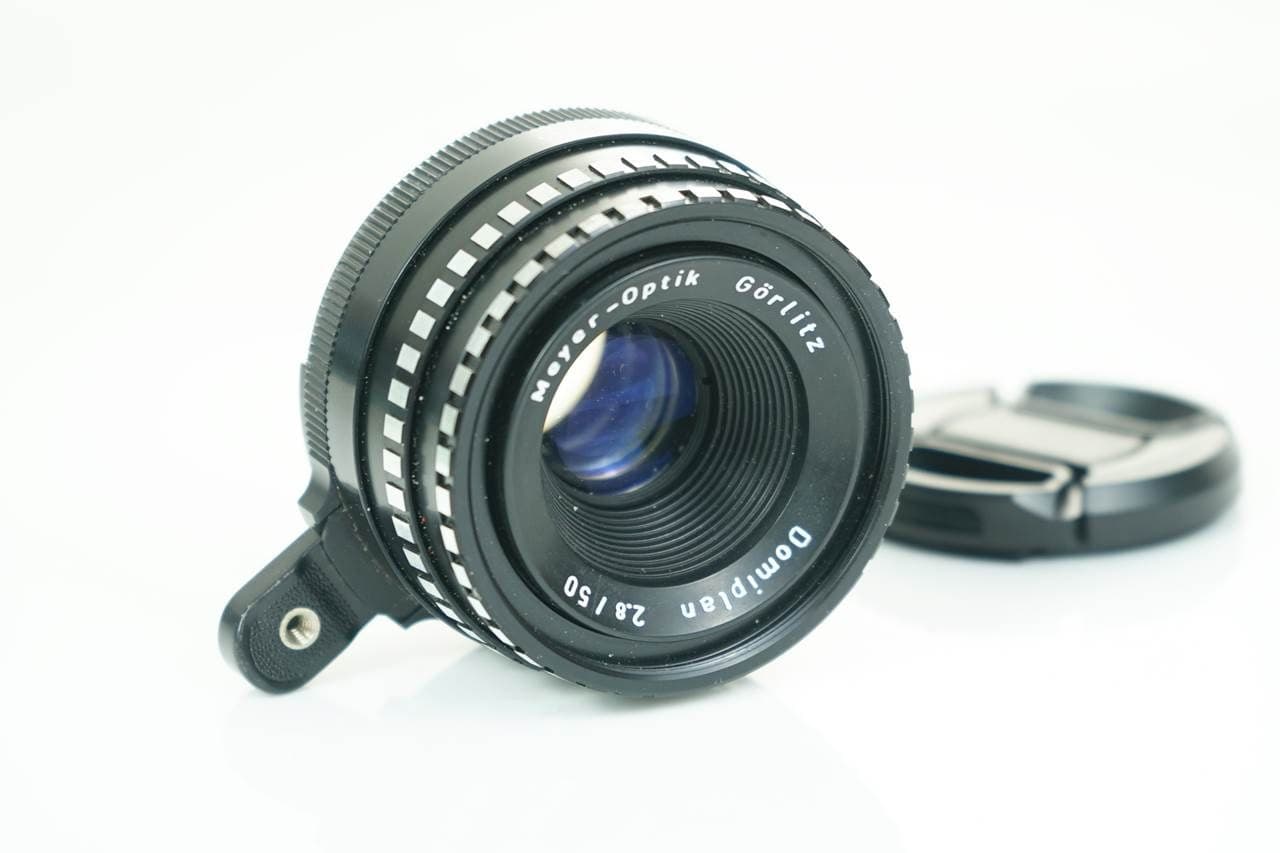
The Meyer-Optik Görlitz Domiplan 50mm f/2.8 was developed in East Germany as a deliberately inexpensive standard lens. According to Meyer-Optik's own 1960 brochure, it was designed to combine 'the advantages of the modern lens mount and the fully automatic pressure diaphragm with an extremely inexpensive three-lens construction' — a classic anastigmatic triplet of the 'proven triplet type.' It served as the standard kit lens on EXA II cameras and was also bundled with many EXA I and Praktica bodies. Produced roughly from 1962 to 1979, the lens is best known in the vintage community for its so-called 'Soap Bubble bokeh,' a term the reviews explicitly use to describe its rounded, defined out-of-focus highlights. Despite being widely dismissed as cheap and simple, it has gained a genuine cult following: it's ultra-cheap (around $20 on average), fun, and characterful, and its very optical flaws become creative features — especially in close-up work with extension tubes. Opinions are polarized; some love it for its sharpness and bokeh, others find it merely average.
Verdict: The Meyer-Optik Görlitz Domiplan 50mm f/2.8 is a cheap, simple East German triplet that is unapologetically a budget lens — but that's exactly its charm. It's for experimental shooters, collectors, and close-up enthusiasts who want distinctive 'Soap Bubble' bokeh and a characterful vintage look at almost no cost. If you demand sharpness and build quality, look elsewhere; if you embrace its flaws as creative tools, it's a genuinely fun lens.
Celebrated 'Soap Bubble' bokeh producing defined, bubble-like out-of-focus highlights, especially prized in close-up work.
Soft wide open at f/2.8 with edge blur; center sharpens significantly at f/8 to f/11.
Low contrast wide open, improving as the lens is stopped down.
The Meyer-Optik Görlitz Domiplan 50mm f/2.8 is a cheap, simple East German triplet that is unapologetically a budget lens — but that's exactly its charm. It's for experimental shooters, collectors, and close-up enthusiasts who want distinctive 'Soap Bubble' bokeh and a characterful vintage look at almost no cost. If you demand sharpness and build quality, look elsewhere; if you embrace its flaws as creative tools, it's a genuinely fun lens.