Production
1970
Country
-
Optical
7 elements in 7 groups
Updated
Jul 4, 2026
Olympus OM · 28mm · f/3.5
Production
1970
Country
-
Optical
7 elements in 7 groups
Updated
Jul 4, 2026
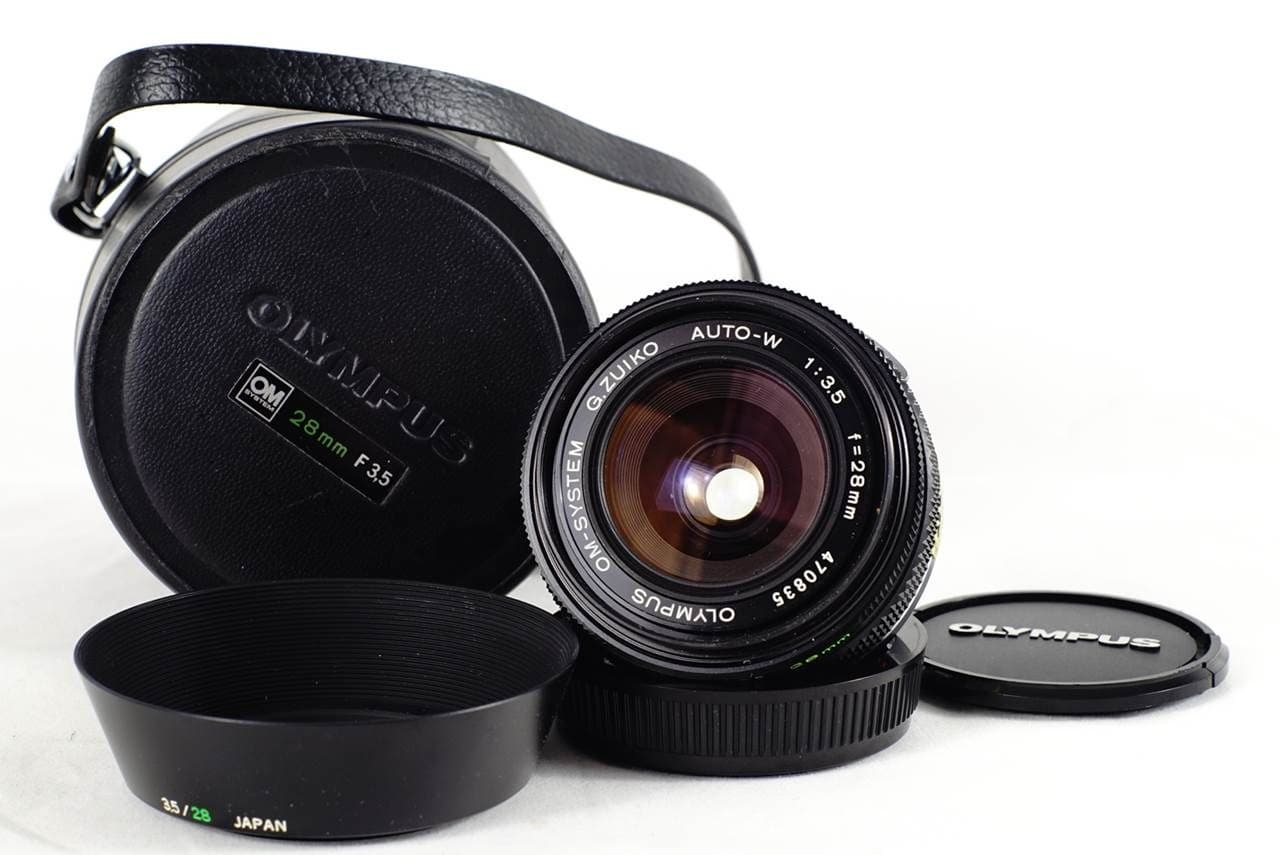
The Olympus OM 28mm f/3.5 is a budget wide-angle prime designed for the Olympus OM SLR system, a lineup that emerged in the 1970s built around the philosophy of compactness and light weight. Reviewers consistently emphasize the tiny dimensions and low weight of the lens: one source lists it at just 180 grams with a length of only 31mm, making it one of the smallest wide-angles in its class. It uses a seven elements in seven groups optical formula (per one source) and single coatings, which is notable given its era. No established nicknames or community jargon (like 'Bokeh Monster' or similar) appear in the reviews, so none are claimed here. Its cult following, such as it is, stems from being an inexpensive, remarkably sharp, and pocketable classic Zuiko wide-angle. Reviewers describe falling in love with it, comparing it favorably to the SMC Pentax 28mm f/3.5 and Zeiss 28mm f/2.8—noting it is no less sharp than those, and lighter, though its single coating makes it more flare-prone. It has become a favorite for hikers, street shooters, and vintage-glass adapters on mirrorless bodies who want a light, sharp, affordable wide-angle.
Verdict: The Olympus OM 28mm f/3.5 is a tiny, sharp, affordable vintage wide-angle that punches well above its price. It's ideal for landscape and street shooters who value compactness and edge-to-edge sharpness over speed, and who don't mind managing flare from its single coatings. If you want a light, honest, high-quality wide-angle to adapt to mirrorless or shoot on film, it's a genuine bargain—just accept the slow aperture and unremarkable bokeh.
Not creamy or a highlight; separates subjects in environmental shots but unremarkable, with bokeh fringing past f/5.6.
Accurate color rendition with natural saturation; vibrant in daylight.
Impressive center sharpness even wide open; corners snap into focus by f/8 with excellent sharpness at f/5.6.
Susceptible to flare due to single coatings, causing color shift and loss of contrast, though a hood helps.
Strong contrast across apertures, excellent at f/5.6, though flare can reduce it in bright conditions.
Minimal; not noticeable on APS-C, full-frame behavior unknown.
The Olympus OM 28mm f/3.5 is a tiny, sharp, affordable vintage wide-angle that punches well above its price. It's ideal for landscape and street shooters who value compactness and edge-to-edge sharpness over speed, and who don't mind managing flare from its single coatings. If you want a light, honest, high-quality wide-angle to adapt to mirrorless or shoot on film, it's a genuine bargain—just accept the slow aperture and unremarkable bokeh.