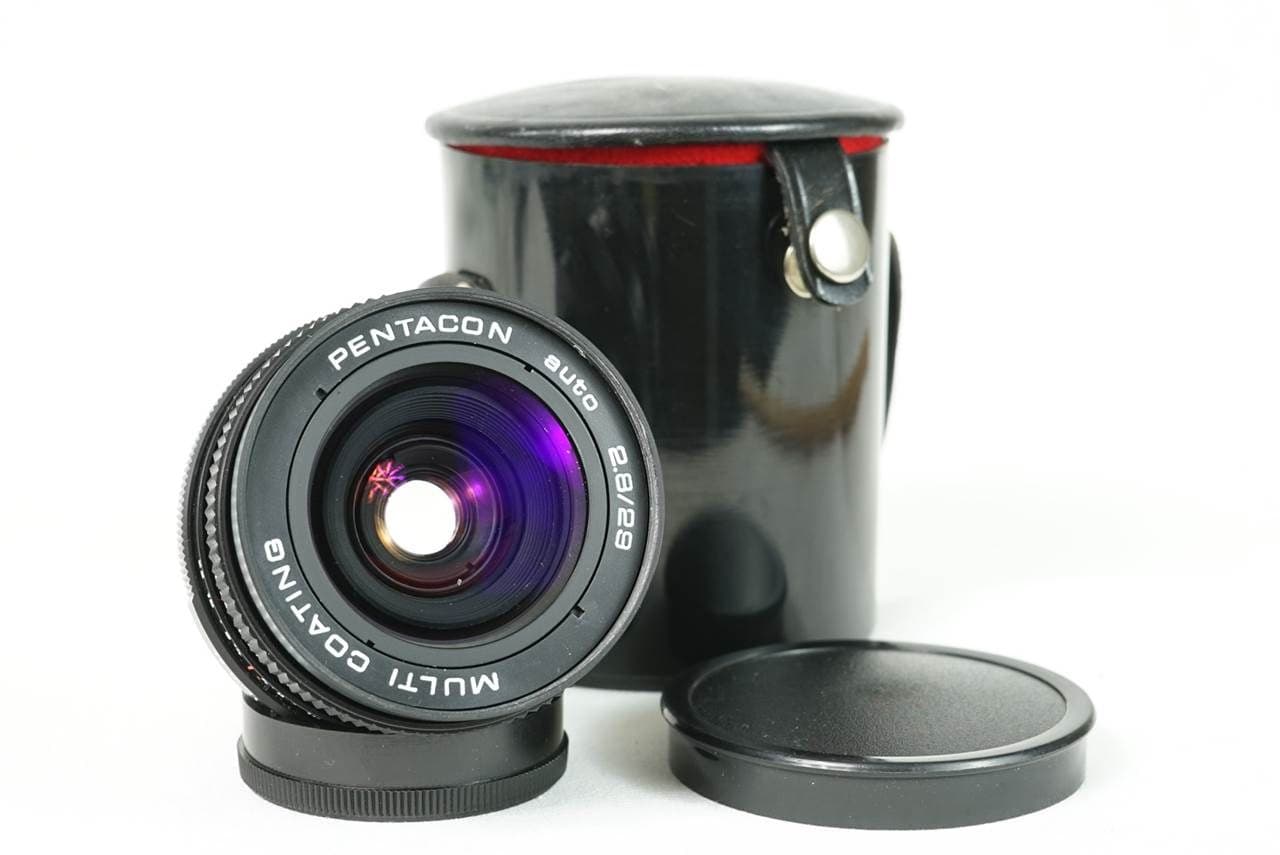
Production
-
Country
East Germany (GDR)
Optical
Derived from the Meyer-Optik Görlitz Orestegon (28mm update of the Orestegon 28mm f/2.9).
Updated
Jul 4, 2026
M42 · 28mm · f/2.8
Production
-
Country
East Germany (GDR)
Optical
Derived from the Meyer-Optik Görlitz Orestegon (28mm update of the Orestegon 28mm f/2.9).
Updated
Jul 4, 2026
The Pentacon 28mm f/2.8 traces its lineage to East German optics: the reviews and databases here document a closely related family produced by VEB Pentacon Dresden (Feinoptisches Werk Görlitz). The most thoroughly reviewed sibling, the Pentacon MC Auto 29mm f/2.8 (M42), was produced in the GDR from roughly 1970 to 1991 and derived from the Meyer-Optik Görlitz Orestegon design. A parallel Prakticar 28mm f/2.8 MC (bayonet B mount) is described as an update of the Orestegon 28mm f/2.9, manufactured from 1971 to 1991. The 28mm f/2.8 name appears across both M42 (Praktica/Pentacon) and later Prakticar B-mount bodies, the latter now part of what enthusiasts jokingly call the 'Dead Lens Mount Club' because the Prakticar B bayonet has no modern camera home. The lens has a genuine cult following as an affordable, character-rich vintage wide-angle. On related-model forums it has earned the nickname 'bokeh monster' for its gorgeous out-of-focus rendering, and swirly bokeh is frequently discussed (though community testing notes that focal reducers/speedboosters on APS-C can accentuate that swirl, so it may not be an accurate representation of the lens's native behavior on full frame). People love it because it is cheap, adapts easily via M42, and delivers a soft, vintage look that stops down to respectable sharpness.
Verdict: A budget-friendly, character-rich East German wide-angle for photographers exploring vintage glass. If you value swirly, 'bokeh monster' rendering and a soft vintage look over clinical sharpness, it delivers—especially stopped down to f/5.6–f/8. Choose the M42 version for easy adaptation and be mindful that focal reducers exaggerate its signature swirl.
Swirly and 'gorgeous,' earning a 'bokeh monster' reputation, though the pronounced swirl in samples may be exaggerated by focal reducers on APS-C.
Modest and slightly soft wide open, improving significantly stopped down to f/5.6–f/8.
Multi-coated glass noted for improved contrast versus earlier single-coated Orestegon designs.
A budget-friendly, character-rich East German wide-angle for photographers exploring vintage glass. If you value swirly, 'bokeh monster' rendering and a soft vintage look over clinical sharpness, it delivers—especially stopped down to f/5.6–f/8. Choose the M42 version for easy adaptation and be mindful that focal reducers exaggerate its signature swirl.