Production
1958 – 1975
Country
Japan
Optical
6 elements in 5 groups
Updated
Jul 4, 2026
M42 screwmount · 55mm · f/2
Production
1958 – 1975
Country
Japan
Optical
6 elements in 5 groups
Updated
Jul 4, 2026
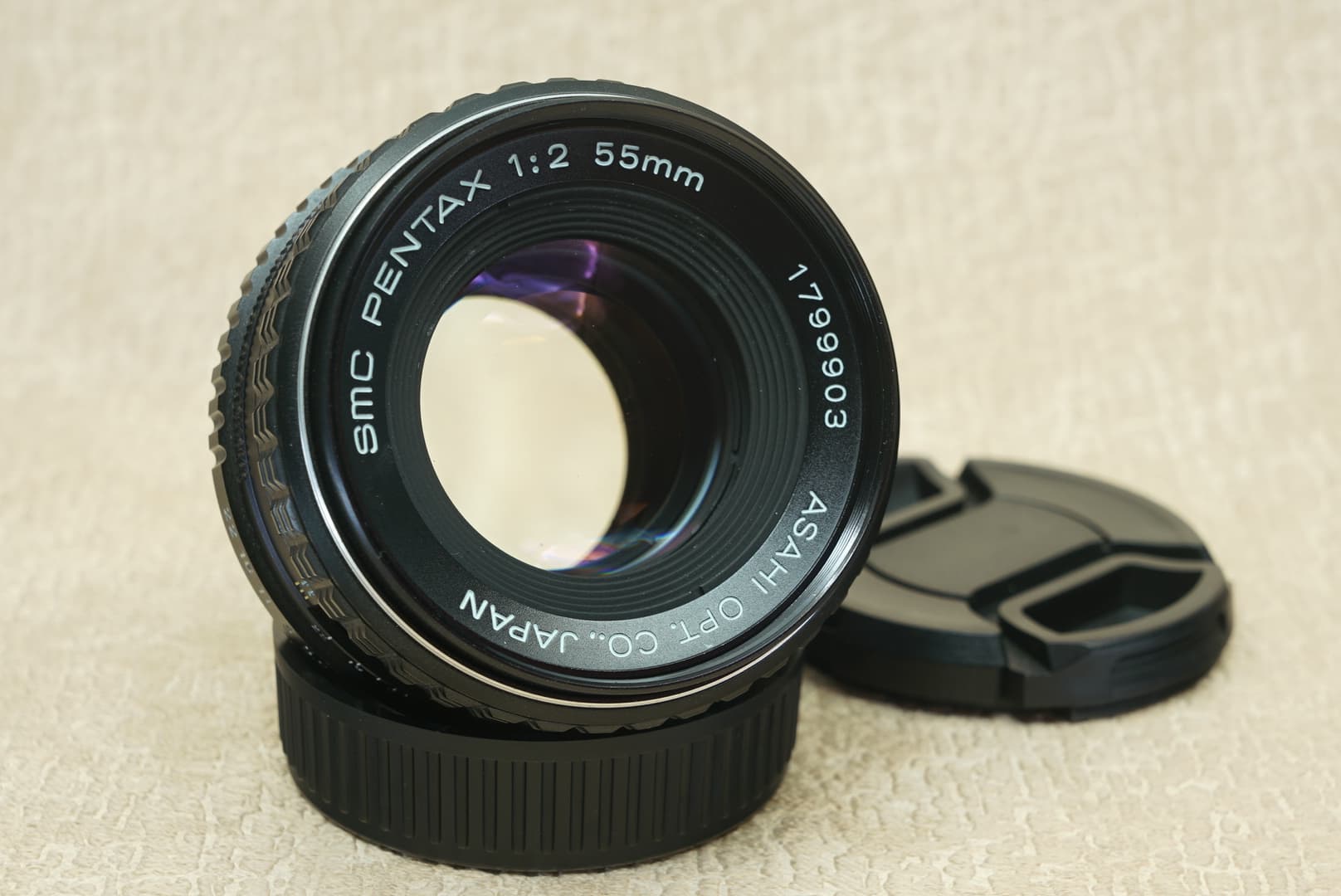
The Auto-Takumar, Super-Takumar, and SMC Takumar 55mm f/2 form a family of classic M42-mount standard primes produced by Asahi Optical Co. from the late 1950s through the mid-1970s. According to the reviews, they were often overshadowed by their faster f/1.8 and f/1.4 siblings, yet remained beloved for their compact size, smooth rendering, and vintage character. All versions share a 6-element/5-group optical formula, with coatings and mechanics evolving over time: the Auto-Takumar (1958-1959) used a semi-automatic diaphragm with a 10-blade aperture, the Super-Takumar (1962-1974) moved to a fully automatic diaphragm with 6 blades, and the SMC Takumar (1972-1975) added Super-Multi-Coating for improved flare resistance and contrast. They were typically bundled with Asahi Spotmatic bodies (and cameras like the Pentax Asahi SV) and remain fully compatible with modern digital cameras via M42 adapters. No specific nicknames are established for this lens in the reviews; while jargon exists for other Takumars, none is documented here for the 55mm f/2. People love it for its all-metal build, buttery long-throw focus, and a gentle, classic rendering that flatters portraits and everyday scenes.
Verdict: The Pentax Takumar 55mm f/2 is a compact, beautifully built M42 standard prime for photographers who value tactile handling and gentle, classic rendering over raw speed. Though overshadowed by its faster f/1.8 and f/1.4 siblings, it rewards users with crisp center sharpness, smooth bokeh, and a subtle vintage glow wide open, all at a very affordable price. It's an ideal choice for film shooters learning deliberate photography and for mirrorless users seeking a characterful, distinctive portrait or video lens.
Smooth, rounded, and unobtrusive out-of-focus rendering, pleasant and creamy in a classic, restrained way with no swirl or bubble effects.
Crisp center sharpness wide open, becoming impressively crisp when stopped down; corner details not documented.
Earlier single-coated versions can lose contrast facing the sun; the SMC version added Super-Multi-Coating for improved flare resistance.
Gentle/pleasant contrast wide open; clean and precise stopped down, with the SMC version improving contrast over earlier versions.
The Pentax Takumar 55mm f/2 is a compact, beautifully built M42 standard prime for photographers who value tactile handling and gentle, classic rendering over raw speed. Though overshadowed by its faster f/1.8 and f/1.4 siblings, it rewards users with crisp center sharpness, smooth bokeh, and a subtle vintage glow wide open, all at a very affordable price. It's an ideal choice for film shooters learning deliberate photography and for mirrorless users seeking a characterful, distinctive portrait or video lens.