Production
1958 – 1975
Country
Japan
Optical
6 elements in 5 groups, shared across all M42 variants.
Updated
Jul 4, 2026
M42 screwmount · 55mm · f/1.8
Production
1958 – 1975
Country
Japan
Optical
6 elements in 5 groups, shared across all M42 variants.
Updated
Jul 4, 2026
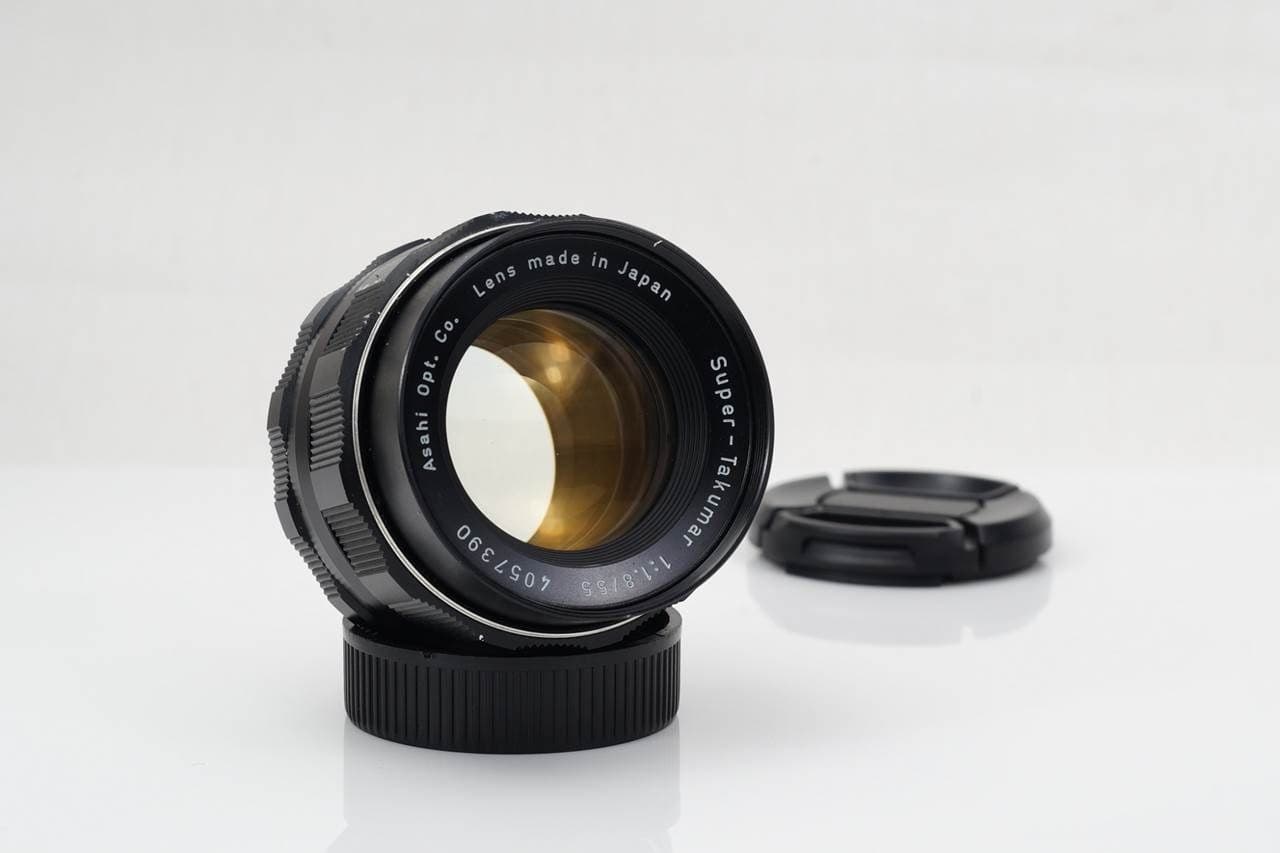
The Takumar 55mm f/1.8 was produced by the Asahi Optical Co. (later known as Pentax, now a subsidiary of Ricoh) in Japan. Asahi Optical was founded by Kumao Kajiwara, who named the Takumar line after his brother, the painter Takuma Kajiwara. According to the reviews, the lens existed in multiple M42 screw-mount variants produced from 1958 to 1975, all sharing the same 6-element/5-group optical formula. It began as the simple 'Takumar 55mm F1.8' in the late 1950s, evolving through Auto-Takumar, Super-Takumar, Super-Multi-Coated (S-M-C) Takumar, and finally SMC Takumar versions, and was frequently bundled with cameras like the Asahi Pentax SV and the Spotmatic. The Super-Takumar 55mm f/1.8 specifically was released in 1962 as a set lens for the Pentax SV. The reviews note it is often called 'radioactive' because at least one glass element (from the 1965 version onward) uses thorium glass, which yellows over time — a yellowing that can be reduced by exposing the lens to ultraviolet light (sunlight). It enjoys a cult following partly because of its extreme affordability, solid build, pleasing rendering, and vintage character. One reviewer notes it is arguably the most popular vintage lens in Japan today, ranking just behind the Helios 44-2 in Instagram popularity, and is widely recommended for beginners entering vintage lens photography. No coined nickname beyond the descriptive 'radioactive' is evidenced in these reviews.
Verdict: The Takumar 55mm f/1.8 is one of the best-value entry points into vintage lens photography. Inexpensive, superbly built, and full of character, it delivers beautiful bokeh and a charming nostalgic flare that make it beloved among beginners and enthusiasts alike — especially in Japan, where it ranks among the most popular vintage lenses. It's not sharp wide open and struggles with bright light, but stopped down to f/2-f/2.8 it produces lovely results. Ideal for anyone wanting an affordable, characterful standard prime for portraits, low-light, and film shooting, provided they accept its vintage quirks like softness wide open and possible thorium yellowing.
Beautiful, pleasing bokeh that renders busy backgrounds smoothly, though slightly less creamy than an f/1.4 lens.
Unknown, though thorium-glass versions commonly develop a yellow cast reducible with UV exposure.
Not very sharp wide open with bluish fringing and softer corners, improving noticeably stopped down to f/2 or f/2.8.
Flares readily with a nostalgic, photogenic character; struggles with bright light even with a hood.
Prone to reduced contrast in bright light and backlit conditions.
The Takumar 55mm f/1.8 is one of the best-value entry points into vintage lens photography. Inexpensive, superbly built, and full of character, it delivers beautiful bokeh and a charming nostalgic flare that make it beloved among beginners and enthusiasts alike — especially in Japan, where it ranks among the most popular vintage lenses. It's not sharp wide open and struggles with bright light, but stopped down to f/2-f/2.8 it produces lovely results. Ideal for anyone wanting an affordable, characterful standard prime for portraits, low-light, and film shooting, provided they accept its vintage quirks like softness wide open and possible thorium yellowing.