Production
1962 – 1979
Country
East Germany (DDR)
Optical
Cooke triplet, 3 elements in 3 groups
Updated
Jul 4, 2026
Exakta · 50mm · f/2.8
Production
1962 – 1979
Country
East Germany (DDR)
Optical
Cooke triplet, 3 elements in 3 groups
Updated
Jul 4, 2026
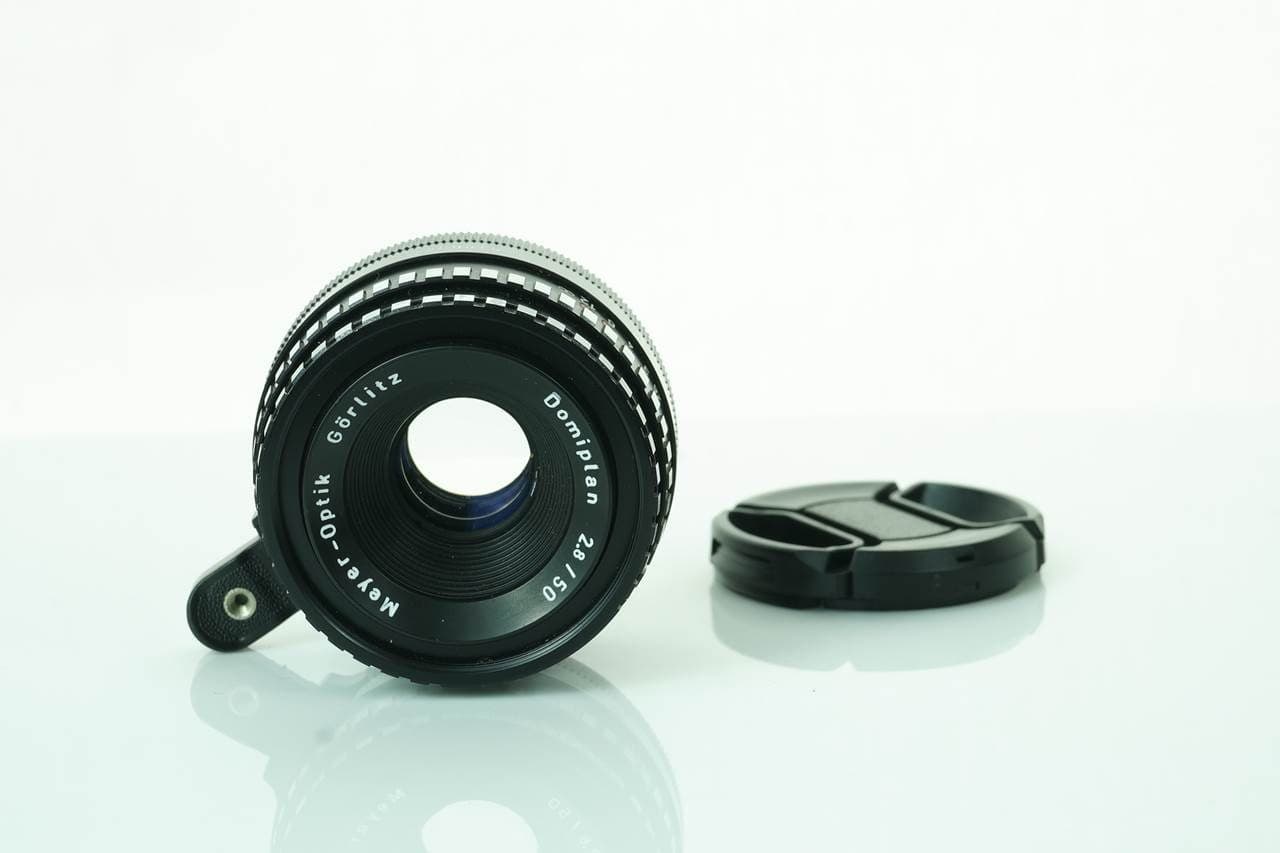
The Meyer-Optik Görlitz Domiplan 50mm f/2.8 is a classical anastigmatic triplet lens produced in East Germany. According to the manufacturer's 1960 brochure, it was designed as an 'inexpensive three-lens anastigmat of the proven triplet type,' combining a modern lens mount and a fully automatic pressure diaphragm with an extremely inexpensive three-lens construction. It served as the standard kit lens on EXA II cameras and was also bundled with many EXA I and Praktica cameras. Originally manufactured by Meyer Optik, production was later taken over by Pentacon in East Germany, which reportedly led to individual differences in quality and a controversial reputation. The pentaxforums database dates production from roughly 1962 to 1979. It has no established nickname, but it is frequently grouped among the 'Soap Bubble Bokeh' lenses due to its triplet design, sharing that trait with its more famous stablemate, the Trioplan. Despite being explicitly a cheap and simple lens from the start, it has gained a cult following for its quirky bokeh, vintage rendering, and ultra-low cost, with 88% of pentaxforums reviewers recommending it.
Verdict: The Meyer-Optik Görlitz Domiplan 50mm f/2.8 is a cheap, simple East German triplet that punches above its price for one reason: its quirky, sharply-outlined Soap Bubble Bokeh. It is the budget-conscious photographer's shortcut to the Trioplan look, ideal for those who enjoy vintage rendering and experimental bokeh and don't mind fiddly handling, a fragile aperture, and softness wide open. Buy it for creative fun, not for clinical performance.
Known for 'Soap Bubble Bokeh' with well-defined, sharp-outlined bubble highlights, especially with a light source in the frame.
Soft wide open with noticeable edge blur, sharpening significantly at f/8 to f/11, with center better than corners.
Low contrast wide open, improving as the lens is stopped down.
The Meyer-Optik Görlitz Domiplan 50mm f/2.8 is a cheap, simple East German triplet that punches above its price for one reason: its quirky, sharply-outlined Soap Bubble Bokeh. It is the budget-conscious photographer's shortcut to the Trioplan look, ideal for those who enjoy vintage rendering and experimental bokeh and don't mind fiddly handling, a fragile aperture, and softness wide open. Buy it for creative fun, not for clinical performance.