Production
-
Country
East Germany (GDR)
Optical
Retrofocus (reverse-telephoto) wide-angle Flektogon design.
Updated
Jul 15, 2026
M42 · 20mm · f/2.8
Production
-
Country
East Germany (GDR)
Optical
Retrofocus (reverse-telephoto) wide-angle Flektogon design.
Updated
Jul 15, 2026
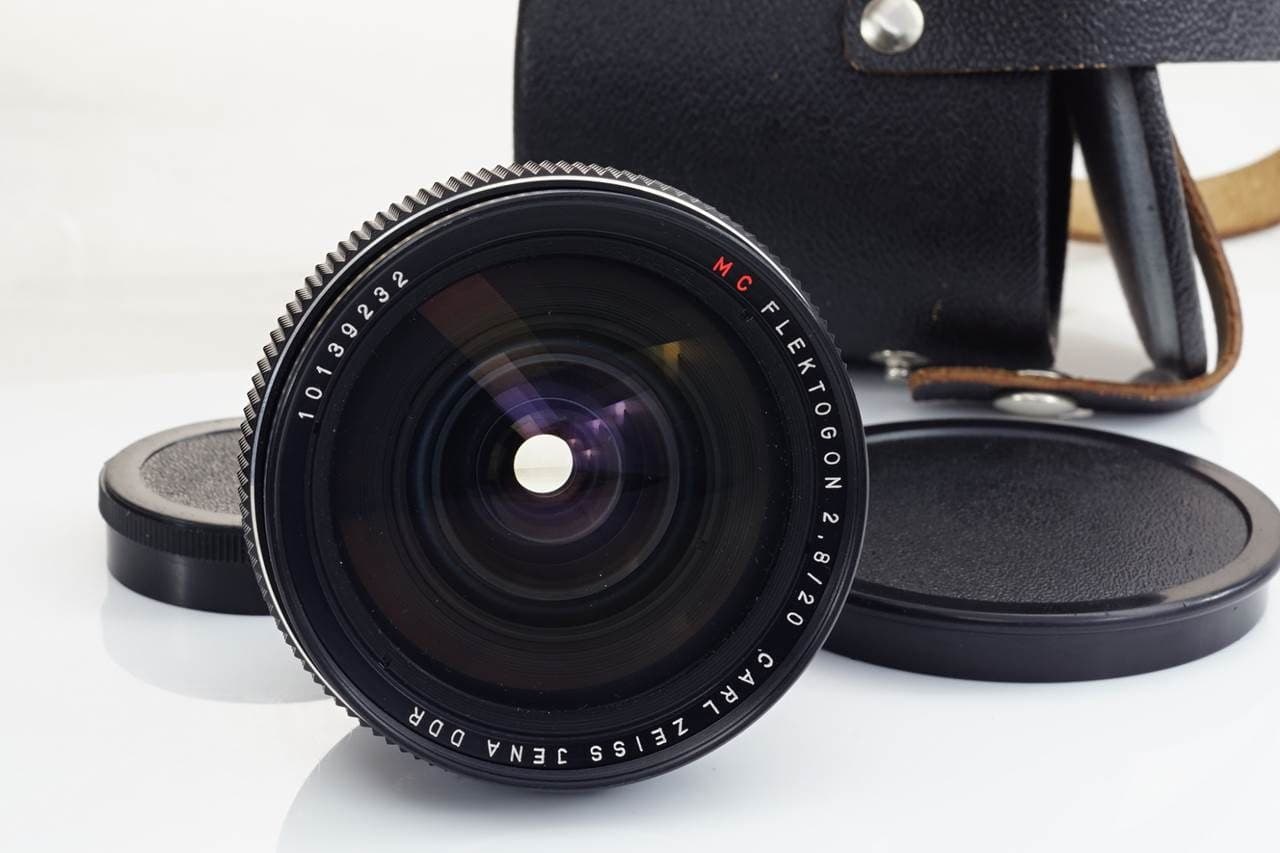
The Carl Zeiss Flektogon 20mm f2.8 is a superwide-angle from Carl Zeiss Jena, made in the DDR (East Germany, the reviews explicitly identify it as 'Carl Zeiss Jena DDR Flektogon'), the successor to the earlier f4 version. The 'Flektogon' name marks it as a retrofocus (reverse-telephoto) wide-angle design, which is what allowed such a wide field of view to clear an SLR mirror on the M42 screw mount. One reviewer's copy was manufactured in 1976, placing it firmly in the classic Jena era of all-metal-and-glass construction that reviewers describe as 'almost indestructible.' It earned a devoted following among adapted-lens shooters for two reasons the reviews make plain: it is exceptionally well-corrected for distortion for such a wide focal length (a rarity that made photographers hunt specifically for it), and it is strikingly sharp even wide open at f2.8 — sharp enough that one reviewer recommends it over the slower f4 sibling specifically for astrophotography. No established nickname or jargon term for this lens appears in the provided reviews, so none is asserted here.
Verdict: A precision superwide for photographers who value optical correctness over character effects: near-distortion-free geometry, saturated colour, and biting sharpness that holds even wide open. It's the pick for landscape, architecture, and especially astrophotography — anyone who needs a trustworthy 20mm that performs at f2.8. Bokeh chasers and those wanting swirl or glow should look elsewhere; if you mostly shoot stopped down on a tripod, the cheaper f4 sibling nearly matches it, so the f2.8 earns its premium chiefly for its wide-open ability.
Only moderately rated; acceptable but not standout out-of-focus rendering with no swirl, bubbles, or glow.
Saturated yet faithful rendering, described as 'fine' and rich colours.
Sharp even wide open at f2.8 including corners, holding through the range, with f8 a sweet spot.
Susceptible to veiling glare into strong light; a lens hood is needed to preserve contrast.
Good contrast best preserved with a hood, though not quantified by reviewers.
Present wide open but largely cleared by stopping down to f4.
A precision superwide for photographers who value optical correctness over character effects: near-distortion-free geometry, saturated colour, and biting sharpness that holds even wide open. It's the pick for landscape, architecture, and especially astrophotography — anyone who needs a trustworthy 20mm that performs at f2.8. Bokeh chasers and those wanting swirl or glow should look elsewhere; if you mostly shoot stopped down on a tripod, the cheaper f4 sibling nearly matches it, so the f2.8 earns its premium chiefly for its wide-open ability.