Production
1968 – 1983
Country
-
Optical
Catadioptric (mirror) telephoto based on Maksutov astronomical telescope principle.
Updated
Jul 1, 2026
Nikon Non-AI · 500mm · f/8
Production
1968 – 1983
Country
-
Optical
Catadioptric (mirror) telephoto based on Maksutov astronomical telescope principle.
Updated
Jul 1, 2026
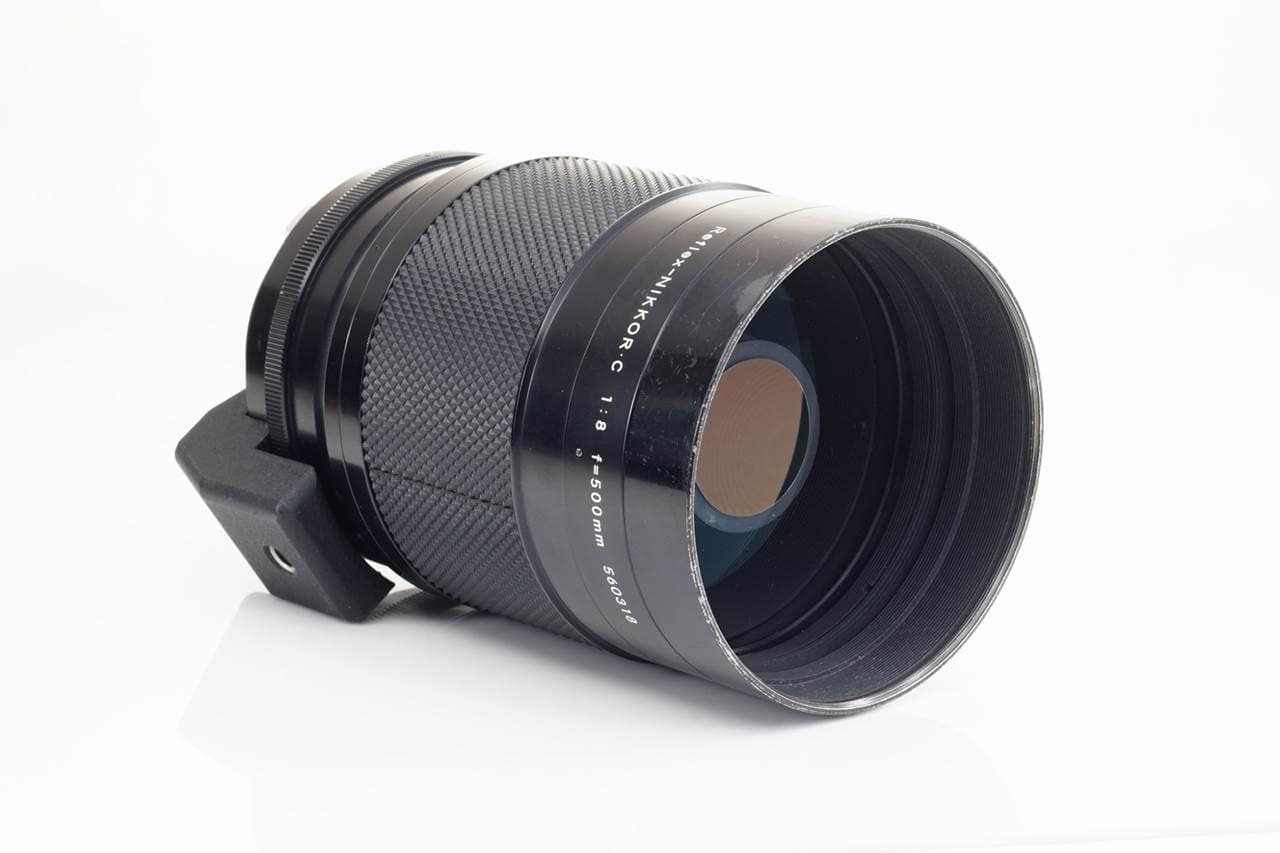
The Nikon 500mm f/8 Reflex-NIKKOR belongs to Nikon's long-running family of catadioptric (mirror) telephotos, which began with the 50cm Reflex-Nikkor of 1961. The design uses a catadioptric ('cat') principle rooted in the work of Russian optical designer Maksutov, who developed it for large astronomical telescopes: light enters through a clear front element, bounces off a large rear mirror, is reflected back off a small mirror on the rear of the front element, and finally passes through a hole in the rear mirror to reach the film or sensor. This folded light path lets Nikon build a 500mm lens that is astonishingly small and light for its focal length. The version covered here is the Non-AI 500mm f/8 Reflex-NIKKOR-C (1968–1983), where the 'C' denotes fully multi-coated optics — a notable feature in its day. It was later superseded by the smaller 500mm f/8 N (1983–2005), which focused even closer and gained a macro/close-focus range. Roughly 32,000 units of the later Ai/N version were produced during its long run. Reviewers note these lenses are extremely common secondhand precisely because photographers keep buying them, discovering how hard they are to use, and reselling them. No established nickname or community jargon is evidenced in the reviews. The lens's cult following, such as it is, rests on its incredible reach-to-weight ratio, its bargain price (typically around $300 used), and its distinctive rendering — for landscape, moon shots, and even use as a telescope with the Nikon Lens Scope Converter.
Verdict: The Nikon 500mm f/8 Reflex-NIKKOR is a marvel of compact optical engineering that gives you 500mm of reach in a lens the size and weight of a normal prime — with essentially zero chromatic aberration and genuinely sharp centers. But it demands a lot: it's low in contrast, effectively f/11, prone to a central hot spot and ring-shaped bokeh, and painfully sensitive to vibration and focus error. It is a poor general-purpose photographic tool and a superb specialty lens. Buy it if you want cheap extreme reach, enjoy the mirror-lens aesthetic, and are willing to shoot at high shutter speeds with modern high-ISO or electronic-shutter cameras (and to fix contrast and hot spots in post). Avoid it if you need reliable, easy telephoto results or dislike doughnut bokeh.
Defining doughnut-shaped (ring/annular) bokeh from the central mirror obstruction, either loved or hated.
Not strongly characterized; fully multi-coated 'C' optics noted as a benefit, though low contrast tends to mute the image.
High center sharpness with great central definition but only barely acceptable by modern standards (peak ~31.8 lp/mm on D610), masked by low contrast.
Consistently described as low contrast; the lens is actually sharp but appears less so, requiring contrast added in post.
Distinctive central hot spot with dimming toward the sides, different in character from normal vignetting but simple to fix in post.
The Nikon 500mm f/8 Reflex-NIKKOR is a marvel of compact optical engineering that gives you 500mm of reach in a lens the size and weight of a normal prime — with essentially zero chromatic aberration and genuinely sharp centers. But it demands a lot: it's low in contrast, effectively f/11, prone to a central hot spot and ring-shaped bokeh, and painfully sensitive to vibration and focus error. It is a poor general-purpose photographic tool and a superb specialty lens. Buy it if you want cheap extreme reach, enjoy the mirror-lens aesthetic, and are willing to shoot at high shutter speeds with modern high-ISO or electronic-shutter cameras (and to fix contrast and hot spots in post). Avoid it if you need reliable, easy telephoto results or dislike doughnut bokeh.