Production
2013
Country
China
Optical
6 elements in 6 groups, one aspherical
Updated
Jul 1, 2026
Multiple SLR mounts including Pentax K, Canon EF, Nikon F, and Sony/Minolta A · 85mm · f/1.8
Production
2013
Country
China
Optical
6 elements in 6 groups, one aspherical
Updated
Jul 1, 2026
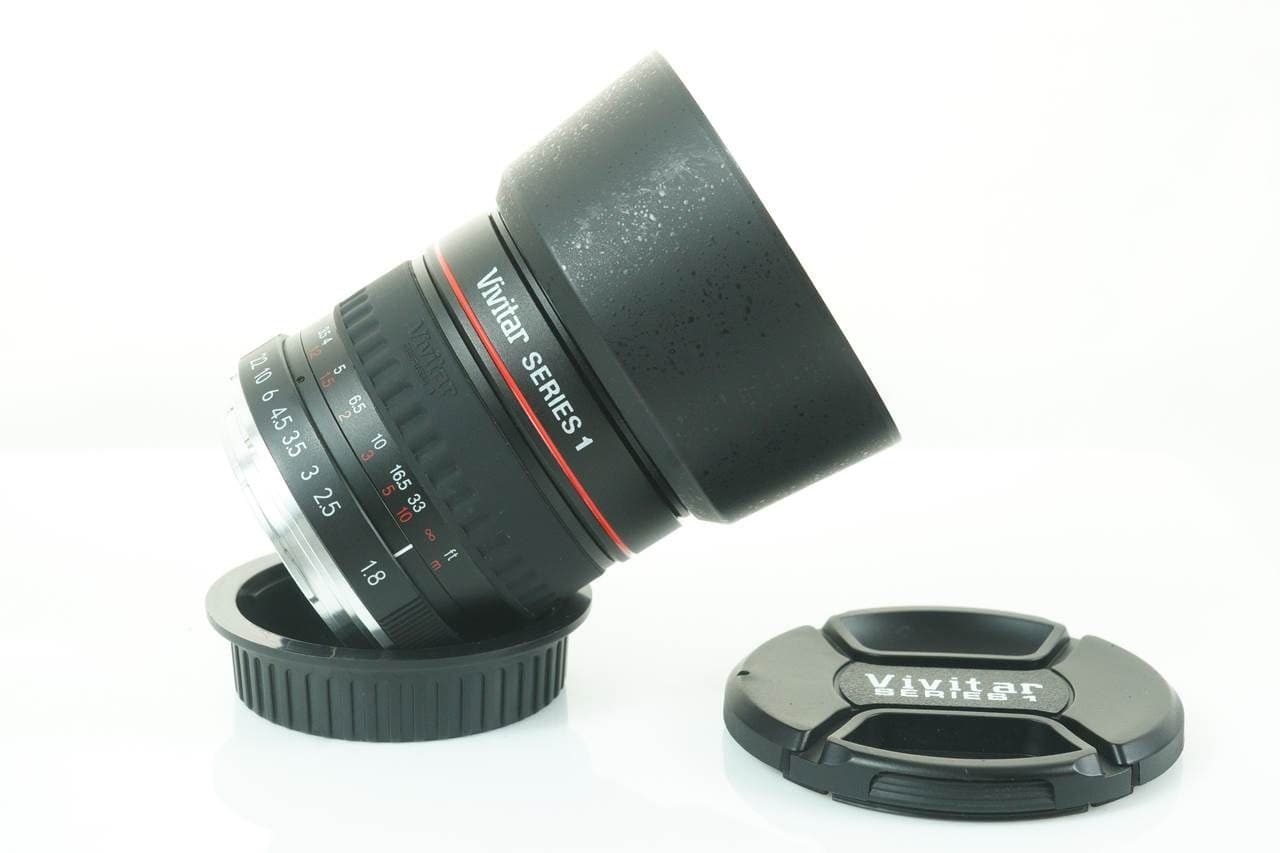
The Vivitar Series 1 85mm F1.8 discussed here represents a notable turning point in Vivitar's history: according to the single detailed user review, this lens 'marked the departure of Vivitar using re-branded Samyang lenses and using a new Chinese manufacturer.' First released in 2013 and made in China, it was offered across most SLR mounts including Pentax K, Canon EF, Nikon F, and Sony/Minolta A. When one reviewer purchased it, there were 'pretty much no reviews on it,' making it something of a gamble at its low price. It has developed a small but appreciative following primarily on value grounds — the reviewer noted that even legacy 85mm lenses sell for a lot more, making this an inexpensive route into fast 85mm portraiture. No established nicknames or community jargon appear in the reviews.
Verdict: This late-production, Chinese-made Vivitar Series 1 85mm F1.8 is a budget-friendly fast portrait lens best suited to photographers who want an inexpensive, compact manual fast 85mm and are willing to accept modest build quality and some wide-open aberrations. It rewards stopping down to f2.8-f4 and offers strong value, but it is a solid performer rather than a character-defining classic.
Bokeh is described as pretty pleasing but nothing amazing, with no swirl or unusual effects.
Sharp wide open at f1.8 with some aberrations that diminish by f2.8 and are essentially gone by f4.
This late-production, Chinese-made Vivitar Series 1 85mm F1.8 is a budget-friendly fast portrait lens best suited to photographers who want an inexpensive, compact manual fast 85mm and are willing to accept modest build quality and some wide-open aberrations. It rewards stopping down to f2.8-f4 and offers strong value, but it is a solid performer rather than a character-defining classic.