Production
1964 – 1982
Country
East Germany
Optical
6 elements in 4 groups (early) or 6 elements in 5 groups (later), Double Gauss.
Updated
Jul 16, 2026
M42 · 50mm · f/1.8
Production
1964 – 1982
Country
East Germany
Optical
6 elements in 4 groups (early) or 6 elements in 5 groups (later), Double Gauss.
Updated
Jul 16, 2026
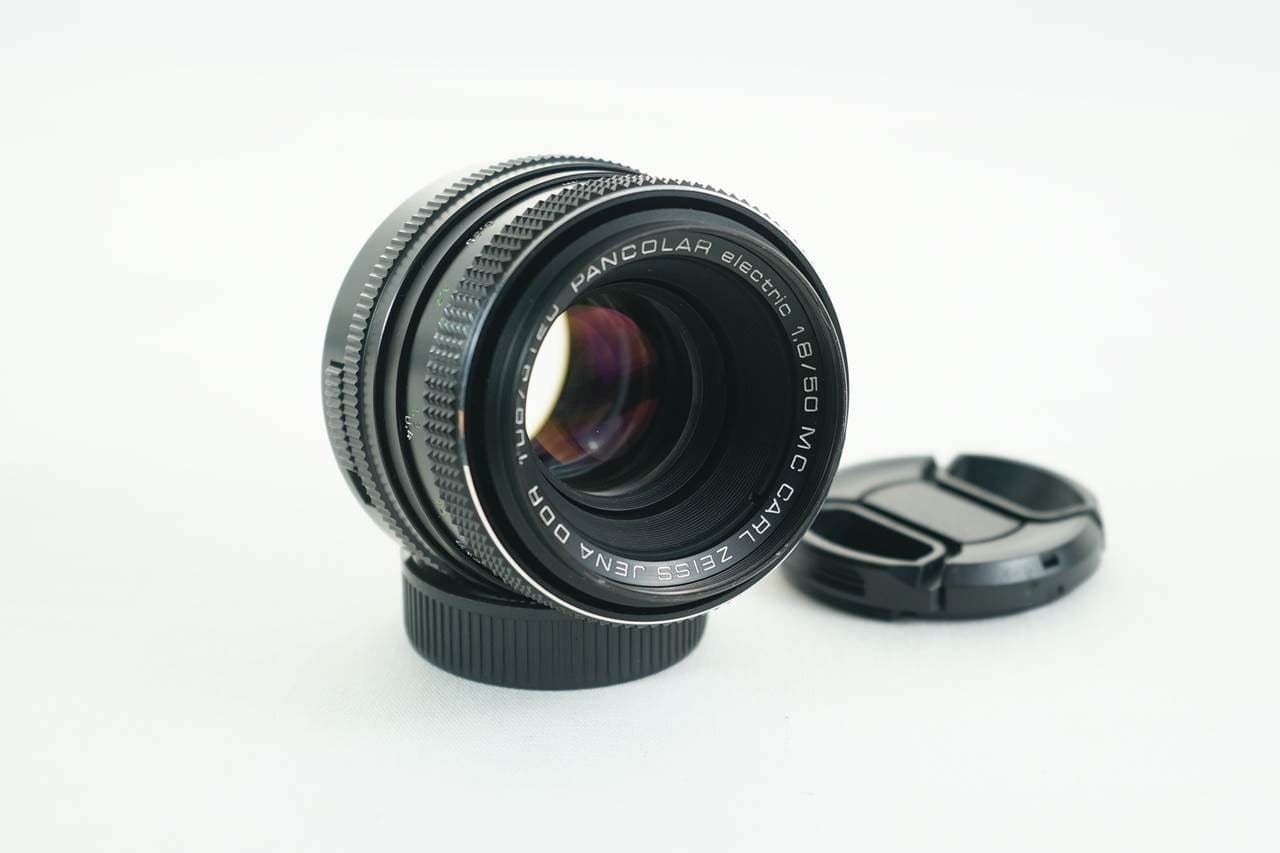
The lens identified as 'Carl Zeiss 50mm f/1.8' in M42 mount corresponds to the Carl Zeiss Jena Pancolar 50mm f/1.8, produced in East Germany between 1964 and 1982 (with production of the family continuing through 1990 per one source). Zeiss Jena had designed the first Pancolar 50mm f/2 in 1960, partly to offer a faster and better-performing alternative to the venerable Tessar 50mm f/2.8. As Japanese competitors began releasing f/1.8 standard primes, Zeiss found it necessary to respond with a lens of similar specification, resulting in the Pancolar 50mm f/1.8 in 1964. It was considered one of the best lenses of its era and remains popular today. Early models (up to 1967, up to serial number 8552600) used a Double Gauss 6-element, 4-group design incorporating high-refractive-index thorium/lanthanum glass, which was mildly radioactive and could develop a yellow hue or slight opacity over time if not exposed to UV light — earning these the 'radioactive' descriptor common to thoriated vintage glass. These early lenses carry the well-known 'zebra' finish (silver/black checkered grip) and typically 8 aperture blades. Later versions switched to safer, more stable, lower-refractive-index glass; to preserve optical quality the formula was revised to a more advanced 6-element, 5-group design, and the blade count was reduced to 6 to save costs. The final black multi-coated (MC) versions are the most refined. Enthusiasts prize it for sharpness, contrast, rich color, and smooth bokeh; the Pentacon 50mm f/1.8 was inspired by it, and it is regarded as a strong step up from the more modest Tessar. The 'zebra' term is an established community label for the checkered-grip finish.
Verdict: The Carl Zeiss Jena Pancolar 50mm f/1.8 is a premium vintage standard prime for M42 shooters who want sharpness, high contrast, rich color, and smooth bokeh in a compact all-metal package. It rewards deliberate manual focusing and suits portraiture and low-light work. Collectors should decide between the character (and caveats) of the early radioactive zebra versions and the cleaner, better-coated later black MC models.
Smooth and pleasing out-of-focus rendering with no swirl or bubble character.
Rich, saturated color rendering, though early thorium-glass zebra copies may show a yellow tint if untreated.
Regarded as sharp across production versions with high reviewer sharpness ratings.
High contrast with notably excellent microcontrast, especially in the multi-coated versions.
Real adapters from our shop that fit this lens mount.
Standard · ฿325 · In stock
Standard · ฿325 · In stock
Standard · ฿325 · In stock
Standard · ฿325 · In stock
Standard · ฿540 · In stock
Standard · ฿540 · In stock
Standard · ฿540 · In stock
Standard · ฿540 · In stock
Standard · ฿540 · In stock
Standard · ฿1,250 · In stock
Standard · ฿890 · Out of stock
Standard · ฿890 · Out of stock
The Carl Zeiss Jena Pancolar 50mm f/1.8 is a premium vintage standard prime for M42 shooters who want sharpness, high contrast, rich color, and smooth bokeh in a compact all-metal package. It rewards deliberate manual focusing and suits portraiture and low-light work. Collectors should decide between the character (and caveats) of the early radioactive zebra versions and the cleaner, better-coated later black MC models.