Production
1966
Country
-
Optical
7 elements in 5 groups (Rokkor-PG)
Updated
Jul 1, 2026
Minolta MD · 58mm · f/1.2
Production
1966
Country
-
Optical
7 elements in 5 groups (Rokkor-PG)
Updated
Jul 1, 2026
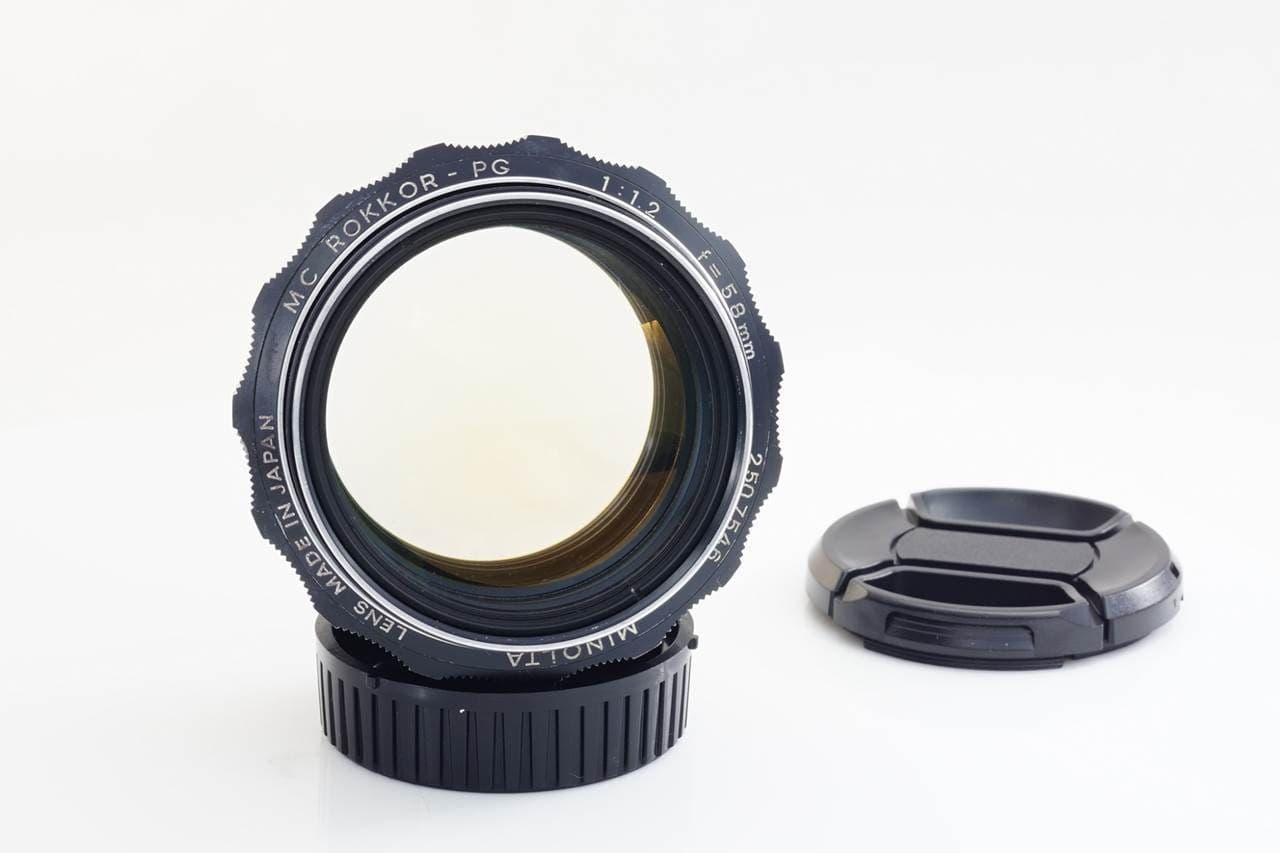
The Minolta MC Rokkor-PG 58mm f/1.2 is arguably Minolta's most famous lens, a super-fast standard prime introduced in 1966 in the SR mount. It shares a single optical design (7 elements in 5 groups) across three mechanically distinct versions produced over its lifetime, with the 'PG' affix referencing the 5-group, 7-element construction. The earliest version (1966-1969) featured a flat all-metal focusing ring and is the rarest of the three; notably, it develops a yellow cast over time, likely due to a radioactive element in its glass. The second version (1969-1973) retained an all-metal ring but with raised elevations, while the third and most common version (from 1973) adopted a rubberized 'waffle' style focusing ring and eventually dropped the PG label. Among enthusiasts the lens has earned the nickname 'Hawkeye,' and it is universally praised for its bokeh and color rendition. Its cult following stems from a distinctive combination: 58mm perspective, a razor-thin depth of field wide open, and a rendering that transitions from dreamy character at f/1.2 to a crisp, high-quality image by f/2. Many owners pay a significant premium for the f/1.2 speed, though reviewers argue its real magic lies at f/2, where it produces exceptionally good bokeh with crisp sharpness.
Verdict: The Minolta MC Rokkor 58mm f/1.2 'Hawkeye' is Minolta's most iconic standard lens: a dual-personality optic that delivers dreamy, character-laden images wide open and transforms into a crisp performer with exceptional bokeh by f/2. It's for the photographer who values rendering and 58mm portrait perspective over clinical wide-open sharpness, and who is willing to pay a premium for its speed and cult reputation. Best used stopped to f/2, where its true magic lives.
Universally praised; shows a ring and UFO-shaped corner bokeh wide open that becomes exceptionally good and 'rugby' shaped when slightly stopped down.
Praised for color rendition, though the earliest version develops a yellow cast over time from a radioactive glass element.
Character with artifacting wide open at f/1.2, becoming crisp and sharp by f/2; sharper than the Minolta 1.4/58.
Mid-level contrast when partially stopped, improving as the lens is stopped down.
Noticeable wide open at f/1.2, mostly gone once slightly stopped down.
The Minolta MC Rokkor 58mm f/1.2 'Hawkeye' is Minolta's most iconic standard lens: a dual-personality optic that delivers dreamy, character-laden images wide open and transforms into a crisp performer with exceptional bokeh by f/2. It's for the photographer who values rendering and 58mm portrait perspective over clinical wide-open sharpness, and who is willing to pay a premium for its speed and cult reputation. Best used stopped to f/2, where its true magic lives.