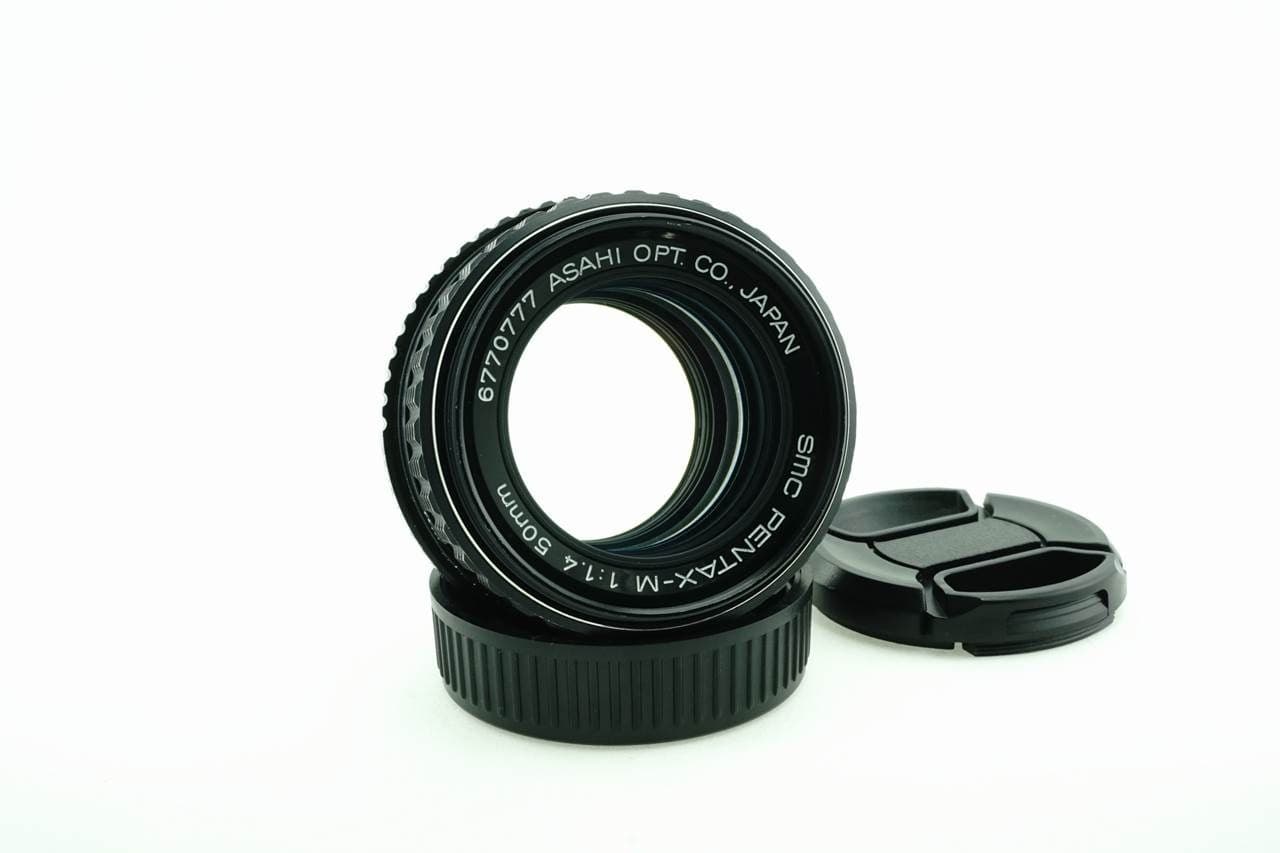
Production
-
Country
Japan
Optical
8 elements (original) or 7 elements (later versions).
Updated
Jul 1, 2026
M42 · 50mm · f/1.4
Production
-
Country
Japan
Optical
8 elements (original) or 7 elements (later versions).
Updated
Jul 1, 2026
The Super Takumar 50mm f1.4 was released by the Asahi Optical Co. in the 1960s and quickly garnered a legendary, cult reputation online. The earliest versions used an unusually high number of elements (8) in an effort to one-up Zeiss, who were regarded as the best lens makers in the world at the time. Pentax achieved their goal, earning the lens the moniker 'Planar Killer,' but later reduced the element count to 7 to make continued production more financially viable. A persistent tale claims money was lost on each 8-element unit before the change, though its truth remains unverified. The lens is also famous for being 'radioactive': later iterations were made with thoriated glass (thorium oxide) in the rear element, which improved optical properties but causes a characteristic yellowing or browning over time due to radioactive decay creating 'F-centers' in the glass. Despite internet fearmongering, reviewers with Geiger counters confirmed the radiation is a weak alpha emitter that poses no real danger in normal use—one reviewer even ran a 36-hour test with film in constant contact with the rear element and found no fogging. People love it for its sharpness, bokeh, satisfying all-metal build, and its place in photographic legend.
Verdict: The Pentax Super Takumar 50mm f1.4 is a legendary M42 lens beloved for its sharpness, solid all-metal build, and rich history as the 'Planar Killer' that took on Zeiss. It's ideal for enthusiasts who appreciate vintage character and don't mind quirks like a reversed focus ring, a propensity to flare, and (on later versions) a radioactive thoriated glass element that yellows over time. Buy carefully to avoid fungus and oil, and you'll own a genuine piece of photographic history.
Known for its bokeh, though considered a secondary strength; specific qualities are unknown.
Thoriated versions develop yellowing/browning over time that shifts color transmission, correctable via white balance.
Renowned for sharpness, allegedly aided by the thoriated glass in later versions.
Known for a propensity for flare.
The Pentax Super Takumar 50mm f1.4 is a legendary M42 lens beloved for its sharpness, solid all-metal build, and rich history as the 'Planar Killer' that took on Zeiss. It's ideal for enthusiasts who appreciate vintage character and don't mind quirks like a reversed focus ring, a propensity to flare, and (on later versions) a radioactive thoriated glass element that yellows over time. Buy carefully to avoid fungus and oil, and you'll own a genuine piece of photographic history.