Production
-
Country
USSR
Optical
7 elements in 3 groups
Updated
Jul 1, 2026
M42 · 85mm · f/2
Production
-
Country
USSR
Optical
7 elements in 3 groups
Updated
Jul 1, 2026
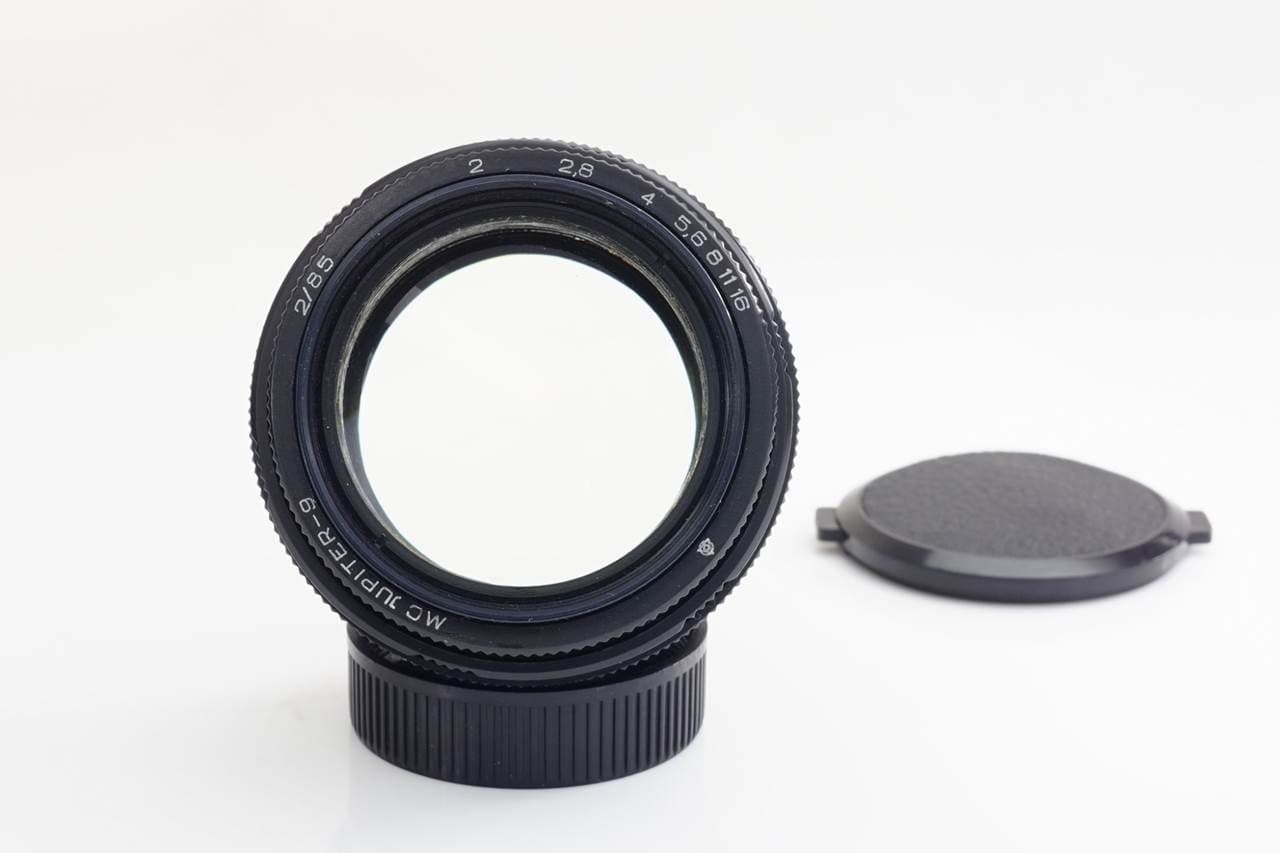
The Jupiter-9 85mm f/2.0 is a Soviet copy of the Zeiss Sonnar 85mm f/2.0, produced in the USSR after WWII. According to the reviews, early versions may actually incorporate Zeiss glass produced in Germany, while later versions may feature different coatings and a black painted barrel. This is one of the classic 'Zeiss designs that were pinched by the Soviets and produced in the USSR.' Within the manual lens community it has earned the nickname 'Soviet bokeh king' (referred to as 'Bokeh King'), owing to its out-of-focus rendering. It has a cult following because, as one reviewer put it, it is 'a slow-burner of a lens... not one to make you jump out of your seat at its native contrast or sharpness but one whose quality creeps up on you over the course of several sessions with it.' It was a favorite among the Jupiter lenses tested by one reviewer.
Verdict: The Jupiter-9 85mm f/2.0 is a Soviet Sonnar-copy portrait lens for photographers who value character over clinical performance. Its soft, low-contrast wide-open rendering and celebrated bokeh (earning it the 'Soviet bokeh king' title) make it a rewarding, slow-burning classic for portraiture. Buyers must accept significant sample variation and some mechanical quirks, but a good copy delivers charming results at a modest price.
Highly regarded out-of-focus rendering earning the 'Soviet bokeh king' nickname, aided by a 15-blade rounded aperture on the 1958 version.
Soft and low-contrast wide open at f/2.0; center good at f/2.8, midframe sharp at f/5.6, corners ok at f/11.
Low native/global contrast, described as somewhat soft and not really contrasty wide open, favorable for portraits.
Surprisingly low given its size, measured at only 1.6 EV wide open and rarely noticeable stopped down.
The Jupiter-9 85mm f/2.0 is a Soviet Sonnar-copy portrait lens for photographers who value character over clinical performance. Its soft, low-contrast wide-open rendering and celebrated bokeh (earning it the 'Soviet bokeh king' title) make it a rewarding, slow-burning classic for portraiture. Buyers must accept significant sample variation and some mechanical quirks, but a good copy delivers charming results at a modest price.