Production
-
Country
-
Optical
Xenotar structure (per Nikon's history of the original 1956 5cm f/3.5; element count of the AI 55mm f/3.5 unknown).
Updated
Jul 1, 2026
Nikon AI · 55mm · f/3.5
Production
-
Country
-
Optical
Xenotar structure (per Nikon's history of the original 1956 5cm f/3.5; element count of the AI 55mm f/3.5 unknown).
Updated
Jul 1, 2026
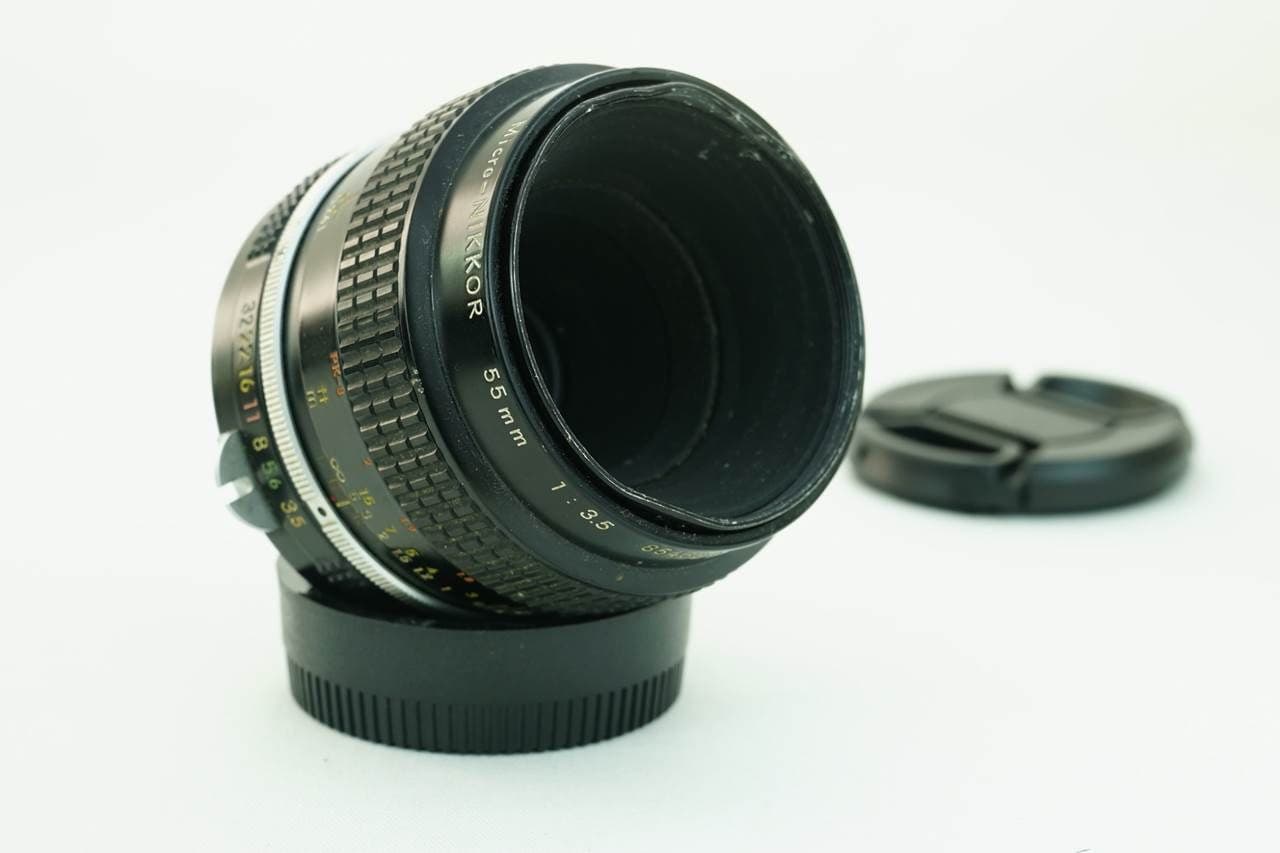
The Micro-Nikkor 55mm f/3.5 traces its lineage to the very first Micro Nikkor lens, developed in the era of the Nikon S rangefinder in response to a request from Professor Zyun Koana of the University of Tokyo. According to Nikon's own 'Thousand and One Nights' history (Tale 85), Hideo Azuma and the great designer Zenji Wakimoto took up Koana's demanding requirements, and the Micro-Nikkor 5cm f/3.5 for Nikon S cameras was released in 1956 using a distinctive Xenotar structure. Wakimoto initially assumed a symmetrical Gauss design would be ideal for a lens needing to focus from infinity to life-size while resisting aberration fluctuations at close distances, but no Gauss variant reached Koana's demanded resolving power. As a last resort Wakimoto turned to a five-element Xenotar layout, which finally satisfied the resolution target — a result that puzzled Wakimoto, who considered the six-element Gauss theoretically superior for correcting spherical aberration, coma, and chromatic aberration. He eventually attributed the Xenotar's success to the specific way chromatic aberration was corrected and to the mechanism of point-image formation. This lineage established the Micro-Nikkor name and made it Wakimoto's signature lens. The 55mm f/3.5 was produced across Pre-AI (Nikkor-P) and AI/K versions. Reviewers note no established nickname beyond the 'Micro Nikkor' family name itself. Its cult following rests on a reputation for near-flawless technical rendering and a rendering that many users simply fall in love with — one reviewer at CasualPhotophile stumbled on the Nikkor-P 3.5/55 by accident while hunting for an extremely sharp standard lens for studio portraits and now loves how it renders everything, even on high-resolution digital bodies like the Nikon D800.
Verdict: The Nikon Micro-Nikkor 55mm f/3.5 is a technically near-flawless standard/macro lens whose sharpness and resolution remain its defining strengths, backed by a distinguished design lineage from Zenji Wakimoto's Xenotar structure. It suits photographers who prioritize clinical sharpness and clean three-dimensional rendering — from studio portraits to close-up work — while still delivering bokeh that many users find smoother and more likable than its successor. It is a lens loved for how it renders rather than for any dramatic vintage 'character' flaw.
Described as beautiful and contributing to three-dimensional rendering, smoother than the later 55mm f/2.8 AI-S, though some find it only average.
Signature strength; incredibly sharp on the focus plane and resolves well even on high-resolution sensors like the Nikon D800, without softening wide open.
The Nikon Micro-Nikkor 55mm f/3.5 is a technically near-flawless standard/macro lens whose sharpness and resolution remain its defining strengths, backed by a distinguished design lineage from Zenji Wakimoto's Xenotar structure. It suits photographers who prioritize clinical sharpness and clean three-dimensional rendering — from studio portraits to close-up work — while still delivering bokeh that many users find smoother and more likable than its successor. It is a lens loved for how it renders rather than for any dramatic vintage 'character' flaw.