Production
1975 – 1986
Country
Japan
Optical
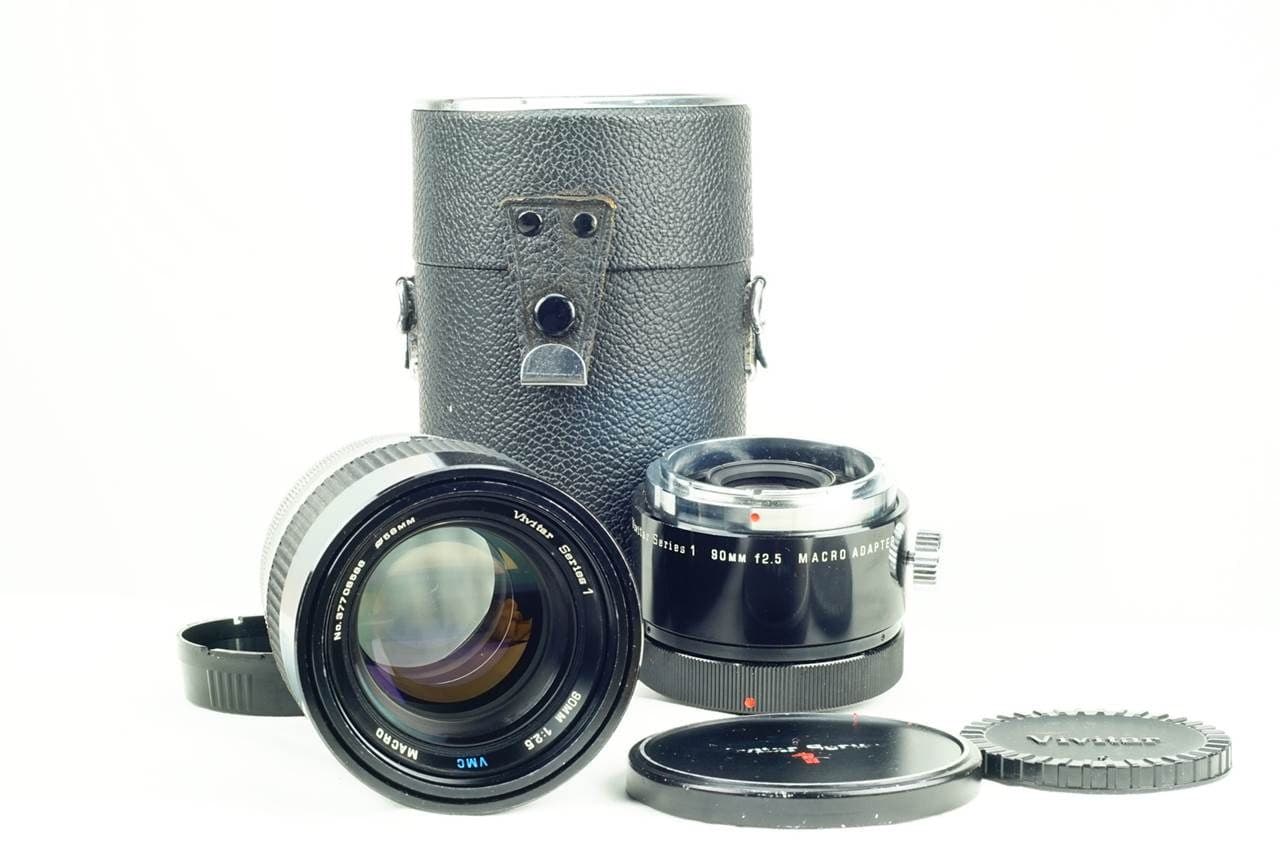
8 elements in 7 groups (main lens); macro adapter 3 elements in 3 groups.
Updated
Jul 1, 2026
Canon FD (also available in M42, C/Y, SR, F, OM, Pentax K/KA). · 90mm · f/2.5
Production
1975 – 1986
Country
Japan
Optical
8 elements in 7 groups (main lens); macro adapter 3 elements in 3 groups.
Updated
Jul 1, 2026
The Vivitar Series 1 90mm f/2.5 Macro was born from an ambitious 1970s initiative by Vivitar, an American photography equipment reseller that famously had no factory of its own. Instead, Vivitar hired talented optical engineers to design top-tier lenses and subcontracted the actual manufacturing to established Japanese makers. In 1975, the company shocked the industry with the Vivitar Series 1 lineup, said to be among the first lenses designed with the help of the largest computers of the era. This 90mm Macro was so sharp that, according to Modern Photography magazine, it shared the crown with Leica's Dual Range Summicron as one of the highest-resolution lenses tested at the time. The reviews document two distinct manufacturers: the well-regarded Tokina-made version (serials 37xxxxx) and the similar but distinct Komine-made version (serials 28xxxxx). After Vivitar's decline in 1986, Tokina took over the design and released it as the Tokina AT-X Macro 90mm f/2.5, which earned the affectionate nickname 'Bokina' (a portmanteau of Bokeh and Tokina) for its beautiful out-of-focus rendering. The optical designs are so similar that the Vivitar and the Tokina are considered essentially the same lens, differing mainly in coatings and aperture shape. The cult following stems from this combination of legendary sharpness, gorgeous bokeh, and a versatile 90mm focal length that doubles as both a close-focusing macro and an affordable alternative to an 85mm portrait lens. Note: the reviews explicitly warn that another Vivitar 90mm f/2.8 Macro exists WITHOUT the 'Series 1' designation and is a completely different lens.
Verdict: The Vivitar Series 1 90mm f/2.5 Macro is a legendary sharp-yet-beautiful macro and portrait lens whose optical lineage directly produced the famous 'Bokina.' It is ideal for photographers who want a single versatile lens that delivers reference-class sharpness alongside gorgeous bokeh — for macro, close-ups, and portraiture alike. Just be sure to secure the genuine Tokina-made Series 1 f/2.5 and not the unrelated f/2.8, and be prepared to manage chromatic aberration and flare when shooting toward the light.
Highly praised, smooth and characterful out-of-focus rendering that earned its successor the 'Bokina' nickname.
Exceptionally sharp, described as 'tack sharp' and historically rivaling the Leica Dual Range Summicron.
Loss of contrast (veiling) when shooting into light sources; ghosting behavior unknown.
Can lose contrast when shooting directly into light sources; overall character otherwise unknown.
The Vivitar Series 1 90mm f/2.5 Macro is a legendary sharp-yet-beautiful macro and portrait lens whose optical lineage directly produced the famous 'Bokina.' It is ideal for photographers who want a single versatile lens that delivers reference-class sharpness alongside gorgeous bokeh — for macro, close-ups, and portraiture alike. Just be sure to secure the genuine Tokina-made Series 1 f/2.5 and not the unrelated f/2.8, and be prepared to manage chromatic aberration and flare when shooting toward the light.