Production
-
Country
Germany (Ulm, formerly Munich)
Optical
Ludwig Bertele Sonnar-derived design; 135mm f3.5 is 4 elements in 4 groups.
Updated
Jul 16, 2026
M42 (also EXA on the 135mm) · 90mm · f/2.8
Production
-
Country
Germany (Ulm, formerly Munich)
Optical
Ludwig Bertele Sonnar-derived design; 135mm f3.5 is 4 elements in 4 groups.
Updated
Jul 16, 2026
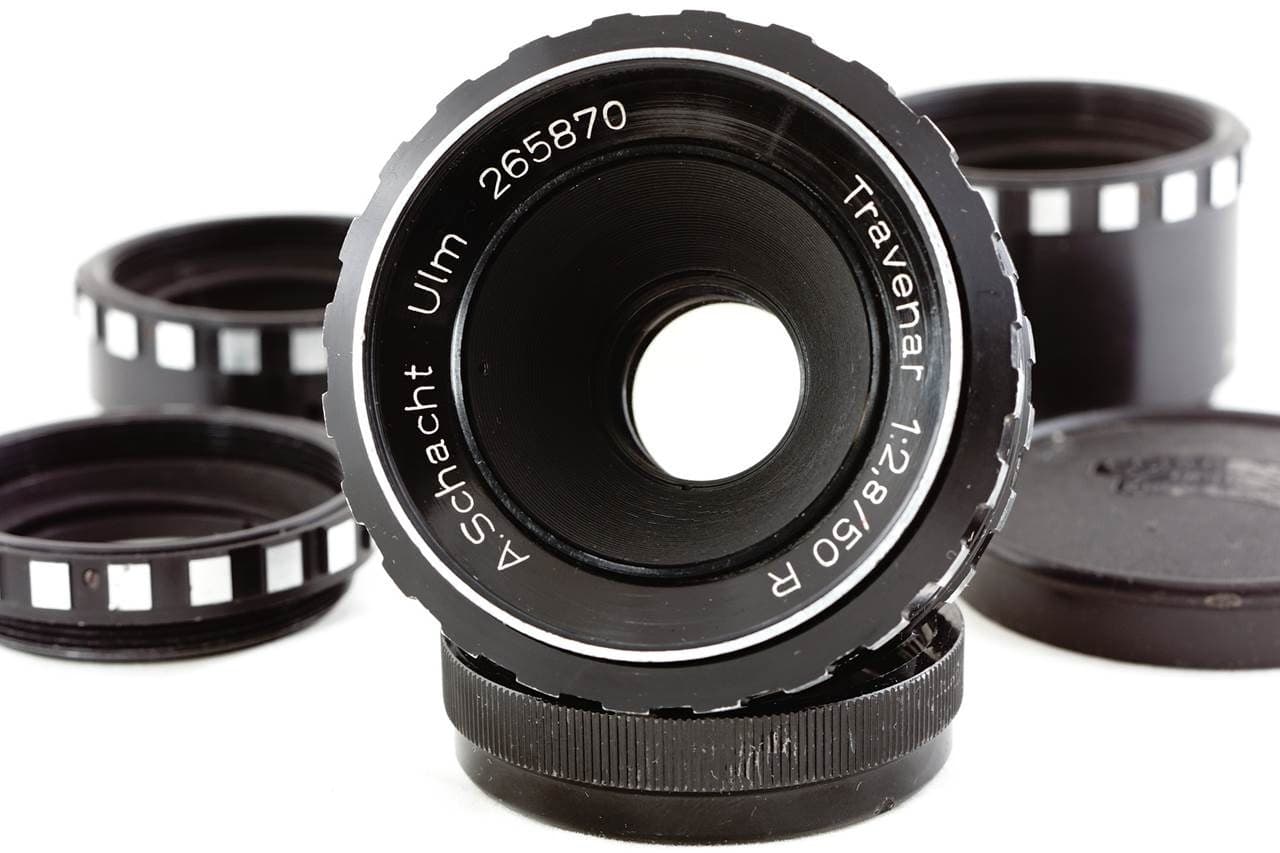
The Schacht company was founded in Munich in 1948 by Albert Schacht, who had previously held a management position at Zeiss and Steinheil. From 1954 onward, Schacht manufactured its lenses in Ulm on the Danube (hence the 'Ulm' designation). According to the Nikolaus-Burgard review, almost all Schacht lenses are optical designs by Ludwig Bertele, the inventor of the Sonnar, meaning the Travenar line can be considered a direct development of the Zeiss Sonnar formula. The company was sold in 1967 and lens production ceased in 1970. Reviewers describe Schacht lenses as 'mechanical and haptic delicacies' that flew under the radar for decades and are only recently being rediscovered, with some arguing they deserve to be mentioned alongside Leica and Zeiss. No established community nicknames appear in the reviews. The cult following stems partly from the beautiful, art-object build and the 16-bladed aperture design, though at least one reviewer cautions the reputation may outpace real-world optical performance. The Travenar name covers multiple focal lengths (a 90mm f2.8 and a 135mm f3.5 are documented in these reviews).
Verdict: The Schacht Ulm Travenar is a beautifully built, Sonnar-heritage vintage lens (courtesy of Ludwig Bertele) that appeals most to collectors who value exquisite mechanics and mid-century optical design. The 135mm f3.5 impresses reviewers as genuinely convincing, while the 90mm f2.8 is solid and sharp in its mid-aperture sweet spot but delivers only acceptable, unremarkable bokeh — leading some to call it over-hyped and overpriced. Best for enthusiasts who appreciate craftsmanship and Sonnar lineage over dramatic vintage character.
OK and acceptable but nothing outstanding on the 90mm f2.8; the 16-bladed aperture does not meaningfully enhance it.
The Schacht Ulm Travenar is a beautifully built, Sonnar-heritage vintage lens (courtesy of Ludwig Bertele) that appeals most to collectors who value exquisite mechanics and mid-century optical design. The 135mm f3.5 impresses reviewers as genuinely convincing, while the 90mm f2.8 is solid and sharp in its mid-aperture sweet spot but delivers only acceptable, unremarkable bokeh — leading some to call it over-hyped and overpriced. Best for enthusiasts who appreciate craftsmanship and Sonnar lineage over dramatic vintage character.