Production
-
Country
-
Optical
-
Updated
Jul 16, 2026
Minolta MD · 70mm · f/2.8
Production
-
Country
-
Optical
-
Updated
Jul 16, 2026
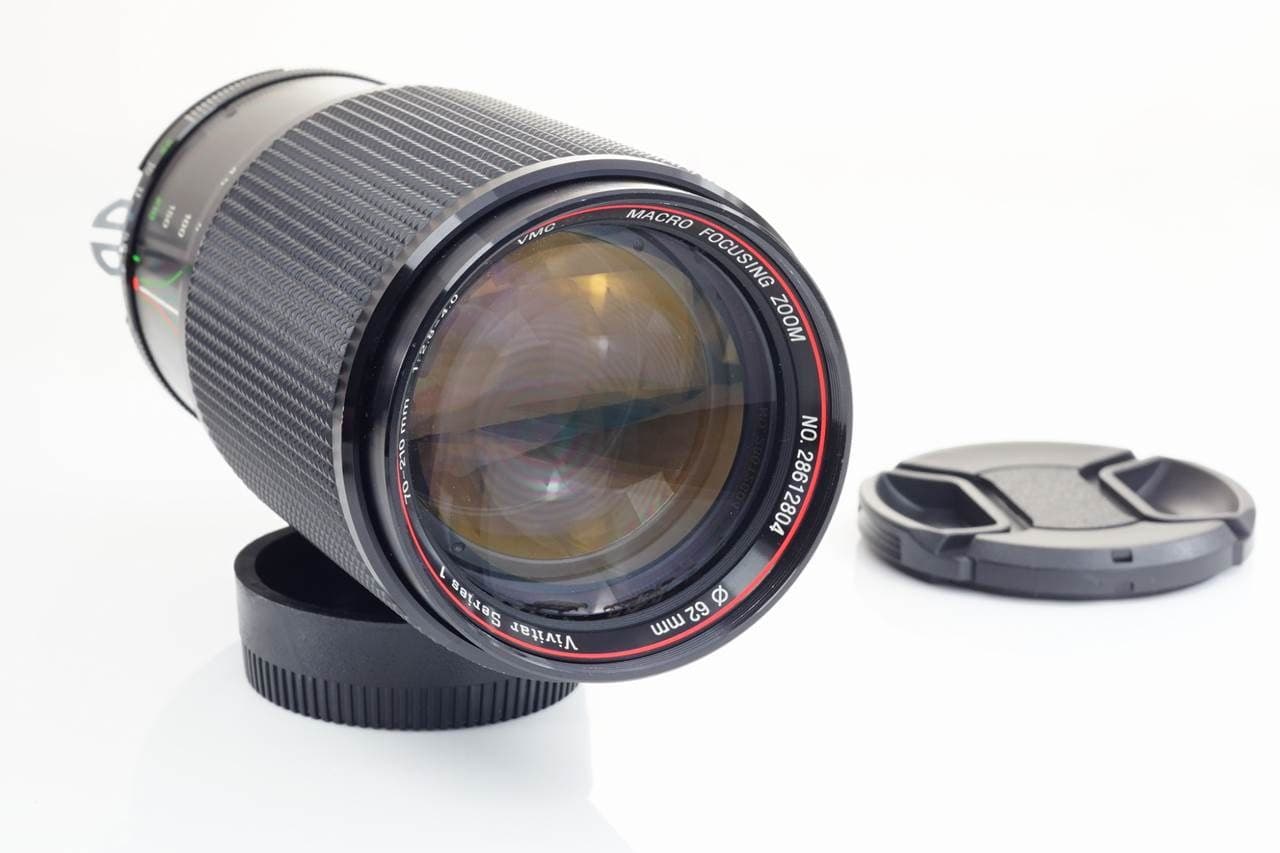
The Vivitar Series 1 line was Vivitar's premium range, conceived in the 1970s as a showcase of ambitious, high-performance optics built to compete with — and in some cases outperform — the first-party lenses of the day. Rather than manufacturing lenses itself, Vivitar contracted out production to a rotating cast of respected Japanese optical houses, and the 70-210mm telephoto zoom became the flagship example of this strategy. According to the reviews, there are at least five versions of this lens, distinguishable most reliably by the first two digits of the serial number. The original mid-70s version was built by the legendary Kiron (serials starting with 22), featured a constant F3.5 aperture across the range, offered the most impressive close-focusing capability of 1:2.2, and was the heaviest of the group. A second version came from Tokina (serials starting with 37), which was smaller and lighter but reduced macro ability to 1:4. A third version was made by Komine (serials starting with 28), introducing the variable F2.8-4.0 aperture, improving macro to 1:2.5, and widely regarded as optically the sharpest. The fourth and last common version was built by Cosina (serials starting with 09), keeping the 1:2.5 macro but with reportedly reduced build quality and a less grippy focus ring. The first three versions (22, 28, 37) are generally considered the best. There is no single established nickname for the 70-210mm itself, though one reviewer draws a comparison to the Tokina AT-X 90mm Macro famously nicknamed the 'Bokina.' The lens has a cult following thanks to its versatile macro function, its character-rich rendering, and its status as an accessible, high-value vintage zoom.
Verdict: The Vivitar Series 1 70-210mm is a versatile, character-rich vintage telephoto zoom whose personality depends heavily on which of its many versions you find. Enthusiasts who want the best optics should hunt for the Kiron (22), Komine (28), or Tokina (37) versions, with the Komine prized as the sharpest. The Cosina (09) version trades some sharpness and build quality for a softer, lower-contrast look that some shooters genuinely prefer. With its useful macro ability and strong rendering, it's an excellent value pick for vintage shooters and videographers willing to accept version variance — just don't expect bokeh that consistently rivals dedicated prime telephotos.
Contested across reviews, ranging from super smooth and awesome to busy and smeary depending on version.
Good center sharpness from wide open to f/16 on better versions; Komine (28) is the sharpest, while the Cosina (09) version is soft wide open with blooming.
Low-contrast, softer look on the Cosina version wide open; pleasing global contrast on the better versions.
The Vivitar Series 1 70-210mm is a versatile, character-rich vintage telephoto zoom whose personality depends heavily on which of its many versions you find. Enthusiasts who want the best optics should hunt for the Kiron (22), Komine (28), or Tokina (37) versions, with the Komine prized as the sharpest. The Cosina (09) version trades some sharpness and build quality for a softer, lower-contrast look that some shooters genuinely prefer. With its useful macro ability and strong rendering, it's an excellent value pick for vintage shooters and videographers willing to accept version variance — just don't expect bokeh that consistently rivals dedicated prime telephotos.