Production
1966
Country
Japan
Optical
6 elements in 4 groups (55mm f/1.8).
Updated
Jul 14, 2026
M42 screw mount · 55mm · f/1.4
Production
1966
Country
Japan
Optical
6 elements in 4 groups (55mm f/1.8).
Updated
Jul 14, 2026
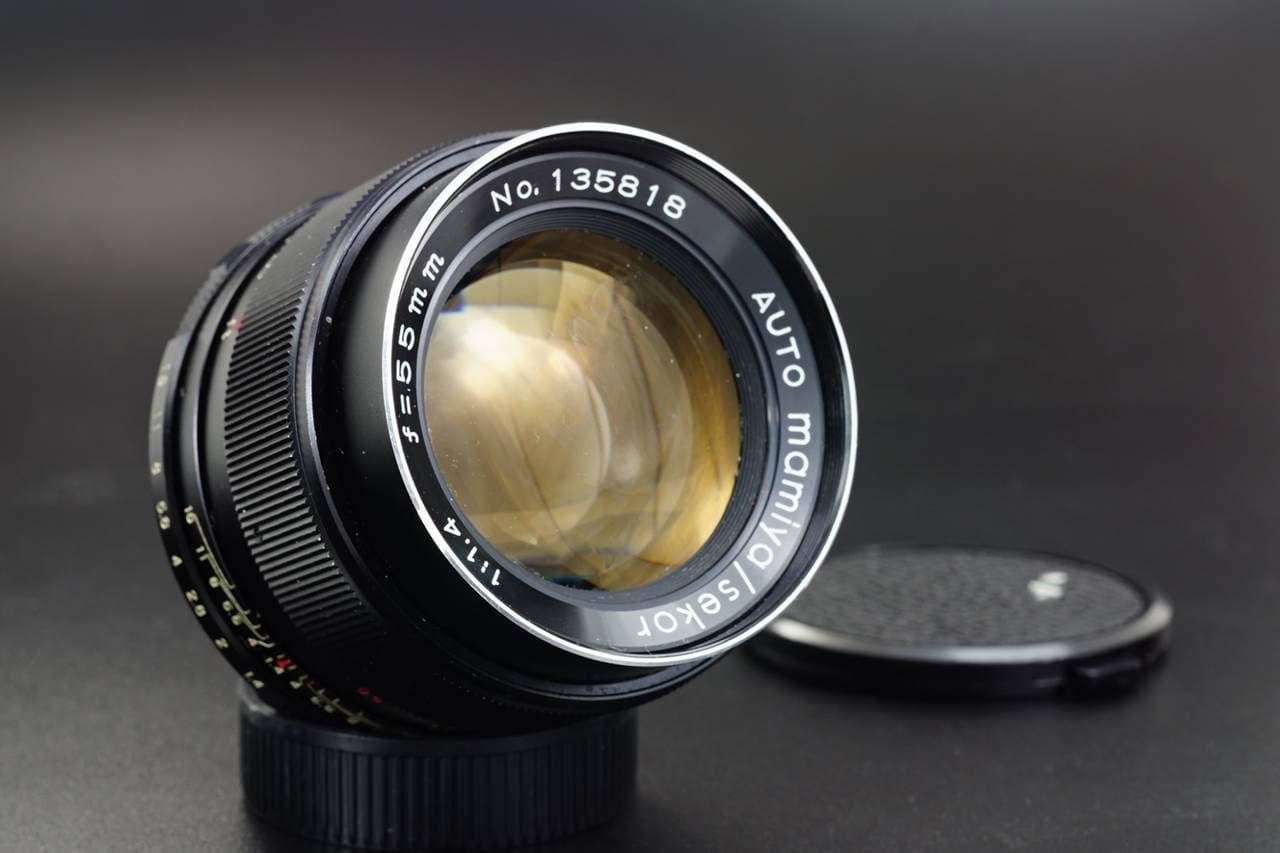
The Mamiya-Sekor name covers Mamiya's own-brand optics, and this profile draws on the celebrated 1960s standard primes made for the Mamiya TL/DTL M42 SLRs, released around 1966. Mamiya was primarily a professional camera maker whose lenses have long been overshadowed by better-known German and Japanese marques, which is exactly why enthusiasts prize them as underappreciated value. The line's crown jewel is the fast 55mm f1.4, a rare-earth (thorium) design whose rendering reviewers openly compare to lenses costing many times more — the Carl Zeiss Contarex 55mm f1.4 and the Carl Zeiss Jena Pancolar 55mm f1.4 — with some enthusiasts calling it 'the one lens to rule them all.' Part of the mystique is genuine uncertainty over who actually designed and built the glass (Mamiya, Tomioka, or even Zeiss lineage is debated), which fuels a 'bottomless rabbit hole' of collector curiosity. The most commonly used community descriptor is 'radioactive': the faster 55mm primes contain thoriated glass that is mildly radioactive and yellows with age. The cult following rests on old-school metal-and-brass build quality, a warm vintage look, and character-rich imperfections that many modern lenses have engineered away.
Verdict: A character-first vintage standard lens for photographers who want atmosphere over clinical perfection. Its dual nature — dreamy and glowing wide open, sharp and detailed stopped down — plus a warm tint and honest, sometimes flare-prone rendering make it ideal for portrait and mood work by shooters willing to work with light and aperture deliberately. The radioactive 55mm f1.4 in particular rewards patience with a look that punches well above its price; those chasing neutral, high-contrast, corner-to-corner modern output should look elsewhere.
Warm and vibrant palette, slightly warmer than neutral.
A bit soft wide open (spherical aberration) yet usable, sharpening up enormously by around f/1.7 and stopped down.
Flares readily and is prone to ghosting and veiling glare against strong light.
Lower-global-contrast classic vintage look; contrasty in good light but loses contrast toward the sun.
A character-first vintage standard lens for photographers who want atmosphere over clinical perfection. Its dual nature — dreamy and glowing wide open, sharp and detailed stopped down — plus a warm tint and honest, sometimes flare-prone rendering make it ideal for portrait and mood work by shooters willing to work with light and aperture deliberately. The radioactive 55mm f1.4 in particular rewards patience with a look that punches well above its price; those chasing neutral, high-contrast, corner-to-corner modern output should look elsewhere.