Production
-
Country
Germany
Optical
Tessar, 4 elements in 3 groups
Updated
Jul 1, 2026
M42 · 50mm · f/2.8
Production
-
Country
Germany
Optical
Tessar, 4 elements in 3 groups
Updated
Jul 1, 2026
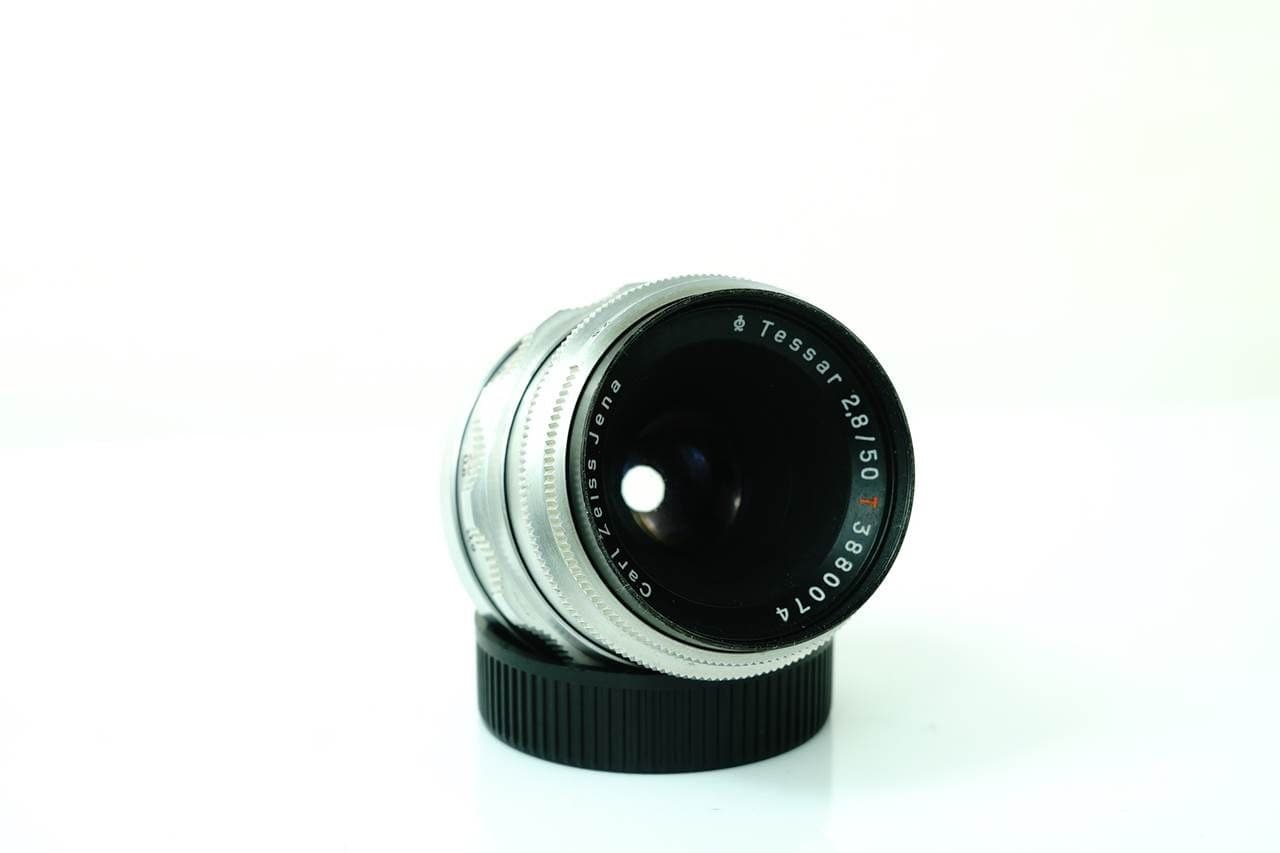
The Tessar is one of the oldest optical designs in photography, dating to 1902, and stands among the very first consumer lens designs. The name 'Tessar' derives from the Greek 'Téssera,' meaning four, a reference to its four-element construction. The 50mm f/2.8 rendition traces to a pivotal moment in camera history: in 1932, when the Leica II by Leitz of Wetzlar ruled 35mm photography, Zeiss Ikon of Dresden set out to build a superior competitor. This became the Contax I, and to serve it Zeiss Jena redesigned the Tessar to cover the 24x36mm negative, birthing the first Tessar 50/2.8 for 35mm format. During its era the lens earned the German nickname 'Adlerauge' ('Eagle's Eye') because it was considered exceptionally sharp. After WWII, the Tessar was produced in both East and West Germany for numerous camera brands and in a wide variety of mounts. The postwar versions were recalculated shortly after the war and differ optically from the prewar design; the silver, collector-favored versions from around 1950 to the mid-1950s are especially sought after for their looks. The 50/2.8 is regarded as the fastest of the 50mm Tessars, stretching the classic design, since Tessars were typically made in moderate speeds from f/5.6 to f/3.5. People love it as one of the most prolific and 'immortal' classic designs, with the multi-blade postwar variants prized for their smoother, rounder aperture discs.
Verdict: The Carl Zeiss Tessar Silver 12 Blade is a compact, historically significant classic lens best suited to collectors and enthusiasts who appreciate the immortal Tessar design and the smoother discs of its 12-blade iris. As the fastest of the 50mm Tessars, it delivers a sharp center that lives up to its 'Eagle's Eye' reputation once stopped down, but you accept mediocre corners and inconsistent bokeh as part of its vintage character.
Mixed and inconsistent by nature of the Tessar design, though the 12-blade iris renders smoother, rounder out-of-focus discs than later 5-blade versions.
Center is a little soft wide open at f/2.8 but becomes good and crisp at f/4 and beyond; corners are characteristically mediocre.
The Carl Zeiss Tessar Silver 12 Blade is a compact, historically significant classic lens best suited to collectors and enthusiasts who appreciate the immortal Tessar design and the smoother discs of its 12-blade iris. As the fastest of the 50mm Tessars, it delivers a sharp center that lives up to its 'Eagle's Eye' reputation once stopped down, but you accept mediocre corners and inconsistent bokeh as part of its vintage character.