Production
1964 – 1990
Country
East Germany
Optical
6 elements in 5 groups (early versions 6 elements in 4 groups), Double Gauss origin.
Updated
Jul 1, 2026
M42 (also Exakta and rare Praktica B-mount) · 50mm · f/1.8
Production
1964 – 1990
Country
East Germany
Optical
6 elements in 5 groups (early versions 6 elements in 4 groups), Double Gauss origin.
Updated
Jul 1, 2026
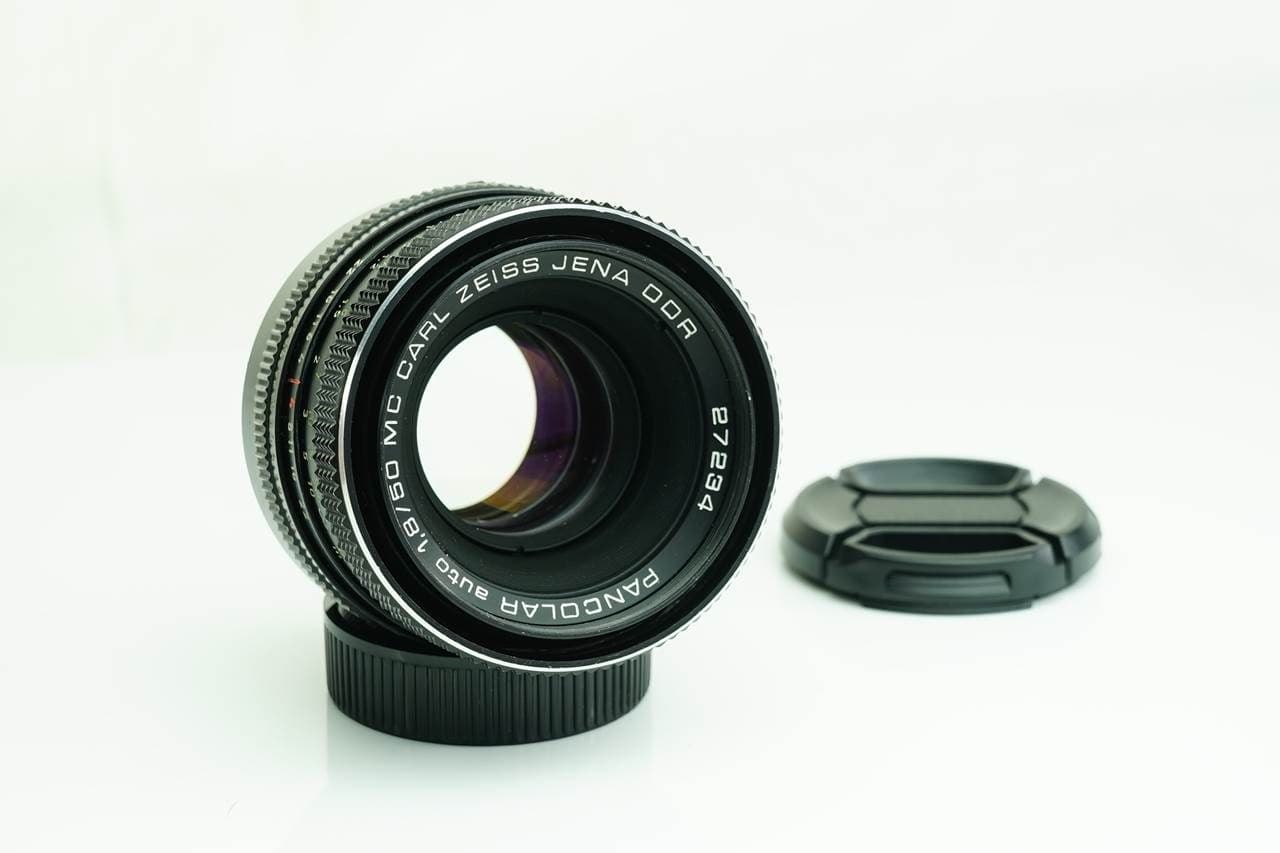
The Carl Zeiss Jena Pancolar 50mm f/1.8 traces its lineage to 1960, when Zeiss Jena designed the first Pancolar 50mm at f/2 to offer a faster, better-performing alternative to the venerable Tessar 50mm f/2.8. As Japanese competitors began releasing f/1.8 standard lenses, Zeiss responded with the Pancolar 50mm f/1.8, designed and produced starting in 1964 and considered one of the best lenses of its era. It was built in East Germany and produced through the 1980s (sources cite end dates ranging from 1982 to 1990). Early models (pre-1967, up to serial ~8552600) used a Double Gauss 6-element, 4-group design with high-refractive-index thorium/lanthanum glass that is mildly radioactive and can yellow or become slightly opaque over time — these are often referred to simply as the 'radioactive' or thorium versions. Later versions used safer, more stable glass and were revised to a more advanced 6-element, 5-group formula. The lens is known for zebra-finish versions (single-coated) and later all-black multi-coated (MC) versions. It is described as a 'cult classic' and remains highly regarded among those who have used it, prized for sharpness, contrast, and rich color rendering. It is also noted as a strong alternative to — and inspiration for — the Pentacon 50mm f/1.8.
Verdict: The Carl Zeiss Jena Pancolar 50mm f/1.8 is a cult-classic standard prime that punches above its Jena reputation, offering sharpness usable wide open, rich color, and excellent microcontrast in a compact all-metal body. It's ideal for photographers and videographers who want vintage character with genuine optical quality — choose the single-coated zebra for more adventurous rendering or the MC version for punchier images. Just be prepared for aging build quirks like stiff focus and loose aperture springs.
Smooth and pleasant bokeh, aided by the close 0.35m focus distance; no swirl or bubble characteristics.
Rich color rendering, with MC versions more vibrant; exhibits a notable color shift when stopped down.
Usable and sharp even wide open at f/1.8, reaching 'perfectly sharp' by f/2.8.
Single-coated zebra versions show stronger purple flares, while MC versions are better controlled.
Good contrast with excellent microcontrast; zebra versions slightly lower global contrast than punchier MC versions.
The Carl Zeiss Jena Pancolar 50mm f/1.8 is a cult-classic standard prime that punches above its Jena reputation, offering sharpness usable wide open, rich color, and excellent microcontrast in a compact all-metal body. It's ideal for photographers and videographers who want vintage character with genuine optical quality — choose the single-coated zebra for more adventurous rendering or the MC version for punchier images. Just be prepared for aging build quirks like stiff focus and loose aperture springs.