Production
1976
Country
East Germany (German Democratic Republic)
Optical
6 elements in 6 groups, retrofocus design
Updated
Jul 16, 2026
M42 (also Exakta and Praktica PB); no Contax/Yashica evidenced · 35mm · f/2.4
Production
1976
Country
East Germany (German Democratic Republic)
Optical
6 elements in 6 groups, retrofocus design
Updated
Jul 16, 2026
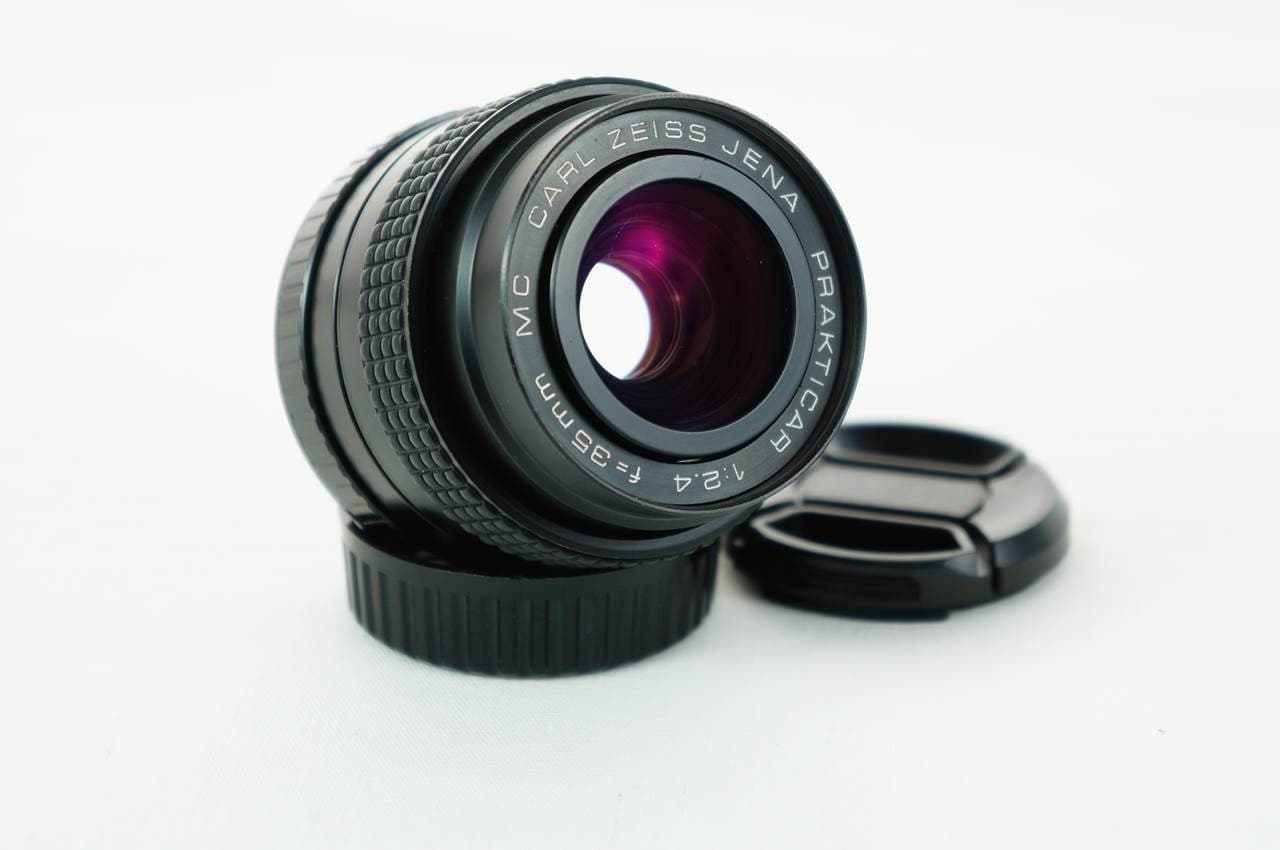
The Carl Zeiss Jena Flektogon 35mm f/2.4 was produced in the former German Democratic Republic (East Germany). It descends from the earlier f/2.8 Flektogon and, according to the reviews, this faster f/2.4 version was released around 1976. The Flektogon design employs what is now known as a retrofocus layout; Carl Zeiss Jena (Eastern Germany) and Angenieux are cited as being among the first to develop such designs, which Carl Zeiss Oberkochen (Western Germany) later adapted under the 'Distagon' name still used today. The 'Flektogon' name itself was given by Zeiss to their wide-angle lenses (35mm counting as wide angle). One reviewer explicitly calls it 'one of the best known cult classics.' The reviews note it was made in M42 (most common), Exakta and Praktica (PB) bayonet mounts, and that the USSR-made equivalent is the 'Mir 1.' People love it for its combination of sharpness, an exceptionally short 0.2m minimum focus distance, pleasant out-of-focus rendering, and strong color, all in a compact package. No Contax/Yashica mount version is evidenced in these reviews; the Flektogon documented here is an M42/Exakta/Praktica lens.
Verdict: The Carl Zeiss Jena Flektogon 35mm f/2.4 is a genuine cult classic for vintage lens enthusiasts who want a sharp, characterful wide angle with an exceptional close-focus trick. It rewards those who love near-macro framing, pleasant subtle bokeh, and good color, and who don't mind manual operation, an adapter, and strong wide-open vignetting. Note that the lens documented in these reviews is an M42/Exakta/Praktica lens, not a Contax/Yashica mount lens.
Subtle, pleasant out-of-focus rendering that adds character without being aggressive, with surprisingly shallow depth of field wide open.
Praised color rendering, with a very slight green cast in extreme corners on a Sony A7rII.
Highly regarded as sharp; center soft at f/2.4-f/2.8 at infinity but improves at f/4.0, and astonishingly sharp at 0.2m even wide open.
The multi-coated version is extremely flare resistant, even shooting into the sun.
Strong wide open at ~2.2 EV, improving to 1.4 EV at f/4.0 and 1.0 EV at f/8.0.
The Carl Zeiss Jena Flektogon 35mm f/2.4 is a genuine cult classic for vintage lens enthusiasts who want a sharp, characterful wide angle with an exceptional close-focus trick. It rewards those who love near-macro framing, pleasant subtle bokeh, and good color, and who don't mind manual operation, an adapter, and strong wide-open vignetting. Note that the lens documented in these reviews is an M42/Exakta/Praktica lens, not a Contax/Yashica mount lens.