Production
1974 – 1977
Country
-
Optical
10 elements in 8 groups
Updated
Jul 1, 2026
Nikon AI · 20mm · f/4
Production
1974 – 1977
Country
-
Optical
10 elements in 8 groups
Updated
Jul 1, 2026
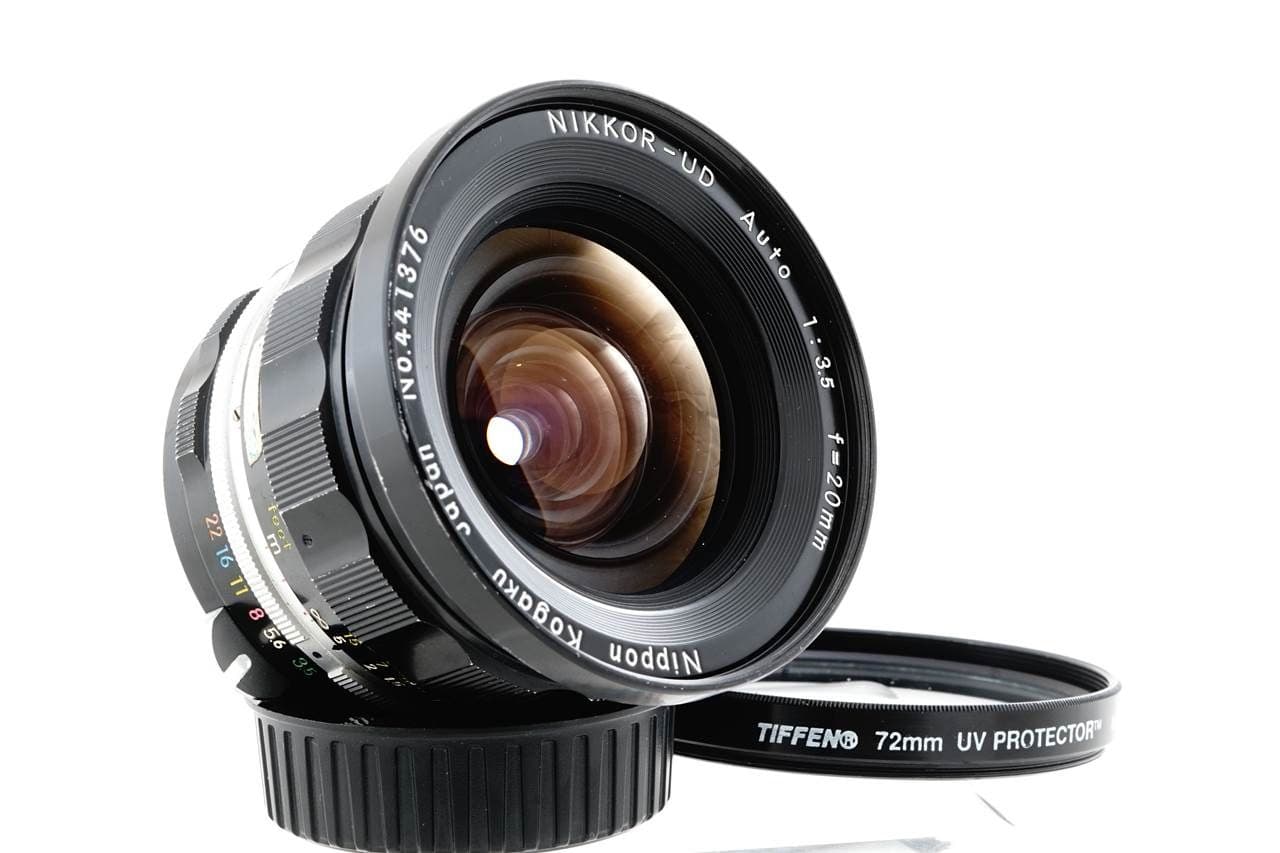
The Nikon Nikkor 20mm f/4 AI is a compact manual-focus ultra-wide-angle lens produced in relatively small numbers, with fewer than 23,000 units made between 1974 and 1977 according to the reviews. Its defining characteristic and primary appeal is its remarkably small and light body, making it notably more compact than its larger-aperture 20mm siblings. It was aimed at landscape photographers, a segment where Nikon's 20mm lenses had long been favored. Because of its short production run and limited numbers, it carries some collector interest, but reviewers are candid that its optical performance is dated: one reviewer had to try three samples before finding one worth keeping, and concluded that modern zooms like the 14-24mm and 17-35mm outperform it 'without a doubt,' calling it an 'old dinosaur.' No established nickname or community jargon for this specific lens is evidenced in the reviews (unknown). People who love it do so for its size, weight, and the DOF/IR markings useful for infrared and hyperfocal shooting.
Verdict: The Nikon 20mm f/4 AI is a collector-friendly, ultra-compact ultra-wide for photographers who prize small size and light weight above outright image quality. It is soft in the corners wide open, prone to flare, and shows real light falloff on full frame, and it is decisively outperformed by modern wide zooms. But stopped down to f/8–f/11 it becomes usable, and its DOF/IR markings make it a charming tool for landscape and infrared shooters who enjoy working within its limits. Buy it for portability and character, not for clinical sharpness — and be prepared to sift through samples to find a good one.
Very soft in the corners wide open at f/4, improving considerably by f/5.6 with peak performance at f/11.
Prone to flare due to older coatings; listed explicitly as a drawback.
unknown; flare tendency may reduce contrast but no explicit description given.
Noticeable light falloff, described as 'pretty bad' on full frame at f/4.






The Nikon 20mm f/4 AI is a collector-friendly, ultra-compact ultra-wide for photographers who prize small size and light weight above outright image quality. It is soft in the corners wide open, prone to flare, and shows real light falloff on full frame, and it is decisively outperformed by modern wide zooms. But stopped down to f/8–f/11 it becomes usable, and its DOF/IR markings make it a charming tool for landscape and infrared shooters who enjoy working within its limits. Buy it for portability and character, not for clinical sharpness — and be prepared to sift through samples to find a good one.