Production
1973
Country
Japan
Optical
Modified Double-Gauss, 7 elements in 6 groups
Updated
Jul 16, 2026
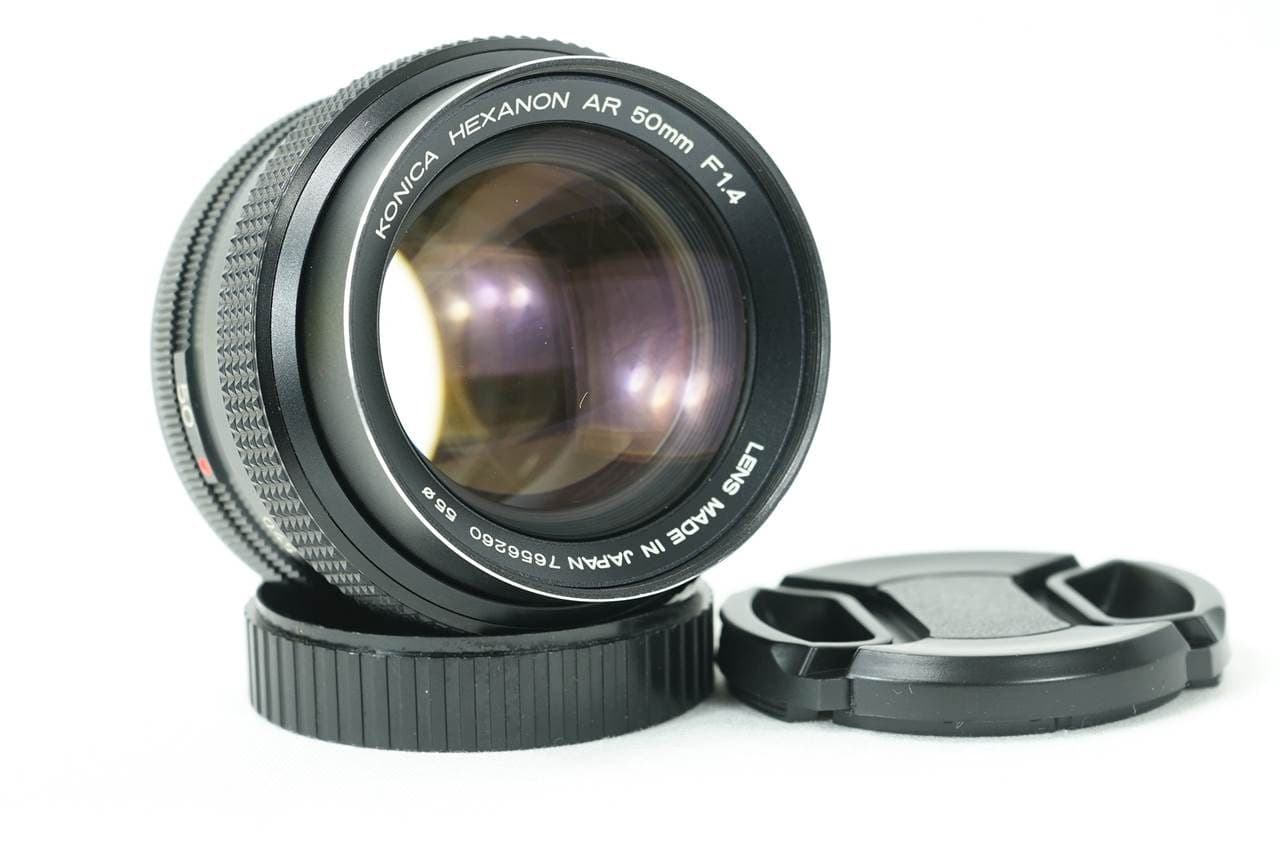
Konica AR · 50mm · f/1.4
Production
1973
Country
Japan
Optical
Modified Double-Gauss, 7 elements in 6 groups
Updated
Jul 16, 2026
The Konica Hexanon AR 50mm f/1.4 represents one of the most underrated achievements in Japanese optical engineering from the 1970s. Konica, originally known as Konishiroku, was one of Japan's oldest camera manufacturers with roots dating back to 1873. By the time this lens was developed in the early 1970s, Konica had established itself as a serious optical innovator, having introduced Japan's first 35mm camera (the Rubikon in 1938) and pioneered numerous coating technologies. The 50mm f/1.4 was designed to compete directly with the fast normal lenses from Canon, Nikon, and Minolta during the golden age of Japanese SLR development. Konica's optical engineers were known for their meticulous attention to aberration correction and their proprietary multi-coating formulas. The lens uses the Konica AR (Automatic Reflex) bayonet mount, not the Minolta MD mount as sometimes confused - this is a critical distinction as they are entirely different systems. The AR mount featured Konica's EE (Electric Eye) coupling for aperture-priority automation. While never achieving the celebrity status of Zeiss or Leica glass, the Hexanon line developed a quiet but devoted following among photographers who discovered their exceptional performance-to-price ratio. The 50mm f/1.4 in particular earned respect for delivering optical quality that rivaled lenses costing significantly more, making it a favorite among those 'in the know' about undervalued vintage glass.
Verdict: The Konica Hexanon AR 50mm f/1.4 is the thinking photographer's secret weapon - a lens that delivers Zeiss-adjacent rendering quality at a fraction of the price, provided you can accept the less-common AR mount. It excels for portrait photographers seeking flattering skin rendering with genuine sharpness, street photographers wanting a compact and unobtrusive fast fifty, and vintage lens enthusiasts looking for exceptional value. This is not a lens for pixel-peeping landscape shooters who demand corner-to-corner perfection wide open, nor for those requiring autofocus or extensive system support. The Hexanon 50mm f/1.4 rewards photographers who understand that character and technical excellence need not be mutually exclusive, and who appreciate that some of the finest optics hide behind lesser-known names. If you're tired of paying premium prices for premium rendering, this lens should be at the top of your list.
Smooth and creamy with minimal outlining or onion ring artifacts; bokeh balls maintain circular shape until extreme corners where mild cat's-eye appears.
Warm-neutral with slight amber cast in midtones; reds and yellows rendered richly, skin tones particularly flattering with natural rosiness.
Excellent center sharpness wide open; corners soft at f/1.4 but improve dramatically by f/2.8; peak sharpness at f/5.6-8 can challenge modern optics.
Multi-coated versions handle flare admirably with minimal veiling; single-coated versions more prone to contrast loss with strong backlight.
Excellent micro-contrast; moderate global contrast wide open with gentle veiling, snapping into punchy tonal separation by f/2.8.
Moderate vignetting wide open (1.5-2 stops in corners), minimal by f/2.8 and essentially gone by f/4.
Real adapters from our shop that fit this lens mount.
Standard · ฿540 · In stock
Standard · ฿540 · In stock
Standard · ฿540 · In stock
Standard · ฿1,250 · In stock
Standard · ฿890 · Out of stock
Standard · Out of stock
Standard · Out of stock
The Konica Hexanon AR 50mm f/1.4 is the thinking photographer's secret weapon - a lens that delivers Zeiss-adjacent rendering quality at a fraction of the price, provided you can accept the less-common AR mount. It excels for portrait photographers seeking flattering skin rendering with genuine sharpness, street photographers wanting a compact and unobtrusive fast fifty, and vintage lens enthusiasts looking for exceptional value. This is not a lens for pixel-peeping landscape shooters who demand corner-to-corner perfection wide open, nor for those requiring autofocus or extensive system support. The Hexanon 50mm f/1.4 rewards photographers who understand that character and technical excellence need not be mutually exclusive, and who appreciate that some of the finest optics hide behind lesser-known names. If you're tired of paying premium prices for premium rendering, this lens should be at the top of your list.