Production
1984
Country
Japan
Optical
8 elements in 6 groups
Updated
Feb 16, 2026
Nikonos · 20mm · f/2.8
Production
1984
Country
Japan
Optical
8 elements in 6 groups
Updated
Feb 16, 2026
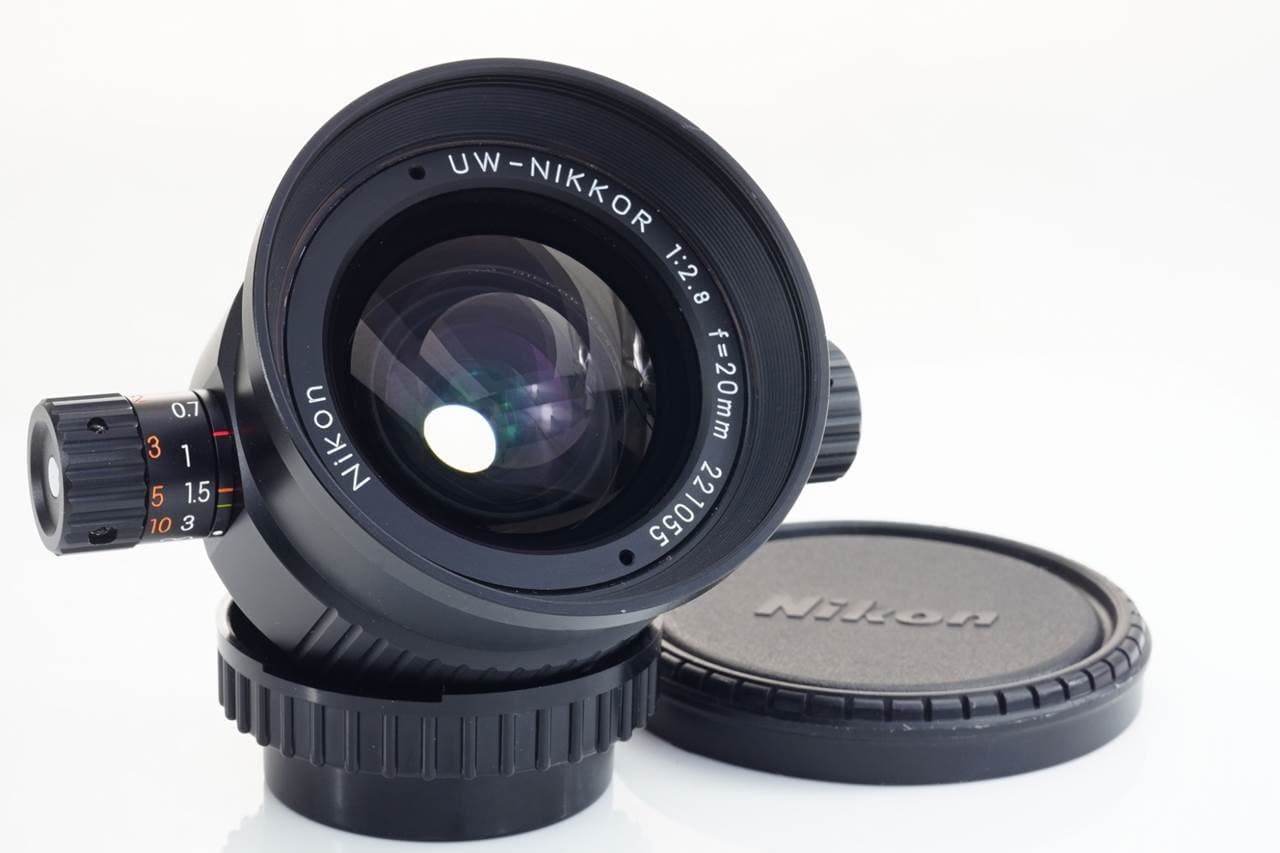
The Nikon UW-Nikkor 20mm f/2.8 was developed as part of Nikon's legendary Nikonos underwater camera system, which began in 1963 when Nikon acquired the rights to Jacques-Yves Cousteau's Calypso camera design. The UW-Nikkor 20mm f/2.8 emerged in the early 1980s as an essential tool for serious underwater photographers who needed a wide field of view to capture marine life and underwater environments. Unlike standard Nikon F-mount lenses, this was a dedicated underwater optic designed to be used exclusively submerged—it cannot focus properly in air due to the optical calculations being based on the refractive index of water. This lens represented Nikon's commitment to the professional underwater photography market and was engineered with water-contact optics, meaning the front element is designed to interface directly with water rather than air. The Nikonos system cultivated an almost religious following among underwater photographers, marine biologists, and documentary filmmakers. The 20mm was particularly beloved because it offered a near-ideal balance of wide coverage (approximately 94° underwater) while maintaining excellent sharpness for documenting reef systems, shipwrecks, and large marine animals. When Nikon discontinued the Nikonos system in 2001, these lenses became highly sought-after collectibles and remain workhorses for dedicated film underwater photographers who refuse to abandon the system.
Verdict: The Nikon UW-Nikkor 20mm f/2.8 is a specialized tool of exceptional quality for a very specific purpose: film-based underwater photography using the Nikonos system. It delivers optical performance that justified its professional-grade price when new and remains the benchmark for dedicated underwater wide-angle lenses. This is not a lens for casual shooters or those seeking versatility—it literally cannot function above water. It belongs in the hands of dedicated underwater film photographers who appreciate the Nikonos system's unique workflow, marine biologists documenting field work on film, or serious collectors of Nikon's professional legacy equipment. For these users, it represents an irreplaceable piece of underwater photographic history with image quality that still impresses decades after its introduction.
Due to wide focal length, extensive depth of field is the norm; when shallow DOF is achieved at close focus, out-of-focus rendering is smooth and unobtrusive.
Neutral to slightly cool color rendering underwater, designed to work harmoniously with blue-green dominant underwater spectrum.
Exceptional sharpness across the entire frame when submerged; center sharpness outstanding wide open, peak performance at f/5.6-f/8; cannot achieve proper focus in air by design.
Well-controlled flare with effective multi-coating; maintains good contrast when shooting toward sunlight penetrating water surface with minimal veiling glare.
Strong micro-contrast for excellent detail rendition on textured surfaces; moderate global contrast preserves shadow detail in challenging underwater lighting.
Minimal vignetting at f/5.6-f/8; slight corner shading at f/2.8 but rarely objectionable and often masked by natural underwater light falloff.
The Nikon UW-Nikkor 20mm f/2.8 is a specialized tool of exceptional quality for a very specific purpose: film-based underwater photography using the Nikonos system. It delivers optical performance that justified its professional-grade price when new and remains the benchmark for dedicated underwater wide-angle lenses. This is not a lens for casual shooters or those seeking versatility—it literally cannot function above water. It belongs in the hands of dedicated underwater film photographers who appreciate the Nikonos system's unique workflow, marine biologists documenting field work on film, or serious collectors of Nikon's professional legacy equipment. For these users, it represents an irreplaceable piece of underwater photographic history with image quality that still impresses decades after its introduction.