Production
1981 – 2005
Country
Japan
Optical
6 elements in 5 groups, Double-Gauss derivative (Planar-type)
Updated
Jul 6, 2026
Nikon AI-S · 50mm · f/1.8
Production
1981 – 2005
Country
Japan
Optical
6 elements in 5 groups, Double-Gauss derivative (Planar-type)
Updated
Jul 6, 2026
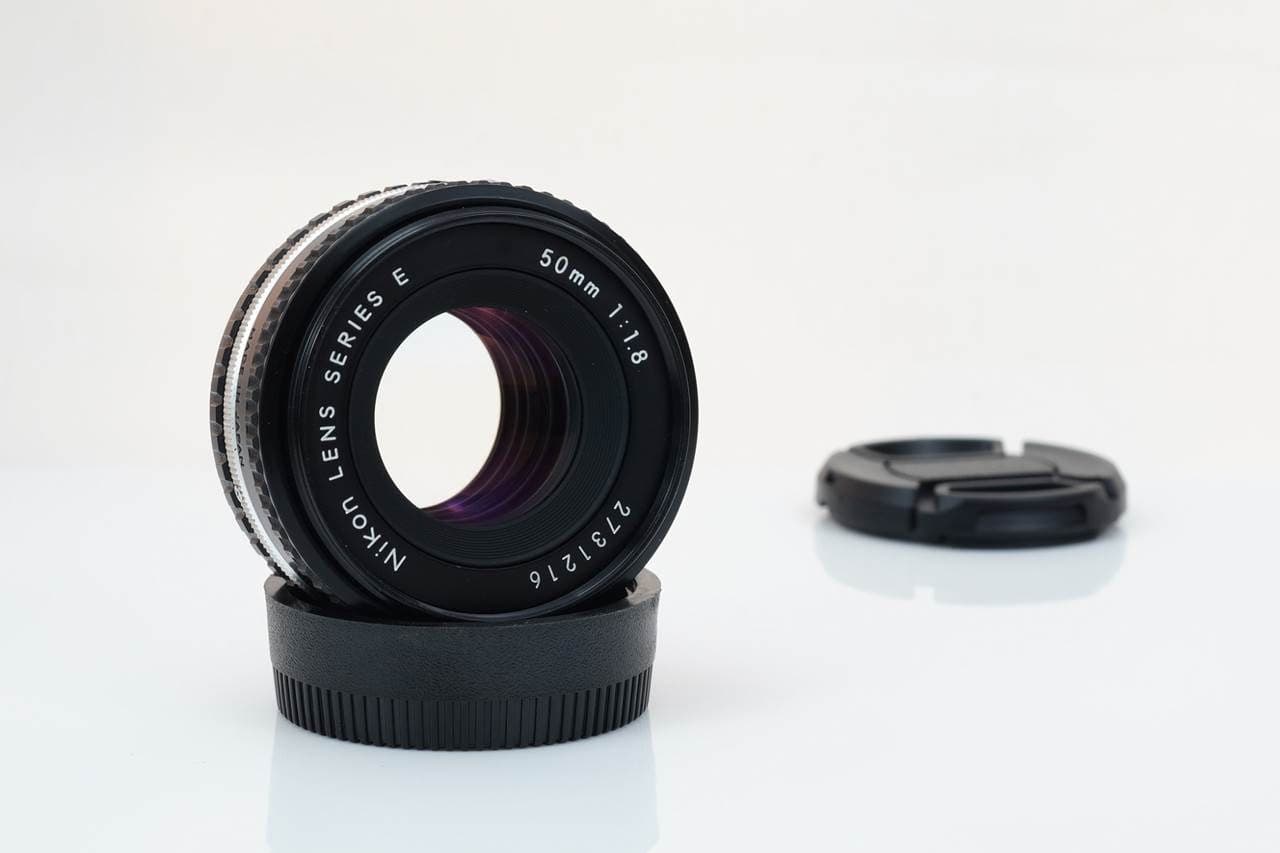
The Nikon 50mm f/1.8 AI-S (Series E predecessor notwithstanding) represents Nikon's refined approach to the standard lens formula, introduced in 1979 as part of the AI-S (Automatic Indexing Shutter) system that enabled Program and Shutter-Priority automation on cameras like the FA and FG. This lens evolved from the earlier AI version and was designed as Nikon's more affordable 'normal' lens alternative to the legendary 50mm f/1.4. Often called the 'Nifty Fifty' (a term broadly applied to affordable 50mm f/1.8 lenses across brands), this pancake-style lens became the workhorse of countless professional and amateur photographers throughout the 1980s and 1990s. Unlike the Series E 50mm f/1.8 which used cheaper plastic construction and was marketed as a budget option, the AI-S version maintained Nikon's traditional metal build quality. The cult following stems from its remarkable optical performance relative to its modest price point, with many photographers discovering it delivers 90% of the f/1.4's performance at a fraction of the cost and weight. It remained in production for decades, a testament to Nikon's 'if it ain't broke' philosophy, and continues to be one of the most recommended manual focus lenses for those entering the Nikon system or adapting to mirrorless cameras.
Verdict: The Nikon 50mm f/1.8 AI-S is the definitive 'honest lens'—it makes no promises it cannot keep and over-delivers on every reasonable expectation. It's the ideal lens for photographers who prioritize results over specifications, those who want a 50mm they can abuse without anxiety, and anyone entering the manual focus Nikon system or adapting to mirrorless. It will not wow you with creamy bokeh or dramatic rendering, but it will produce consistently excellent images in nearly any condition. For photojournalists, documentary photographers, and those building a working kit on a budget, this lens is not merely 'good enough'—it's often the smartest choice in the room.
Pleasant but not exceptional; 7 straight blades create slightly polygonal highlights when stopped down, smooth wide open with minimal outlining.
Neutral to slightly warm with Nikon's characteristic amber bias in warm light; accurate colors without oversaturation, excellent for natural skin tones.
Excellent center sharpness even wide open; corners achieve uniformity by f/4; peak performance at f/5.6-f/8 rivals much more expensive glass.
Well-controlled thanks to Nikon Integrated Coating; direct sun produces small green/magenta ghosts but veiling flare is minimal.
Moderate global contrast with good micro-contrast stopped down; wide open shows slightly reduced contrast due to mild spherical aberration, clears by f/2.8.
Noticeable wide open at approximately 1.5 stops in corners; clears substantially by f/2.8 and negligible by f/4.
The Nikon 50mm f/1.8 AI-S is the definitive 'honest lens'—it makes no promises it cannot keep and over-delivers on every reasonable expectation. It's the ideal lens for photographers who prioritize results over specifications, those who want a 50mm they can abuse without anxiety, and anyone entering the manual focus Nikon system or adapting to mirrorless. It will not wow you with creamy bokeh or dramatic rendering, but it will produce consistently excellent images in nearly any condition. For photojournalists, documentary photographers, and those building a working kit on a budget, this lens is not merely 'good enough'—it's often the smartest choice in the room.