Vintage glass has a fingerprint. Beyond the swirly bokeh and dreamy glow we covered in the first Character Playbook, here are six more optical signatures worth knowing — what causes them, which lenses make them, how to shoot for them, and how we disclose them when we grade a lens.
1. Donut bokeh — the mirror-lens signature


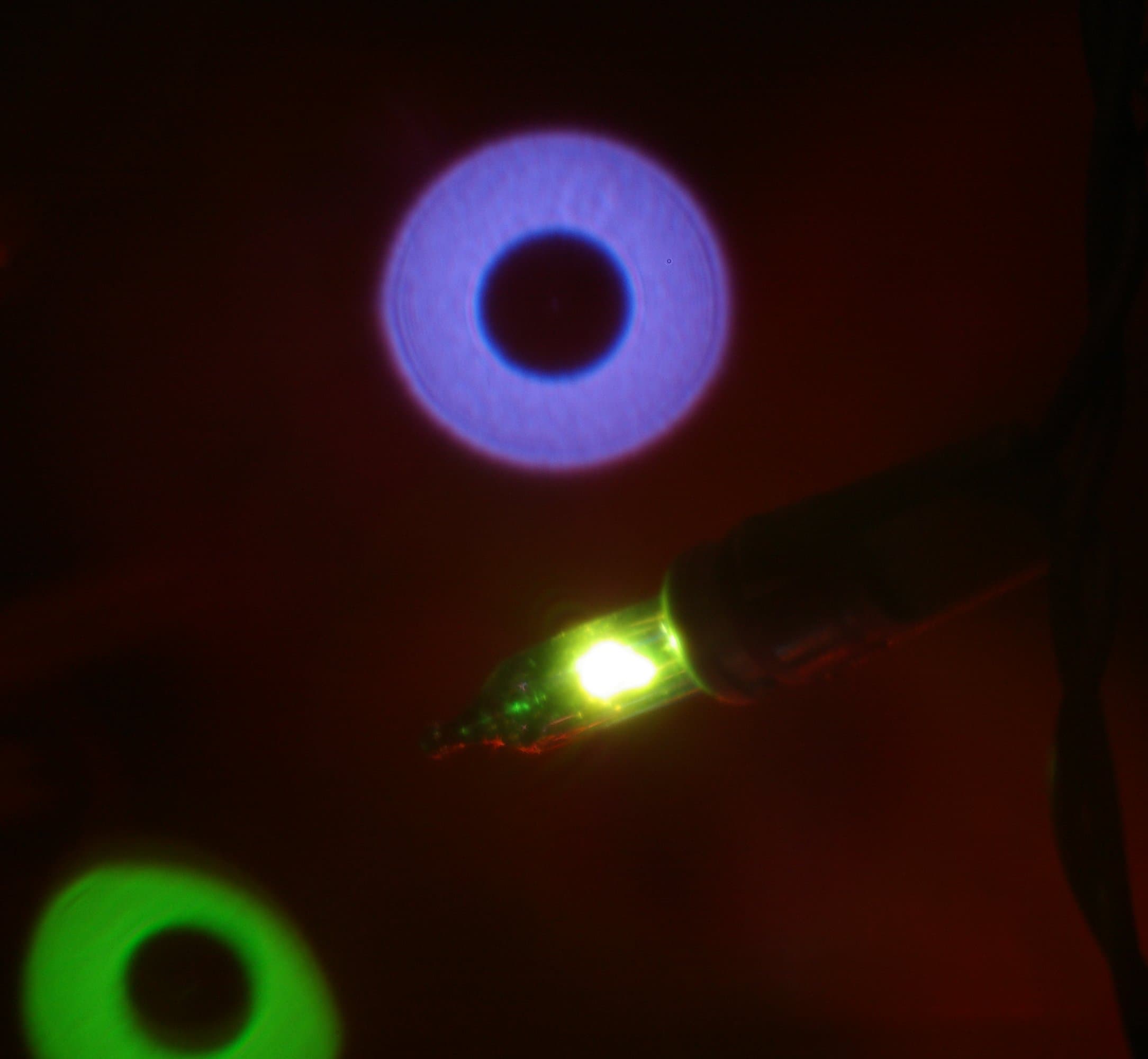
A catadioptric — “mirror” or “reflex” — lens folds its light path around a small secondary mirror set in the centre of the front element. That mirror blocks the middle of the aperture, so the opening is a ring rather than a disc. Because every out-of-focus highlight is an image of the aperture, each one becomes a tiny doughnut: a bright ring with a genuinely dark, empty centre. It is unmistakable, and unlike soap-bubble bokeh (which only brightens the edge of a still-solid disc) the dark hole here is real, caused by the physical obstruction.
Mirror lenses have a fixed aperture — usually f/8 — because there is no room for an iris. You can’t dial the donut in or out; you control it only with the amount of defocus and the number of bright point-highlights behind your subject. The trade-offs are lower contrast and a paper-thin plane of focus, but in return you get huge reach in a tiny, light, inexpensive package, and — being all-mirror — essentially zero chromatic aberration.


Lenses to look for: the 500mm f/8 staples — Tamron SP 500mm f/8 (Adaptall, adapts to anything), Reflex-Nikkor 500mm f/8, Minolta RF Rokkor, Canon Reflex 500/8, Olympus Zuiko Reflex 500/8 — plus the Vivitar Series 1 “Solid Cat” 600/800, and the cheap, characterful Soviet MTO-500/1000 and Rubinar lenses (grade each copy: QC varies). The standout collectible is the Minolta / Sony AF Reflex 500mm f/8 — still the only autofocus mirror lens ever made for a 35mm-style SLR system. Modern reflexes are still sold new too (Tokina SZX 400/8, Samyang/Rokinon 500/6.3).
How to shoot it: put separated specular highlights behind your subject — sun on rippled water, dew, wet leaves, fairy lights, sun through foliage. Keep the background well behind the subject (more defocus = bigger rings), shoot at the native f/8, and nail focus with peaking or magnification. To avoid the look for a plain long shot, choose smooth, even, distant backgrounds with no point highlights. Donut bokeh can’t be faked convincingly in software — it is a real artefact of the ring-shaped pupil, which makes it a genuine “authentic look.”
Browse mirror / donut-bokeh lenses →
2. Shaped & novelty bokeh — stars, hearts, squares
Put a mask with a cut-out shape over a fast lens and every defocused highlight copies that shape — the deliberate, controllable cousin of the mirror-lens donut. You need three things: a fast lens (roughly f/1.2–f/2.8, because the mask costs you light), bright point highlights in a defocused background, and the lens shot wide open so the mask defines the pupil. Any fast fifty works — a Helios 44, Takumar 50/1.4 or Canon FD 50/1.4 pairs naturally with this. Commercial kits (Bokeh Masters Kit, GIZMON, Lensbaby’s Creative Bokeh Optic and Omni, or the dedicated SG-image “Funtom” with built-in heart/star plates) make it a low-cost, impulse-friendly add-on. Like donut bokeh, it’s hard to fake in post.
3. Sunstars & starbursts
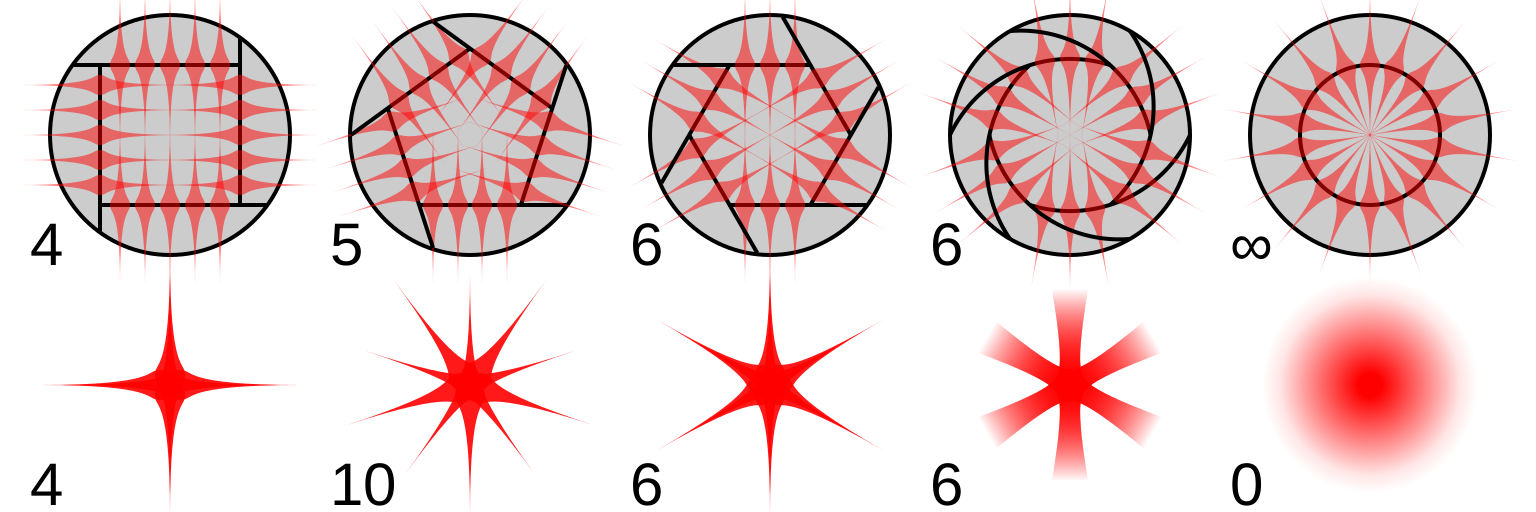

Photograph a bright point of light with the lens stopped down and the aperture-blade edges diffract it into radiating spikes. The rule every buyer should know:
- Even blade count → that many points. 8 straight blades = 8-point star; 6 blades = 6 points.
- Odd blade count → double. 7 blades = 14 points; 9 blades = 18 points.
- Straight blades give cleaner, sharper rays; the rounded “bokeh-optimised” blades modern makers use for creamy bokeh give weak or mushy stars. It’s a real design trade-off.
Strong performers: straight-blade primes — the Nikon 50mm f/1.8D and f/1.4D (“sublime 14-point” stars from ~f/5.6), Voigtländer 10-blade Noktons, the “green-ring” Pentax DA Limiteds. Poor performers: lenses with many rounded blades (Jupiter-9, Jupiter-3) barely form a defined star at all.
4. Onion-ring vs smooth bokeh


“Onion-ring” bokeh is concentric texture inside an out-of-focus highlight, like the cross-section of an onion. It comes from aspherical elements: most are precision-moulded from tools cut by diamond-turning, which leaves microscopic concentric ridges that the glass replicates and a bright highlight reveals. (Panasonic spent two years polishing its moulds down to ~20-nanometre roughness specifically to kill it.)
Here’s the selling point for classic glass: onion rings are largely a modern trait. Older all-spherical vintage primes have no aspheres, so they render smooth, clean, ring-free discs. “Creamy, ring-free bokeh balls” is a genuine, defensible advantage of lenses like the Helios, Biotar, classic Takumars and Zeiss Jena double-Gauss designs — and a standardised “bokeh ball” test shot (fairy lights, wide open) proves it.
Browse smooth-bokeh classics →
5. The bokeh to know about — so we can grade it honestly
Not every character is flattering. None of these is automatically a defect — some buyers want “character” — but we disclose them per copy.
Nervous / double-line (nisen) bokeh
Out-of-focus edges that stay sharp or double, making backgrounds look jittery. It’s the lens’s spherical-aberration correction: over-corrected glass brightens the edge of the blur disc (outlined, doubled), under-corrected fills the centre (softer). Worst against twiggy, high-contrast backgrounds. Stop down a stop and pick smooth, distant backgrounds.
Longitudinal CA — “bokeh fringing”
Colour fringes on out-of-focus high-contrast edges: green behind the focus plane, magenta in front. Normal for fast vintage primes wide open (and plenty of modern ones); it reduces sharply by f/4–f/5.6 and cleans up in post. Not a fault — but worth setting expectations.
Lateral CA
Red/cyan or blue/yellow fringing that grows toward the corners. Unlike LoCA it doesn’t improve when you stop down, but it’s trivially removed in software (most raw converters auto-correct it).
6. Other notable characters
Focus breathing — the framing shifts slightly as you refocus; harmless for stills, distracting for video focus pulls. Worth flagging to videographers. Field curvature — a dish-shaped plane of focus that gives portraits a pleasing centre-weighted “pop” but makes flat copy work tricky (strong in Petzval types and lenses like the Biotar 75). Halation / bloom — a soft glow specifically around bright highlights from older, weakly-coated glass; cinematographers seek it for a dreamy, filmic look.
Quick reference
| Character | Optical cause | Key technique |
|---|---|---|
| Donut / ring bokeh | Central mirror obstruction → ring-shaped pupil | Specular highlights behind a near subject; fixed f/8; nail focus |
| Shaped / novelty | Masked aperture shape copied by highlights | Fast prime wide open + point lights + near subject |
| Sunstars | Diffraction at aperture-blade edges | Stop to f/8–f/16; bright point source partially occluded |
| Onion-ring | Diamond-turned aspheric mould ridges | Avoided by all-spherical vintage glass → smooth discs |
| Nervous / double-line | Over/under-corrected spherical aberration | Stop down 1 stop; smooth distant backgrounds |
| LoCA fringing | Wavelengths focus at different distances | Stop down to f/4–5.6; defringe in post |
Shop by character
Image credits, all via Wikimedia Commons: donut bokeh — Hustvedt (CC BY-SA 3.0); Rubinar 500mm — Armin Kübelbeck (CC BY-SA 3.0); aperture diffraction diagram — Cmglee (CC BY-SA 3.0); smooth bokeh — JWCreations (CC BY-SA 3.0). This article extends the LensSeed Character Playbook.