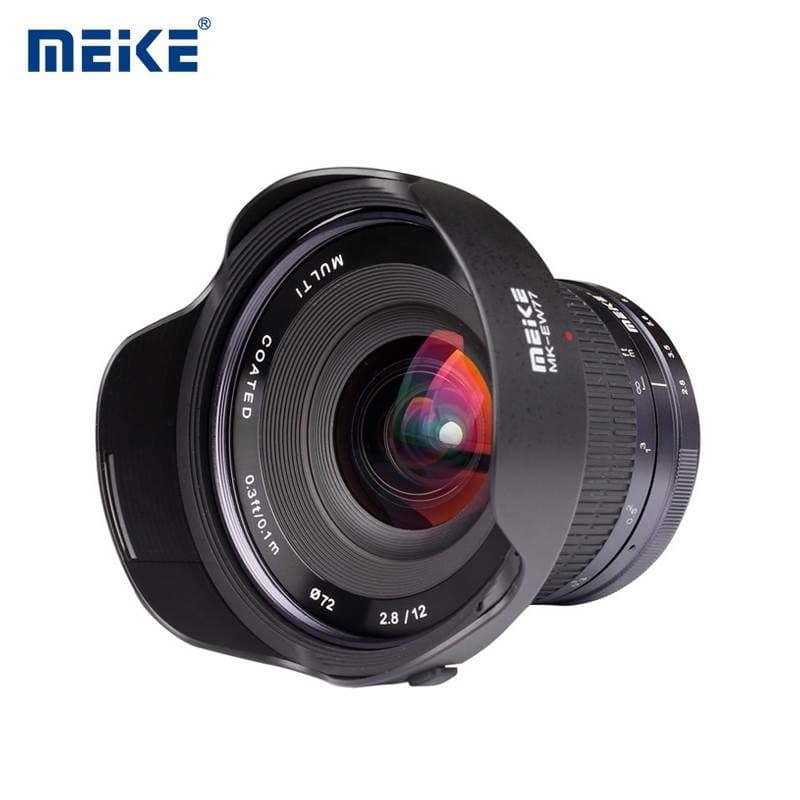
Meike Meike 12mm f2.8

ไม่มีข้อมูลสเปก

สรุปจากรีวิวจริง 1 แหล่ง · เรียบเรียงด้วย AI · ตรวจสอบความถูกต้องแล้ว · อัปเดต 18 ก.ค. 2569
ยังไม่มีภาพสำหรับเลนส์นี้

ปีผลิต

-

ผลิตที่

-

สูตรเลนส์

-

อัปเดต

18 ก.ค. 2569

เรื่องราวของเลนส์

The Meike 12mm f/2.8 is a budget ultra-wide-angle prime introduced around 2016 by Hong Kong Meike Digital Technology — a Chinese maker whose name blends 'Mei' (beauty) and 'Ke' (technology), and which built its reputation on accessories (notably grips for Sony's A7 series) before moving into manual-focus optics. It was positioned squarely as a value play: reviewers noted a launch price near 229 USD / 150–200 euros, roughly a third of the Zeiss Touit 12mm f/2.8 and about half the Rokinon/Samyang 12mm f/2.0 it was implicitly compared against. On APS-C it gives an ~18mm-equivalent field of view; the Micro Four Thirds version yields the classic ~24mm-equivalent. As one reviewer observed, producing a fast ultra-wide (over 100 degrees of coverage) with a usable aperture is optically difficult, so a metal-bodied f/2.8 twelve at this price was seen as offering 'more for less.' Meike is also the original manufacturer behind rebadged copies sold under other names, including Neewer. No established collector nickname or jargon for this lens appears in the reviews, and it is a modern budget optic rather than a cult classic — its appeal is practical value, all-metal construction, and features rare at its price (a 72mm filter thread on an ultra-wide, 10cm close focus) rather than a legendary rendering signature.

สรุป: A pragmatic, inexpensive all-metal ultra-wide for manual-focus shooters — landscapes, architecture, interiors and astro on APS-C or Micro Four Thirds — who value a solid build, a rare 72mm filter thread and unusually close 10cm focusing over autofocus convenience. Its documented strengths are handling and value; its actual optical rendering signature is not established in the available reviews, so buy it as a capable budget wide-angle tool rather than a character lens with a famous look, and be ready to embrace fully manual operation and an unconventional aperture scale.

รีวิวจากผู้ใช้

ข้อดี
  • Value: a metal ultra-wide f/2.8 at roughly a third the price of the Zeiss Touit and about half the Samyang 12mm competitors.
  • All-metal, densely built construction with a metallic mount and a well-made bayonet hood that has a securing catch so it won't rotate off in use.
  • A 72mm filter thread — reviewers specifically call this out as rare and welcome on an ultra-wide, and the near/rear-focusing design means the filter thread doesn't rotate.
  • Close 10cm (0.1m) minimum focus, tighter than several competitors, allowing near-macro foreground emphasis and background separation.
  • Compact and light for the class (about 360g on E-mount), with a metal, rubber-covered focus ring that has pleasant damping and stays put.
  • Half-stop clicked aperture ring that is smooth and ribbed for easy finger-feel while using an EVF.
ข้อเสีย
  • Fully manual with no electronics — no autofocus, no aperture coupling, and no EXIF data transmitted to the body.
  • Unusual aperture-ring progression: it jumps f/2.8 to f/3.5 (no f/4), and runs f/8 straight to f/22 with no marked f/11 or f/16 (only an unlabelled detent near f/11).
  • Focusing at close range is noted as less than easy on the wide angle, requiring focus-magnification assistance for precise near-subject work at f/2.8.
  • One reviewer's note that the lens lacks a depth-of-field scale/markings was cut off in the source, so treat this as reported-but-incomplete rather than confirmed.
เทคนิคการใช้
  • On APS-C or MFT the depth of field is enormous — for landscapes and street set around f/8 and place focus anywhere from ~1m to infinity and everything is sharp; precise focusing only matters for very close subjects.
  • For close work at or near f/2.8, use your camera's focus-magnification to nail focus, since manual focusing on such a wide angle is otherwise hard to judge.
  • Exploit the 10cm minimum focus to push a foreground subject close for exaggerated wide-angle perspective and background separation.
  • Learn the odd aperture scale before shooting: it skips f/4, f/11 and f/16 markings, so use the detents deliberately (there is an unlabelled stop near f/11).
  • Keep the bayonet hood fitted — it shields the front element and helps suppress stray/parasite light in contrasty scenes.
  • Because the filter thread is a non-rotating 72mm, screw-in ND or polarizing filters are easy to use for long exposures or sky control.
  • It's fully manual with no EXIF — meter carefully and set your aperture on the ring; note the lens won't record settings for later reference.

แหล่งอ้างอิง (1)

ค้นคว้าจากเว็บแหล่งรอง

A pragmatic, inexpensive all-metal ultra-wide for manual-focus shooters — landscapes, architecture, interiors and astro on APS-C or Micro Four Thirds — who value a solid build, a rare 72mm filter thread and unusually close 10cm focusing over autofocus convenience. Its documented strengths are handling and value; its actual optical rendering signature is not established in the available reviews, so buy it as a capable budget wide-angle tool rather than a character lens with a famous look, and be ready to embrace fully manual operation and an unconventional aperture scale.

อยากได้Meike Meike 12mm f2.8?

ยังไม่มีในสต็อกตอนนี้ — ฝาก LINE หรืออีเมลไว้ เข้าเมื่อไหร่เราแจ้งทันที

LINEอีเมล