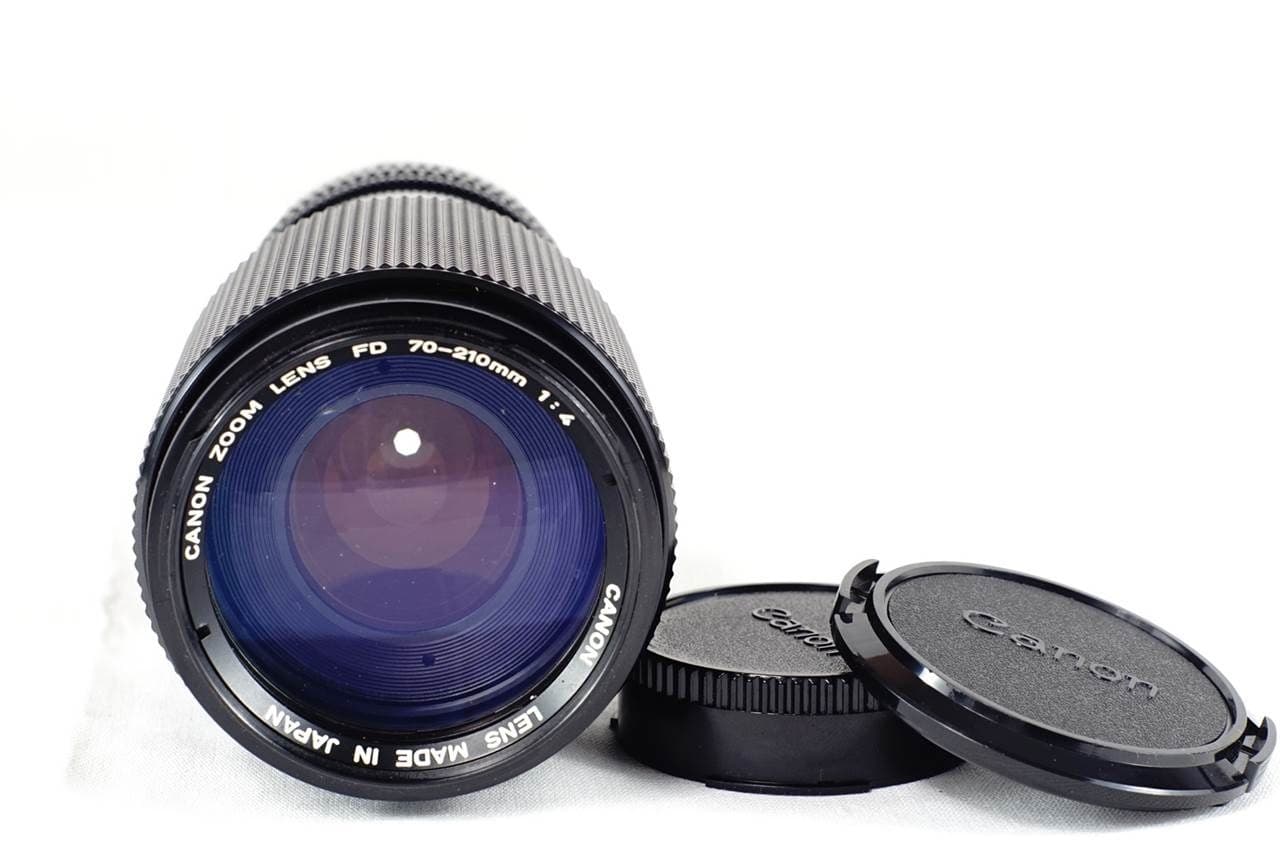
Canon Canon 70-210mm f4

Canon FD · 70mm · f/4

ยังไม่มีภาพสำหรับเลนส์นี้

ปีผลิต

1980

ผลิตที่

Japan

สูตรเลนส์

12 elements in 9 groups

อัปเดต

4 ก.ค. 2569

เรื่องราวของเลนส์

The Canon New FD 70-210mm f/4 was introduced in 1980, a year after Canon's related 80-200mm f/4 lens, arriving at a time when zoom lens optical science was maturing and telephoto zooms were coming into their own. Aimed largely at the consumer market, it packed a constant f/4 aperture across a 3x zoom range covering focal lengths that would otherwise require several fixed lenses (roughly 85mm, 100mm, 135mm and 200mm territory). It uses a one-touch push-pull design where a single ring handles both zoom and focus simultaneously, and it includes a macro function accessible at 70mm allowing focus down to 44cm. Canon's own design notes emphasize that a high-refraction element was used to prevent coma at the center focal length while maintaining resolution and contrast throughout the zoom range. Built in Japan before Canon moved manufacturing offshore, it is a metal-and-glass instrument that feels like a precision tool. No established nickname or community jargon is evidenced in the reviews. Its cult following stems from being an underrated, dirt-cheap performer (often found for €25-$40) that punches above its consumer-grade origins, and it has found a second life among video shooters and mirrorless adapters who appreciate the smooth one-touch operation.

สรุป: The Canon New FD 70-210mm f/4 is a hugely underrated, budget-friendly telephoto zoom for those who value sharpness, contrast, and solid mechanics over dreamy bokeh or premium color saturation. It's ideal for beginners learning telephoto work, travelers wanting a versatile do-it-all zoom, and video/mirrorless shooters who love smooth one-touch operation. Enthusiasts chasing the ultimate rendering or the richer color of the 80-200mm f/4L may want to look elsewhere, but for the money it is hard to beat.

คาแรกเตอร์ของภาพ

โบเก้

โดยรวมไม่โดดเด่นและให้ภาพค่อนข้างเป็นกลาง — ไม่สามารถสร้างโบเก้แบบนุ่มละมุนที่ผู้ใช้บางคนคาดหวังได้ที่รูรับแสง f/4

โทนสี

ให้โทนสีที่นุ่มกว่าและความอิ่มตัวของสีน้อยกว่า เมื่อเทียบกับเลนส์ Canon 80–200mm f/4L รุ่นพรีเมียม

ความคม (เปิดสุด)

ให้ความคมและคอนทราสต์ดีตลอดช่วง — เมื่อเปิดรูรับแสงกว้างสุดที่ f/4 ความคมจะอ่อนลงเล็กน้อย แต่เมื่อหรี่รูรับแสงลงไม่กี่สต็อปจะกลับมาคมชัด

คอนทราสต์

คอนทราสต์สูง ได้รับคำชมอย่างต่อเนื่อง และยังคงไว้ตลอดช่วงซูม

รีวิวจากผู้ใช้

ข้อดี
  • Excellent value for money, frequently found for as little as €25 to $40, making it a great starter telephoto zoom
  • Sharp and contrasty output that remains slightly competitive with modern lenses when stopped down
  • Butter-smooth one-touch push-pull zoom/focus ring that suits video and quick handheld shooting
  • Constant f/4 aperture across the full 70-210mm range
  • No visible distortion at any focal length, useful for architecture
  • Handy macro focusing down to 44cm at the 70mm setting
  • Solid metal-and-glass build quality that feels like a precision instrument; one copy survived a 5-foot drop onto pavement and kept working
  • Good aberration correction and low coma per Canon's design
ข้อเสีย
  • Image quality softens noticeably wide open at f/4
  • Colors are more subdued and less saturated than the premium 80-200mm f/4L
  • Bokeh is not the dreamy effect some users hope for
  • Front-heavy handling
  • The front element rotates during focus, interfering with polarizers and graduated filters
  • Macro function is only available at 70mm and limited to 1:4 (0.32x) magnification
  • Long zoom design draws internal elements in and out, which can pull in dust in dirty environments
เทคนิคการใช้
  • Stop down a few clicks from f/4 for markedly sharper, more usable results
  • Use the macro function at the 70mm setting for close-up work (down to 44cm)
  • Because the front rotates during focus, compose and focus FIRST, then set polarizers or graduated filters
  • A 58mm EF lens hood (BT-58 equivalent) fits well and gives it a modern look while cutting stray light
  • The one-touch zoom shines when adapted to mirrorless cameras for fast composing and focusing without moving your hand

แหล่งอ้างอิง (1)

Web-grounded synthesissecondary

The Canon New FD 70-210mm f/4 was introduced in 1980, a year after Canon's related 80-200mm f/4 lens, arriving at a time when zoom lens optical science was maturing and telephoto zooms were coming into their own. Aimed largely at the consumer market, it packed a constant f/4 aperture across a 3x zoom range covering focal lengths that would otherwise require several fixed lenses (roughly 85mm, 100mm, 135mm and 200mm territory). It uses a one-touch push-pull design where a single ring handles both zoom and focus simultaneously, and it includes a macro function accessible at 70mm allowing focus down to 44cm. Canon's own design notes emphasize that a high-refraction element was used to prevent coma at the center focal length while maintaining resolution and contrast throughout the zoom range. Built in Japan before Canon moved manufacturing offshore, it is a metal-and-glass instrument that feels like a precision tool. No established nickname or community jargon is evidenced in the reviews. Its cult following stems from being an underrated, dirt-cheap performer (often found for €25-$40) that punches above its consumer-grade origins, and it has found a second life among video shooters and mirrorless adapters who appreciate the smooth one-touch operation.

อยากได้Canon Canon 70-210mm f4?

ยังไม่มีในสต็อกตอนนี้ — ฝาก LINE หรืออีเมลไว้ เข้าเมื่อไหร่เราแจ้งทันที

LINEอีเมล